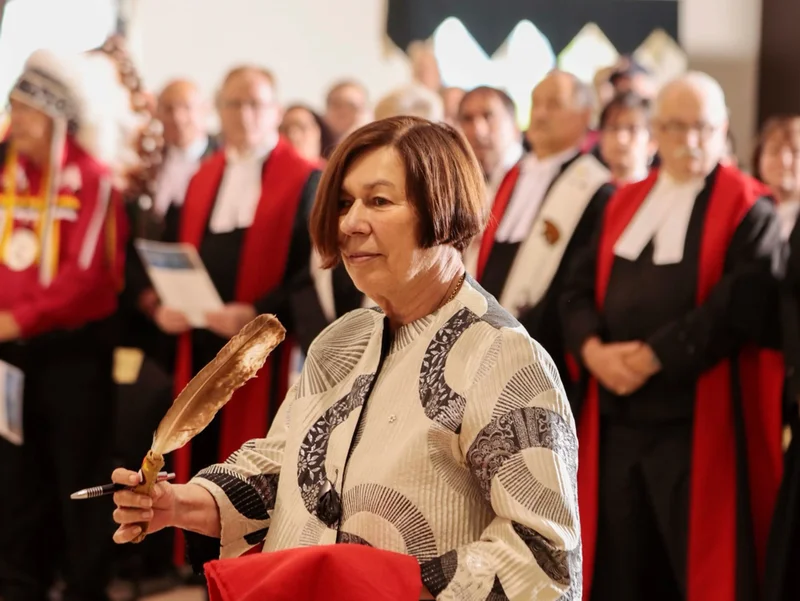

Marlys Edwardh holds a feather at a ceremony opening a superior court at the Wagmatcook First Nation in Cape Breton. Ms. Edwardh died of cancer on July 14.Len Wagg/Supplied
It would not be the most legally significant battle ever waged by Marlys Edwardh, but it surely had the most shocking result.
Late in the evening on May 24, 1987, Ms. Edwardh’s client, Kenneth Parks, drove 20 kilometres to his in-laws’ home, bludgeoned his mother-in-law to death with a tire iron, seriously injured his father-in-law and then turned himself in to the police. All the while, Ms. Edwardh contended before a Toronto jury, her client had been in a deep dream state and was unaware of his gruesome deed. A seemingly impossible defence, yet thanks to Ms. Edwardh’s peerless preparation and courtroom skills, Mr. Parks became the first person ever acquitted of murder based on a defence of sleepwalking.
In a career that spanned four decades, Ms. Edwardh pushed the legal envelope time and again. She played a pivotal role in exposing police corruption and rolling back repressive laws. She helped correct a skein of wrongful convictions and was a leader in Charter of Rights litigation in its fledgling years.
Jackie MacDonald stood out as a Canadian woman who dominated her sports
Ms. Edwardh died of cancer on July 14, leaving a legacy as a pioneering legal lioness who busted her way into the male preserve of law and became one of the most skilled criminal lawyers the country has seen.
Born in Lethbridge, Alta, on March 6, 1950, Marlys Anne Edwardh’s parents – Mel and Kay Edwardh – were teachers with a passion for social justice. The family moved to Toronto when she was eight. Her father imbued in his daughter a belief that women should accept no limits on their aspirations. Her mother force-fed Ms. Edwardh books about utopian and dystopian systems, creating in her profound views of right, wrong and the perils of unbridled state power.
Mesmerized by these duelling heaven and hells, Ms. Edwardh’s guiding light became the fearless advocacy of unpopular ideas and the role an individual can play in righting wrongs. Inquisitive, headstrong and unwilling to accept dogma of any kind, in her early adolescence she obsessively questioned the existence and nature of God.
She dragged her father from church to church, denomination after denomination, searching for one that might supply the answers she required. Mr. Edwardh finally posed a question: “Marlys, how would you live your life differently if you knew whether God did or didn’t exist?” It was a pivotal moment. “I was finally free of the need for proof from God,” Ms. Edwardh recalled in a 2002 eulogy to her father. “The values of community, family, respect, tolerance and service made the answer to the question irrelevant.”
Above all, Ms. Edwardh loathed racism and the evils done to Indigenous people. In her father’s eulogy, Ms. Edwardh memorably described racism as “the worm that eats and destroys reason and fairness.” By the age of 12, she was attending Vietnam War protests. At 15, she and her older sister Joey marched through Selma, Ala., led by Martin Luther KingJr.
She attended Carleton Universityin Ottawa, graduating in 1971. A campus firebrand, Ms. Edwardh was inexorably drawn toward a future in law. Her father queried which attracted her more – the law or justice? Decidedly, it was justice. “The search for reason, liberty and fairness was not enough,” Ms. Edwardh recalled in a speech. “The bar was to be set higher by the struggle to eradicate their enemies.”
Ms. Edwardh obtained her law degree from Osgoode Hall Law School in 1974, and was plunged into an overwhelmingly male profession. With just three other female criminal lawyers in the country, courthouses had no women’s robing rooms. Women lawyers were viewed with skepticism, if not outright disdain.
“As the faces of hundreds of men, all wearing blue suits and ties, floated through my day, I soon realized my difficulty was that they all looked the same,” she observed in a 2002 speech to the Law Society of Upper Canada.
Ms. Edwardh articled with noted civil rights crusader Clayton Ruby and went on to be his law partner,with the two operating out of a house with creaky floors and a rabbit warren of offices in Toronto’s Yorkville district.
Ruby and Edwardh LLPbecame a magnet for talented, progressive young lawyers such as Melvyn Green, a retired judge and longtime friend of Ms. Edwardh. He said she had an impeccable feel for judges and was a master of preparation: “Her submissions were well-reasoned, well-organized, clear and driven by the sincerity of her delivery. She never talked down to the bench. She treated every judge as her peer, and each of them returned the respect.”
Actor Joanna Pettet was a mysterious darling of the stage and screen
In the early 1980s, Ms. Edwardh helped mastermind Dr. Henry Morgentaler’s fight to strike down the country’s anti-abortion laws. She would also prevail in the landmark 1991 case of R. v. Swain, establishing the right of mentally ill defendants to control their own defence. She led a successful courtroom battle to end a prohibition on midwifery in Ontario and, in four highly publicized cases over the years involving nurses accused of murdering hospitalized babies under their care, she eviscerated shoddy police evidence. Charges were eventually dropped or dismissed in each of the cases.
Ms. Edwardh also worked as commission counsel at an inquiry into political corruption involving former federal Cabinet minister Sinclair Stevens, and at the Krever inquiry into the Canadian blood system, which had been contaminated with HIV and hepatitis C virus during the 1980s. Each helped set new standards for government conduct and public health.
She represented Donald Marshall Jr., a Mi’kmaw man, at a public inquiry into his 1971 wrongful conviction for the murder of Sandy Seale, influencing important changes to curb systemic racism.
With the Charter of Rights on the horizon, Ms. Edwardh spent a year at University of California, Berkeley in 1982, devouring programs in political science, civil rights and constitutional law. “Human rights and civil liberties were the oxygen she breathed,” said a close friend, Susan Reisler. Ms. Edwardh fought many a case for press freedoms, but she had no interest in building a personal media profile. Her public utterances were invariably connected to clients or causes.
A fierce opponent of the death penalty, she regularly took on the cause of those facing execution abroad, often on a pro bono basis. She was instrumental in achieving the exoneration of Maher Arar, a Syrian national who had been deported from the U.S. with Canadian complicity as a suspected terrorist. She was similarly entrenched in correcting the notorious wrongful murder convictions of Steven Truscott and Guy Paul Morin.
A dedicated mentor to female lawyers, Ms. Edwardh was equally loyal to her clients. Her steadfast support was as vital as her legal ingenuity, Mr. Morin said. “Marlys was a ray of sunshine at a dark time in my life, bringing me comfort and hope,” he said. “She was not just a fabulous lawyer, but even more, a beautiful human being.”
Ms. Edwardh brooked no arbitrary measures. Ms. Reisler recalls an incident when Ms. Edwardh insisted on parking behind a car that Ms. Edwardh believed was occupied by security officers who had her under surveillance on account of her advocacy for foreign nationals. She was intent on out-staring them. On another occasion, a tennis club official tried to order her off the court for wearing a coloured skirt. Ms. Edwardh threatened to play in her acceptably white underwear. “Marlys was utterly uncompromising on her principles,” Ms. Reisler said.
Holocaust survivor Ted Bolgar devoted his life to education
Ms. Edwardh’s life partner was an ebullient Toronto forensic psychiatrist, Graham Turrall, who died in 2024. They shared a love of travel and sailing. Her calm resolve was in evidence on a flight the couple took to Muskoka, Ont., from Toronto Island. The landing gear on their small planejammed. For three hours, as the skies emptied of other planes, they circled overhead. Ms. Edwardh located a flight manual, deduced that a hydraulic line had leaked, and took over the controls as the pilot crawled back to work on it. At her urging, he utilized wine the couple had brought as a makeshift lubricant.
It was vintage Marlys Edwardh: “There is a problem; don’t panic,” Ms. Reisler said. “Study it. Read anything available. Make informed decisions.” The plane landed safely – with Ms. Edwardh in the co-pilot’s seat – in a wall of fire retardant foam.
Ms. Edwardh adored Inuit artwork, travel and cigarettes. She rarely came across a dog without stopping to share a psychic connection. She was as disarmingly direct as she was personable. In her 2002 speech to fellow lawyers, she urged them not to be “preoccupied with counting billable hours and nothing more than a hired gun for sale to the highest bidders.”
Ms. Edwardh received the Order of Canada in 2010, as well as top honours from Canadian Journalists for Free Expression, the Law Society of Ontario’s Parliament and the Criminal Lawyers Association.
She leaves her son and stepsons Kyle, David and Ryan Turrall; her sister Joey Edwardh and brother-in-law Miguel Aravena; and niece and nephews Mel, Mischa, Jason, Matthew, Leslie, Neil, Scott and Christopher. She was predeceased by her brother Grant.
You can find more obituaries from The Globe and Mail here.
To submit a memory about someone we have recently profiled on the Obituaries page, e-mail us at obit@globeandmail.com.