This essay was written by Albert Ioffe, Jawad Fairooz, and Aleksejs Ivashuk, courtesy of The Global Movement Against Statelessness (GMAS), a content partner of Global Voices. This post is part of Global Voices’ July 2026 Spotlight series, “Statelessness.” This series offers insight into the issue of statelessness and how it hinders people’s freedom of movement, educational opportunities, political access, and more. You can support this coverage by donating here.
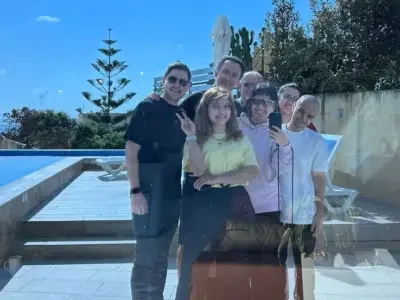
At the end of March 2026, stateless-led organisation Apatride Network, with funding support from the organisation Porticus, facilitated a three-day gathering in Malta called Hearing and Healing. In that event, people from different stateless communities came together to share experiences and reflect collectively on the personal and collective dimensions of statelessness. The participant-led gathering moved beyond formal discussions to centre lived experience as a crucial centrepiece for unpacking and understanding statelessness. Those involved listened closely to one another, found common ground across different histories, and began shaping shared goals for future advocacy and impact.
Among the many profound discussions during the event, the following key question was covered: How do we define our identity and cultural belonging when states systematically exclude us and deny us citizenship for political, religious, ethnic, or other such arbitrary reasons? This article focuses on answering this question from the reflections of several participants of Hearing and Healing.
For many people, citizenship is an invisible part of everyday life. It is assumed rather than questioned. It provides legal recognition, freedom of movement, employment and education rights, political participation, and a sense of security, among many other rights and protections. Only when citizenship is denied does one begin to understand how profoundly it shapes the relationship between a person and the state.
Due to the unpredictability of political winds and the imperfections of governance, no state can ever truly guarantee the inviolability of legal membership in the state and the corresponding rights, no matter the factual belonging. Statelessness can suddenly happen to anyone, anywhere, at any time.
For stateless people, or those arbitrarily denied citizenship, identity becomes something that exists in constant tension. A person may have been born in a country, have ancestry on its territory, speak its language, celebrate its traditions, and contribute to its society for an entire lifetime, yet still be suddenly told that they do not legally belong. This contradiction creates one of the deepest wounds of statelessness: the separation between lived belonging and formal legal recognition.
During our Hearing and Healing gathering in Malta, participants from different countries shared remarkably similar experiences despite their diverse backgrounds. Many spoke of growing up feeling connected to their communities while simultaneously facing legal barriers that questioned their place in society. The conversations revealed that statelessness is not simply the absence of a passport. It is the experience of having one’s existence continuously challenged by administrative systems that fail or refuse to acknowledge who you are.
When governments deny citizenship for systemic reasons, people often respond by strengthening community institutions, preserving language and traditions, documenting their history, and maintaining networks across borders. These acts are not merely cultural practices; they are affirmations of existence in the face of exclusion. Their power should not be underestimated.
Statelessness is not only a legal condition — it can also become an attempt to erase history and belonging. Yet identity is shaped by many overlapping factors that exist independently of citizenship. Family, language, shared memories, cultural traditions, and collective history cannot simply be revoked by an administrative decision. Attempts to do so lead to the origins of totalitarianism and a threat to the freedom and security of everyone, whether currently impacted or not.
Throughout our discussions, it became clear that healing begins when these experiences of statelessness and erasure are acknowledged and shared. Many participants spoke openly for the first time with others who truly understood what it means to live in legal uncertainty. While every personal story was unique, they all reflected the same underlying reality: states may define legal status, but they cannot fully determine who people are. Ultimately, states possess significant power over legal status and practicability of rights, but they do not have absolute authority over principles, identity, or belonging. Those emerge from lived experience, shared history, culture, genuine dialogues, individual self-understanding, and mutual recognition.
Imposition of statelessness is by nature and definition divisive and destabilising: it fragments the social fabric and membership of society that make up the edifice on which the state is built and depends. Statelessness creates a painful contradiction for the affected: a person may belong deeply to a place culturally and historically while lacking the legal right to belong there. Recognising this contradiction is essential if societies are to understand the human cost of exclusion and work toward more inclusive systems that respect both legal rights and human dignity.
Our meeting in Malta reminded us that while statelessness isolates individuals, sharing our stories reconnects us and helps us to clear up the haze surrounding it. It transforms invisible experiences into collective understanding and reminds us that identity is ultimately defined not only by the documents we hold, but by the lives we have lived and the communities to which we truly belong.
Citizenship and even nationality should never determine whether a person’s identity is considered valid or possible. Documents can confirm a legal relationship with a state, but they cannot create or erase a person’s existence, history, family, or sense of belonging. For the many millions of stateless people around the world, the struggle is not only for a passport. It is for recognition that they have always existed, always belonged, and always deserved to be seen as full members of the societies and territory they call home.
Apatride Network is a stateless-led organisation in the European Union, focusing on impact projects, legal assistance, strategic litigation, and awareness-raising. Its work has led to improvements in banking regulations in Europe to be more accommodating to vulnerable populations, removal of administrative barriers to stateless persons’ employment in UNHCR and the UN Secretariat, and Czech judicial recognition of Latvian “non-citizens,” the largest community of stateless people in Europe, as de jure stateless.