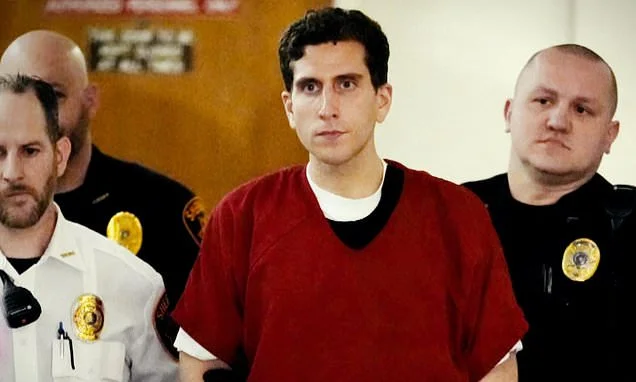
Late one Sunday morning in November 2022, a clearly petrified young woman in Moscow, Idaho, rang emergency services. She sounded terrified. ‘Something happened in our house and we don’t know what,’ she said. Nearly four years after the horrific murder of four student housemates from the University of Idaho by a knife-wielding criminologist and obsessive scholar of serial killers named Bryan Kohberger, there’s much that we still don’t know about what happened in that house, and why.
On Monday Idaho officials revealed that Kohberger, now 31, has filed an astonishing petition seeking to challenge his conviction on the grounds he was misled into pleading guilty.
His decision to agree to a plea deal in July 2025, just weeks before his trial was due to start, ensured he was spared a possible death penalty and instead received four consecutive life prison sentences.
The absence of a trial also meant many lingering puzzles about the case were never resolved – puzzles that a new Netflix series, The Idaho Murders: College Nightmare, hopes to solve.
Claiming to be the ‘definitive’ account of the crime that has both horrified and captivated the US, the documentary certainly offers new insights and details – from the body camera footage worn by police officers who were first at the grisly scene to emotional interviews with the parents and siblings of some of the victims.
The three-part series, which was released this week, also confirms prosecutors had amassed compelling evidence against Kohberger, who was pursuing a PhD in criminology at Washington State University just eight miles from his victims’ home.
His DNA was found on a combat knife sheath that had been left next to two of the victims and Amazon records show he’d purchased such a weapon just months earlier. He drove a white 2015 Hyundai Elantra, the type of car that investigators determined from surveillance cameras had been circling the students’ house on the night of the killings. His mobile phone records revealed he’d repeatedly visited the students’ neighbourhood in previous weeks, sometimes very late at night. And he had no solid alibi for the night of the murders – he claimed he’d been out star-gazing but admitted he had been alone.
However, the producers of the Netflix series can hardly call it definitive when so many questions remain unaddressed. They include fundamental issues, such as why the anti-social and awkward loner felt compelled to kill and why he targeted these four students in particular. But there are also specific details left uncertain, such as the strands of unidentified hair one of the victims was reportedly found holding in his hand and the extraordinary failure of the two surviving housemates to call the police for eight hours.
Idaho officials revealed that Bryan Kohberger has filed an astonishing petition seeking to challenge his conviction on the grounds he was misled into pleading guilty
Four students from the University of Idaho were killed at their apartment in November 2022
Why did Kohberger want to kill?
Kohberger was a troubled man who had been bullied at high school in Pennsylvania for being overweight and later became a heroin addict. His family said he dreamed of going into law enforcement.
Many found him to have an unnerving personality and said he had enormous difficulty connecting with other people, particularly women.
His defence team said he had been diagnosed with autism although the judge wasn’t convinced.
Kohberger himself claimed online that he struggled with his mental health and suffered from tinnitus, saying he sometimes heard ‘demons in my head mocking me’. He also said he was plagued by a rare neurological condition called ‘visual snow syndrome’. This reportedly caused him to see static in his vision and left him feeling disconnected from the real world.
However, the speculation about his decision to kill has chiefly focused on his intense interest in criminology – and murderers in particular. For some, it is simply too much of a coincidence.
Kohberger was said to be a ‘brilliant’ student who loved to show off his knowledge of crime. He wrote his master’s thesis about people’s thoughts and feelings while committing crimes.
His intense questioning of teachers revealed an especially strong interest in crime scenes and serial killers.
‘At the time it seemed as if he was just a curious student, so if his questions felt odd we didn’t think much of it because it fit our curriculum,’ said classmate Brittany Slaven.
With hindsight, many believe he was preparing to commit the ‘perfect’ murder: one in which he would leave no clues and couldn’t be traced to the victims.
He obviously failed on both counts but it wasn’t for lack of trying.
Police found his car had been efficiently scrubbed of any evidence and he did his best to do the same on his phone and computer.
Experts told the Daily Mail that Kohberger may have known just enough about forensics to convince himself he could get away with it – but not enough to escape detection.
Why did he target these particular victims?
There’s no evidence that Kohberger knew the four victims socially but he certainly knew of them, visiting the King Road area where they lived repeatedly and at all hours.
Theirs was a notorious ‘party house’ and, shortly before the murders, they had posted a TikTok video of themselves wandering around their home imitating each other.
‘It sent a chill up my spine when I saw it,’ forensics expert Professor Joseph Scott Morgan told the Daily Mail, as it revealed not only who lived in the house but a bedroom-by-bedroom layout to any would-be intruder.
The video also showed that this was a house inhabited only by women (sole male victim Ethan Chapin was staying the night with his girlfriend, Xana Kernodle).
Xana Kernodle and Ethan Chapin were both stabbed to death at an off-campus rental home, with Ethan being the only male victim
Kaylee Goncalvez and Madison Mogen were also among the victims of the 2022 attack, which many speculate was motivated by misogyny
Some have speculated they were precisely the sort of women – attractive, outgoing and popular – that the misogynistic and shy Kohberger particularly couldn’t stand.
University classmates have widely attested that he was not only awkward with women but also abrasive, patronising and even threatening towards them – to the point that one female student made an official complaint about his aggressive behaviour when he once followed her out to her car.
Investigators found no evidence he was connected to the so-called ‘Incel’ movement of young men who hate women out of sexual frustration, but also accepted he was careful to cloak his online activities.
The vicious circumstances of the killings have also fuelled claims that, for whatever reason, he was motivated by hatred. ‘Someone who kills somebody with a knife – it’s very personal,’ Moscow Police Chief Anthony Dahlinger tells the new Netflix documentary.
At 10.31 on the morning of the killings, Kohberger – standing in what appears to be his bathroom – took a photo of himself giving a thumbs-up sign.
Did he only have one name on his kill list?
According to a 2024 book by Pulitzer Prize-nominated investigative journalist Howard Blum, Kohberger intended to kill only one of the students: pretty blonde Madison ‘Maddie’ Mogen, 21, and the others were merely ‘grim collateral damage’.
Blum claimed Kohberger, who became fixated with having a healthy diet after struggling with his weight, encountered Maddie after visiting the Moscow vegan restaurant where she worked part-time as a waitress.
Even if he didn’t speak to Maddie – who studied marketing – on that occasion, he was able to keep tabs on her and her housemates through their frequent posts on social media, said Blum.
While Kohberger reportedly followed both Maddie and her lookalike best friend Kaylee Goncalves on Instagram, he seemed more interested in Maddie, ‘liking’ all her photos.
Blum wrote that ‘obsessions came easily’ to Kohberger, whom he believed ‘continued to follow her over many nights’.
The living areas of the students’ house had large windows overlooked by trees from which someone could spy on them without detection.
On the night of the murders, Kohberger entered the house on the first floor but initially ignored the bedrooms there and went straight to the top floor where Maddie slept.
He went into her bedroom first and found her sharing her bed with her best friend, Kaylee Goncalves, who no longer lived in the house because she had recently graduated but had come to stay for the weekend.
A crime scene photo shows a knife in the home – but the seven-inch Ka-Bar combat knife which police believe Kohberger bought before the attack has never been found
A yellow rose, being the school color, is laid at a memorial in front of the house where four University of Idaho students were killed
Blum believes Kohberger had no idea that Kaylee would be in the house and only killed his other two victims because they were sleeping downstairs and were ‘in his way’ (Xana Kernodie reportedly went upstairs and ran into the intruder) as he made to leave the house.
If he only came to kill Maddie, that would explain why he didn’t go into the bedrooms of either of the two students on the bottom floor, thereby sparing their lives.
An alternative theory is that Kohberger was actually stalking Kaylee Goncalves, who had repeatedly complained to friends – up to a month before she was murdered – that she thought she was being watched or followed by an unknown man.
Housemate Bethany Funke told police after the murders that Kaylee – who suffered particularly savage wounds – had recently confided to her that when she lived at the house she once saw someone outside ‘staring at her’.
What happened to the murder weapon?
The seven-inch Ka-Bar combat knife, which police believe Kohberger bought online from Amazon months earlier, has never been found.
He could easily have dumped it on the curiously long route he took back from Moscow to his university accommodation or during the long car journey he later made across the US with his father back to the family home in Pennsylvania. The knife’s importance to the case, however, isn’t crucial as its sheath was recovered and DNA testing matched it to Kohberger.
Did he have an accomplice?
Investigators reportedly discovered strands of hair that didn’t match those of Kohberger in the closed fist of 20-year-old victim Ethan Chapin.
Forensic scientist Brent Turvey, who analysed the crime scene for the defence, argues that the killings were committed by more than one person.
He says the hair strands were six inches in length and a light brown colour with a reddish tint – so did not match Kohberger’s darker hair.
Turvey reportedly found samples of the same hair in blood on a bedframe. He says investigators failed to take the hair as evidence and it was never tested.
However, sceptics have cautioned that hair transfer between housemates and visitors (and this house had a lot of visitors) is common and may not be suspicious.
Why did the survivors take eight hours to call the police?
Two other housemates – Dylan Mortensen and Bethany Funke – were in their bedrooms that night but were never attacked. Dylan came under considerable criticism after admitting she’d heard one of the victims scream in the middle of the night that there was somebody in the house. She later stuck her head out of her door and saw a masked stranger walk straight past her.
She locked herself in her room in what she called a ‘frozen shock phase’, later joining Bethany Funke in her bedroom downstairs. They spent several hours trying to contact their housemates on the phone, later asking male friends to come over but only phoned the police just before noon on Sunday.
Alivea Goncalves, sister of victim Kaylee Goncalves, speaks during the sentencing hearing of Bryan Kohberger in Boise, Idaho
Steve and Kristi Goncalves speak to Netflix for The Idaho Murders: College Nightmare, a new series on the 2022 crime which killed their daughter Kaylee
Dylan told them she was ‘intoxicated and didn’t want to believe what was going on’. It’s been mooted she thought it had been a student prank. Both women were rapidly discounted as suspects in the investigation.
‘Shock and trauma can do a lot of damage to people,’ local police chief Anthony Dahlinger tells the Netflix programme. ‘It can impair judgement, it can impair thought processes.’
‘I don’t blame them for making the phone call a little bit late,’ Xana’s friend Kacy Johnston says in the same programme. ‘I can only imagine what was going through their minds.’ Others continue to consider such a long delay incomprehensible.
What did his family know?
Kohberger’s working-class parents – Michael is a retired maintenance worker, and Maryann worked with special-needs children – had struggled for years with a son who lived at home until he moved to Washington State University at 28 to do his PhD.
Critics have asked how much they might have known about his guilt before his arrest at the end of December 2022.
It was even claimed that his mental health therapist sister Mel – one of the killer’s two older siblings – actually suggested her brother might be responsible for the murders after seeing him vacuuming his car in surgical gloves and sneaking out at night to put their family rubbish in neighbours’ bins.
According to writer Howard Blum, when she shared her ‘increasingly certain deduction’ with her father, after a ‘long, agonised silence’ he walked away.
However, in January, Mel told the New York Times she had never suspected her brother, instead warning him to be careful going out late at night because there was a ‘psycho killer’ on the loose near his home in Washington.
She said: ‘I have always been a person who has spoken up for what was right. If I ever had a reason to believe my brother did anything, I would have turned him in.’
She insisted she was completely shocked by his arrest. Prosecutors say Kohberger – perhaps assuming he was home and dry – was stunned, too.
- What kind of cases do you want to read more about? Let us know at: crimedesk@dailymail.co.uk