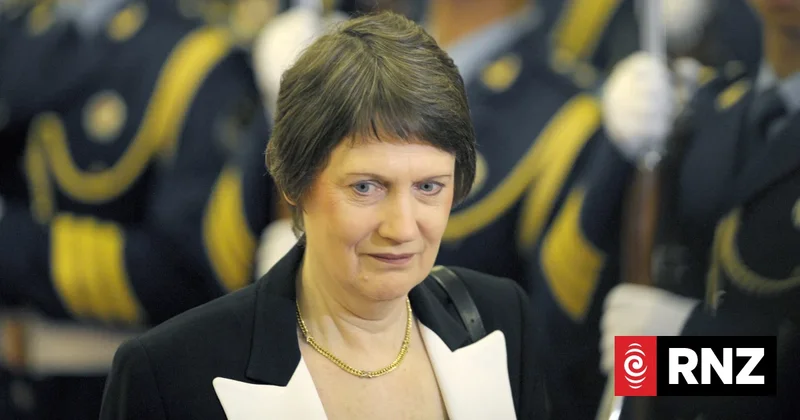
Less than 100 days out from the next election, Helen Clark tells The Detail New Zealand needs less clickbait politics and more long-term thinking.
Helen Clark's warning for NZ
Nearly two decades after leaving the Beehive, Helen Clark remains a confessed "political junkie", and still watches New Zealand politics with the eye of a former prime minister.
And she's concerned this country is losing sight of the bigger picture.
Speaking to The Detail following the release of the Helen Clark Foundation's new book - Facing up to our Future: Challenges and Choices for New Zealand - Clark says the country's biggest problem isn't any single issue.
It's more that governments, she says, have stopped thinking long term.
"Generically, the biggest challenge is to have people do long-term thinking," she says. "There are big challenges, and none of them are susceptible to one swing of the wheel."
The book is edited by her husband Emeritus Professor Peter Davis, and brings together 21 contributors from across the political and policy spectrum, including former National Minister Chris Finlayson and former Climate Change Commission Chair Rod Carr.
Together, they tackle everything from housing, infrastructure and fiscal pressures to climate change, media, and the Crown-Māori relationship, and Clark hopes the collection gives voters a chance to think beyond the next headline ahead of November's election.
She says the infrastructure space is an example of what happens when governments abandon long-term planning.
"Most of the infrastructure we need is already in place, but it is badly under-invested in."
She says that during her time as prime minister, from 1999 to 2008, projects carried over between governments regardless of who was in power.
"There was not a single New Zealand infrastructure project that I inherited … that was dropped. When we left office, there was not a single project which the Key-English government dropped."
Today, she says, politics has become increasingly polarised.
"I put it down partly to the polarisation of New Zealand politics … somehow we have to find, like the Dutch or the Danes, ways of getting people together around long-term challenges."
Climate change, she says, is another issue demanding consistency rather than political cycles.
"I've spent quite a lot of weeks in the last three months in Europe. It is too hot to be there anymore. It's like a furnace in the summer.
"We know what the extreme rain events do to us, the increasing drought that our farmers are suffering. We have to act."
Clark believes the country's political culture has also shifted.
"I think we've drifted to a place where the clickbait takes priority, but that's not a way to run public policy for a government."
Instead of repeatedly scrapping major reforms, she argues governments should be looking for areas of agreement.
"If you dump years of investigation of pumped hydro, if you dump Three Waters and then you bring in something else, and then the next government's not happy with that, we end up with nothing but a lot of money spent on consultants.
"We're wasting money, and we don't get results either way."
While debate continues over extending parliamentary terms from three to four years, Clark says the issue isn't simply about time.
"A four-year term … doesn't address these issues I'm talking about because if our political actors continue to act the way they do now, they'll do it through a four-year term and not just a three-year one."
Instead, she supports strengthening Parliament itself, including more powerful select committees and independent institutions, like the Commerce Commission, Infrastructure Commission, and Climate Change Commission.
"Empower these independent institutions which have integrity and let them get on with the job that the politicians now find difficult."
Clark also worries about the calibre of political debate - and some of those now wanting to enter Parliament, namely 'celebrity candidates' - saying that politics should never become entertainment.
"The announcement of candidates this year has had a certain vaudeville quality around it.
"It's not a theatre where you act out your comedy as it were. This is serious stuff … we need serious people to do that."
As for long-term minister Winston Peters - she says his comments about a Chinese-born Green MP "invite a sacking".
Last Wednesday, Peters told Lawrence Xu-Nan to "go back to your own country" during a debate in Parliament.
"That's where they lie like a flatfish, but they don't lie like that here, all right?" Peters said.
Clark tells The Detail that the incident "is divisive at home and it's reputation damaging for New Zealand abroad" and questions whether the same remarks would have been directed at someone from a different background.
"Would that have been said to someone who had come from the United Kingdom at the age of two?… Or is it the sort of insult that will be thrown to a person of colour?"
Asked whether Peters could have remained Foreign Minister had he made those remarks under her government, Clark doesn't hesitate.
"No."
She says Peters served diligently as Foreign Minister during her administration and believes something has changed.
"Maybe everyone's got older and crankier."
But she understands and accepts that "politics is addictive, and it's not easy to walk away from it".
She says one of the best decisions she ever made was stepping aside after Labour's 2008 election defeat.
"I passed the baton on at age 58 and I think that was appropriate."
Although she insists she has no desire to return, Clark admits she's still a "political junkie" and expects Election 2026 to be unpredictable.
She says the emergence of TOP has added an intriguing new dimension to coalition mathematics and believes Peters' latest controversy could yet become a significant election issue.
"This is a wild card, and it will be interesting to see how it plays out. The next three months will be a rollercoaster ride."
While she admits New Zealand has changed considerably since her time in office, Clark remains optimistic.
"I think, great as the challenges are that we face, we do have the capacity to deal with them.
"It calls for a little more wisdom, a little more give and take … I think we could have a better quality of politics; we could have better public policy."
You can also get in touch with us by emailing thedetail@rnz.co.nz