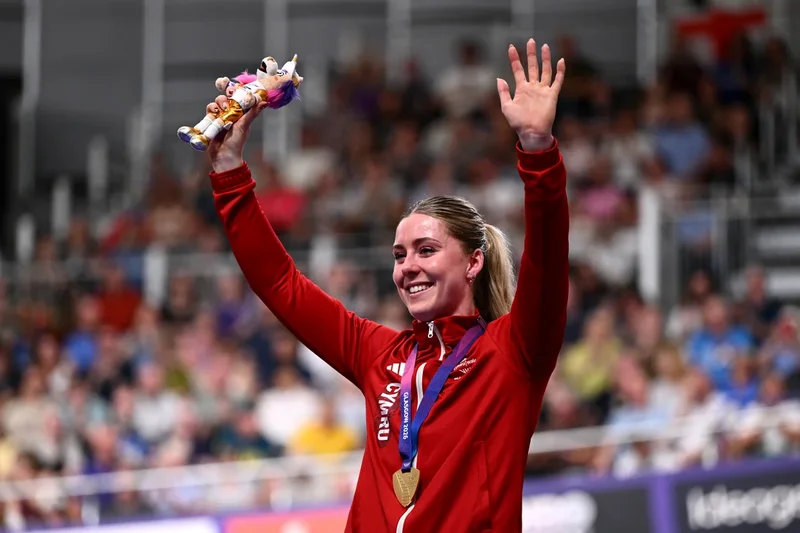
Emma Finucane has spent much of the past two years learning how to live with expectation. In Glasgow, she discovered how to thrive under it.
The Welsh cyclist became the first rider in 96 years to complete a Commonwealth Games sprint clean sweep, winning gold in the time trial, sprint, team sprint and keirin.
Yet the significance of the achievement, she revealed, was not just the medals themselves but also the way she dealt with the pressure that came with them.
After winning three medals at Paris 2024, Finucane returned home as one of the most recognisable figures in Olympic sport.
With that status came a new challenge, the knowledge that every rival wanted to beat her.
“After Paris, I definitely felt like I had a target on my back,” she said. “But I’ve learned to embrace that.
“I’ve learned how to deal with it better and just focus on improving every day.
“After Paris, everything was a huge learning curve for me emotionally too.
“That week was really tough, and what I achieved was difficult to process. But going into these Games, I’ve learned how to handle pressure better and regulate my emotions more.”
That development was evident throughout a week in which Finucane appeared increasingly comfortable with her position as the rider to beat.
In the keirin final, she took the unusual decision to move to the front with two laps remaining, exposing herself to the slipstream of the riders behind her. It was a calculated risk that could have left her vulnerable in the closing stages.
The keirin is cycling’s answer to a chess match played at 70km/h: six riders circling behind a pacing bike before the tactical battle explodes into a final-lap sprint.
But Finucane had already taken control long before the final dash.
She controlled the race from the front and secured the fourth gold medal of a remarkable Games.
“I did feel the pressure, of course, especially with people talking about history and what could be achieved,” she said, before a quick shower and change of clothes so she could carry the Welsh flag at the closing ceremony.
“But as an athlete, you don’t really think about that in the moment. You’re just in your own bubble, focused on the next race.
“I knew I had a chance to do something special, but anything can happen in sprinting. I nearly didn’t even get through the semi-final, so it just shows you have to take it one race at a time.“I’m always thinking about the next thing, but I really want to stay in the moment now.
“That’s something I haven’t always been good at, but I’m trying to change that.”
Any suggestion that Finucane’s achievement came against diminished opposition was quickly dismissed by the quality of the riders she defeated.
Olympic champion Ellesse Andrews took silver while defending her title, Katy Marchant – her Olympic team sprint team-mate – finished fifth, while Sophie Capewell, the other member of that Team GB trio, failed to reach the final.
This was no procession.
Finucane’s achievement also secured her a place in Welsh sporting history. She became the first Welsh woman to win four gold medals at a single Commonwealth Games, moving beyond para-sprinter Olivia Breen’s record as Wales’ most successful female athlete at the event.
The overall Welsh record remains with weightlifter David Morgan, whose haul of nine gold medals and three silver medals makes him the nation’s most decorated Commonwealth athlete.
“I just hope I’ve inspired people back home to get on a bike or into a velodrome,” she added.
“I’m so glad I found this sport – or maybe it found me. I absolutely love what I do.”
Away from the track, Finucane’s week also contained distracting questions about her partner Matt Richardson, who was forced to withdraw from the Commonwealth Games after suffering an injury.
Richardson, who controversially switched allegiance from Australia to Great Britain, had been expected to compete in Glasgow but was ruled out before the start of the competition.
Despite his absence, Finucane said his support — alongside that of her family — had been crucial throughout her historic week.
“My mum, dad, sister and her partner were all here, and my brother was watching from home,” she said. “My partner was even on FaceTime from Japan at 2am. That support network is everything to me.”
“My partner was even on FaceTime from Japan at 2am. That support network is everything to me. They love me no matter what, win or lose, and that takes all the pressure away.”
For now, though, Finucane is determined not to look too far ahead. First comes a holiday to Corfu before she narrows her focus on October's World Championships and then the 2028 Olympics.
“I just want to keep riding my bike, keep enjoying it, and keep improving," she added.
"I’m grateful for everything I’ve achieved, and I don’t take any of it for granted.”
Thanks to National Lottery players, more than £33m is raised every week for good causes. It’s because of you that sport, arts, heritage and community projects, as well as our athletes competing at the Glasgow 2026 Commonwealth Games, are supported across the UK.