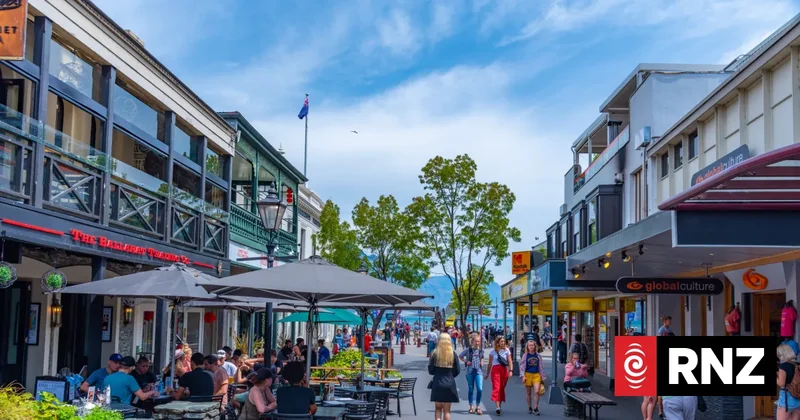
Some Queenstown residents and authorities say the town's roads are not coping as international arrivals hit a new high - more than two-thirds above pre-pandemic levels.
The Regional Tourism Organisation is calling for immediate changes to protect the town's reputation, while Queenstown's mayor is setting up an anti-traffic congestion taskforce.
Data from Queenstown Airport shows 247,820 international arrivals in the first six months of 2026 - nearly 100,000 more people than in the same period in 2019.
The number of domestic arrivals also rose, with an extra 14,000 people compared to the first six months of 2019, including locals taking trips away and then returning.
The town's permanent population has grown more than twice as fast as the rest of the country since 2018, topping 35,000 last year.
Destination Queenstown & Lake Wānaka Tourism chief executive Mat Woods said although there was enough physical room for visitors, transport had become a major problem at peak times.
"The last long weekend we had, Queenstown was gridlock - and no one comes on holiday to go to gridlock. As residents and visitors alike, that was really unpleasant. You definitely heard people unhappy about that," he said.
Last year a report to councillors warned the resort town could become the next Barcelona, as local sentiment towards tourism deteriorated.
Woods said the town's reputation would suffer if it stopped delivering a quality experience.
"We actually have to do something immediately, because I think we are seeing that point, with infrastructure, where the residential growth and visitation - we just can't handle any more," he said.
"I think we all have concerns that Queenstown is the real draw card for New Zealand tourism, and grows New Zealand tourism. And if we aren't delivering a great experience for the people that live here, as well as the people that visit, we actually do run the risk of killing the golden goose."
Residents told RNZ that hour-long traffic delays on an eight-kilometre stretch of Frankton Road - heading into central Queenstown - were not uncommon.
Callum Fisher said the town felt like a far cry from the place he first moved to 25 years ago.
"It's just exploded really. It's always been busy... but it seems worse than it probably ever was," he said.
"The town can't keep up - the hospital... the roads - there are numerous things you could look at which are undersize for the amount of people that are here."
Daniel Wren - who worked at a local holiday park - said he was among those in the town who relied on visitors for a job, but the summer rush was turning some daily errands into a logistical battle.
"I feel like the town's been outgrown by the number of people that are coming here. Even getting home - just simple things - are becoming quite a hassle. Getting to work, going to the supermarket - everything is so busy. The town is not really keeping up," he said.
Ben Hollins, who was visiting from Australia, said the volume of fellow tourists came as a surprise.
"It is a lot more busy than I thought it would be. Especially last night when we were coming back home... it was like 30 minutes just to get through the city. Walking around it feels within capacity, but the transport situation I think is a bit overloaded," he said.
However, another Australian visitor Natasha Jones said the popularity of the town was a positive for her - in part because it felt safe at night.
"I was quite surprised how many people are still wandering around when it's dark... I feel safer walking around," she said.
New taskforce to tackle traffic woes
On Friday, Queenstown Lakes District Mayor John Glover announced he would be setting up a mayoral taskforce to tackle traffic congestion, bringing together councils, government agencies, mana whenua and transport experts to find solutions over the next three to six months.
Modelling showed Queenstown's transport would fail "even if every currently identified intervention is delivered", he said.
"Continuing to plan within the existing framework is therefore not enough... we must act now, implement faster and think differently," he said.
"Our community expects us to show leadership rather than wait for someone to do something, and we are responding to that."
More details would be provided later this week, the council said.