Two weeks before leaving for Ubud, I was already hyperventilating about Bali’s crowds. As someone who spends much of their life chasing quietude, just the thought of the over-development and the Instagrammable chaos made me twitch.
So when a friend told me about Sibang – describing it as Ubud’s calmer cousin and the way it might have been 30 years ago – I was in. Now, waiting for said friend on a dirt road corner with just an ancient temple to my left and jungle to my right, I’m glad I’ve come.
That Sibang (which actually encompasses two villages, Sibang Kaja and Sibang Gede) has stayed under the radar is no accident. “Locals have told us about a curse that was placed on the village many years ago, by an angry giant who threatened that it would one day be swallowed by ants,” my friend says. “It’s said the villagers fled because of this, and the jungle took over.”
The story lingered for decades, leaving Sibang quiet and largely overlooked – until Canadian John Hardy arrived to build Green School Bali.
Green School’s bamboo campus, which offers eco-focused education to about 500 local and international students from kindergarten to year 12, put the village on the map when it opened in 2008. My friend, who’s living in Sibang, so her son can attend the school, walks me down the street flanking the campus. Aside from local homes and a couple of sleepy cafes, a sustainability-focused concept store named Muka, and a slick year-old villa stay called Mahajiva, there is, happily, not much here.
Get exclusive travel deals delivered straight to your inbox. Sign up now.
But change is looming. A padel court has broken ground opposite Green School, slated to include a bar, air-conditioned co-working space, gym and lap pool. I hear from others in the community that both locals and foreigners living in Sibang are upset about this development, worried it could be the last nail in the coffin for Sibang’s green soul.
The Balinese have, of course, watched this story unfold before. Rice paddies paved over for boutique villas, quiet roads funnelling into traffic jams, the cost of land soaring beyond what locals can afford. Sibang, they fear, may be sliding onto the same conveyor belt.
For now, though, it does feel like a haven. That’s especially clear at Kul Kul Farm, a permaculture farm turned bamboo-building school and guest-stay founded by Orin Hardy, whose family started Green School, and his wife Maria Farrugia.
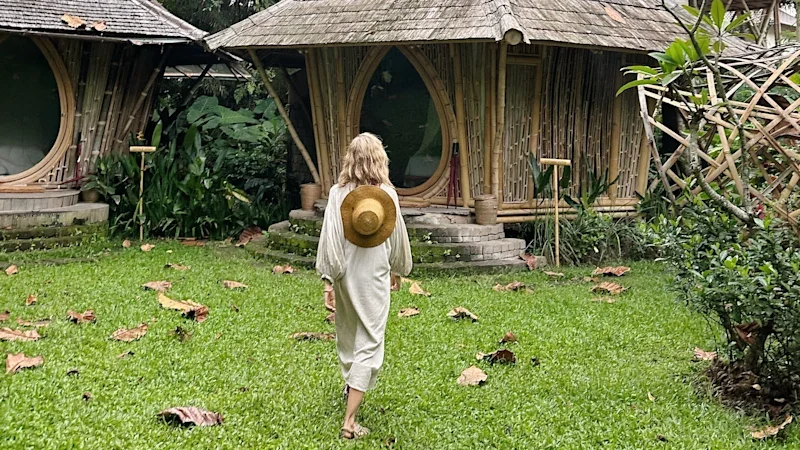
Each April, Kul Kul runs a 10-day bamboo-building course, teaching about a material that restores land, grows rapidly, and sequesters carbon. Student-built curving structures, five of which are newly open to guests, are dotted between beds of lettuce, tomato, chilli and eggplant. Much of this produce lands on plates at Taani, Kul Kul’s new restaurant where I slurp the best soto (a warming turmeric-spiced soup) I’ve ever had in Indonesia.
Next afternoon I walk to Astungkara Way, a regenerative rice-farming collective. Twenty minutes from Kul Kul Farm, the road dissolves into paddies alive with birdsong and the loamy scent of turned earth. Here, travellers learn how rice is grown the natural way. This means ducks instead of pesticides, compost instead of chemicals, and respect for the Subak system, a co-operative irrigation network that has sustained Bali’s farmers for centuries.
“Look around,” says manager Oka Dewanti, spreading her arms wide to the rice paddies rolling out around us. “This is what Ubud or Canggu was 30 years ago.” She speaks of the heartbreak of watching development swallow farmland, the urgency of bringing youth back to agriculture, and how travellers can support the kind of Bali they want to see. To that end, alongside hands-on farming courses, Astungkara Way leads multi-day walking journeys that begin in the thick of traffic and development, and slowly carry travellers back to the Bali that once was.
Strolling back to Kul Kul in the indigo evening light, past boys fishing in irrigation canals and women carrying baskets of offerings towards local temples, I worry about what Sibang might lose as more travellers arrive. Change is already gathering at its edges. But if places like Kul Kul Farm and Astungkara Way set the tone for what’s to come, maybe this village has a fighting chance to remain the kind of Bali travellers dream about, rather than the kind we flee.
THE DETAILS
Related Article
Stay
A stay at Kul Kul Farm costs from $US72 ($111) a night. See kulkulfarmbali.com
FlyJetstar operates daily flights between Sydney, Melbourne and Brisbane and Bali. See jetstar.com.au
Moreindonesia.travel
The writer stayed as a guest of Kul Kul Farm.