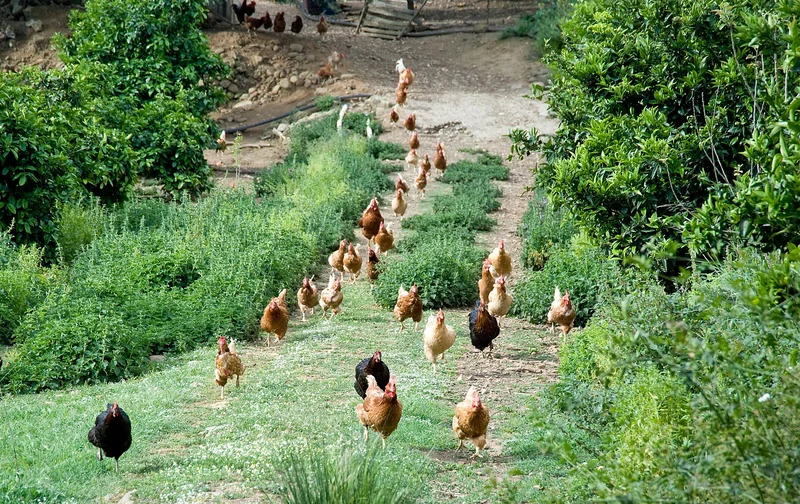
When consumers pay a premium for organic, free-range eggs at Woolworths or other retailers, it is generally with animal welfare concerns, including the hormones pumped into the birds, and the environment in mind.
But a study published on 29 July in the peer-reviewed and highly respected UK journal Royal Society Open Science has scrambled this narrative with startling findings that organic eggs are worse for the environment and have questionable outcomes for animal welfare.
âThe organic free-range scenario exhibited the highest total environmental burdens across all impact categories. These elevated impacts were attributable to a combination of higher emissions per kg of eggs, a larger required population to maintain production and elevated mortality rates, which amplify resource use and emissions per unit of effective output,â says the study, which was focused on the UK poultry industry.
âBy contrast, cage-based scenarios consistently showed the lowest environmental impacts when accounting for losses owing to mortality, owing to lower baseline mortality rates and higher production efficiency. The global warming potential ranged from 1.80 to 3.52 kg CO2-eq kgâ1 of eggs, with the highest values observed in the organic free-range system.â
The environmental impact from free-range husbandry boils down largely to productivity: more chickens outdoors are required to produce the same amount of eggs as caged birds. And this feeds into the production pipelines, including for feed.
âAcross all systems, feed production was the dominant contributor to the total production emissions,â the study noted.
âFeed production is a major contributor to global warming potential; therefore, variations in feed intake and feed conversion efficiency help explain the lower impacts observed in intensive systems and the higher impacts associated with freeârange systems, where feed input per unit of egg output is greater.â
Manure also plays a role â more chickens mean more chicken faeces, and when they are outside it spreads around.
âManure management and housing are also important, as freeârange systems often exhibit greater NH3 volatilisation [the process that transforms nitrogen into a pollutant] and nutrient leaching owing to larger land areas and manure spreading practices.â
The study also found that caged-hatching systems had the lowest âeutrophication potentialâ â water degradation from fertilisers â and that organic operations had poorer land occupation outcomes.
Chicken wellbeing
Perhaps even more surprising â and controversial â were the findings on the animal welfare front, which is the main driver of consumer demand for organic eggs.
âAll the whole eggs we sell are laid by hens free to roam outdoors during the day with access to shelter and fresh water. Thatâs the difference,â proclaims a sign in a Woolworths egg section.
Thatâs the hook: the hens are âfree to roamâ, and consumers will shell out more because of their well-intentioned concerns about chicken wellbeing.
But the study, crunching numbers through a range of scenarios, points to cracks in this perception.
âThe fully caged scenarios have a lower number of animals slaughtered. Mortality rates vary significantly across scenarios, with free-range scenarios exhibiting the highest losses,â according to the study.
âAlthough free-range and organic husbandry systems are often perceived as more welfare-friendly, they require more animals to produce the same yield, thereby increasing the number of animals affected and slaughtered.â
This, it must be said, is sure to ruffle some feathers. It would seem obvious that a life outdoors is preferable to one cramped in a cage.
The authors of the study acknowledge that their welfare lens was both focused and limited. Issues around hormones in feed for example are not explicitly addressed.
âNumerous welfare indicators are recognised in the scientific literature; however, for this study, only three were available for analysis. These can serve as useful âicebergâ indicators but should be interpreted with caution,â they write.
âMortality rate is a useful indicator, but it lacks information on the underlying causes of animal welfare issues.â DM
Edâs take
The environmental findings â notably concerning climate change â highlight how animal welfare concerns and activism can sometimes give rise to unexpected conservation consequences and ill-conceived policies.
They also underscore how economic productivity can come with a green sheen.
And someone who is, say, a vegan for environmental reasons might say it shows that farmed animal meat has no redeeming conservation qualities.
Itâs certainly all food for thought the next time you are shopping for eggs.