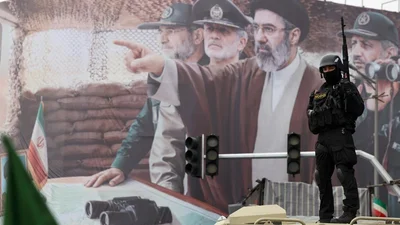
TEHRAN — Iran’s Islamic Revolution Guard Corps (IRGC) on Monday vowed to deliver an “unforgettable lesson” to the United States, while announcing a series of military operations and maritime security measures amid escalating tensions across the Persian Gulf and neighboring countries.
Brigadier General Ahmad Vahidi, commander-in-chief of the IRGC, said Iran would respond decisively to continued US aggression against the country.
Addressing a recent strategic message by Leader of the Islamic Revolution Ayatollah Seyyed Mojtaba Khamenei, Vahidi said the IRGC would not “tie the destiny of this land to the promises of a child-killing enemy whose record is marked by betrayal, deception, and hostility toward the Iranian nation.”
“Now that the criminal United States has once again chosen the path of aggression, violation, and adventurism, we reaffirm this pledge: with strength, resolve, wisdom, and power, we will teach it the ‘unforgettable lesson’ that the Leader promised,” he said.
Vahidi also emphasized the importance of preserving national unity, saying the IRGC and other branches of the Armed Forces considered strengthening the domestic front and preventing enemy infiltration among their most important responsibilities.
IRGC announces three-phase operation
In a separate statement, the IRGC Navy said it had carried out a coordinated three-phase operation targeting US military facilities in Bahrain and Kuwait.
According to the statement, the first phase targeted drone maintenance and repair hangars used by US forces at Al-Sakhir Air Base in Bahrain. The second phase reportedly struck facilities associated with Task Force 59 at Salman Port in Bahrain, while the third phase targeted support and equipment facilities for US special naval forces at Camp Arifjan in Kuwait.
The IRGC added the attacks caused heavy damage and destroyed several facilities. The United States had not publicly commented on the issue at the time of publication, and the reported damage could not be independently verified.
The invading army admits its casualties
The US military on Monday identified two soldiers killed in action recently as part of the war with Iran.
The Defense Department said in a statement that 1Lt Tyler James Feehan, 25, of Ewa Beach, Hawaii, and Pvt Isabella Gonzales, 19, of Carrollton, Texas, were killed in Jordan.
On Saturday, the US Central Command said two service members were killed in Jordan while defending against Iranian ballistic missile and drone attacks.
The US military has said the total number of deaths in the war with Iran, which was started in late February, is 17.
Tensions spread across Persian Gulf and beyond
The IRGC also announced a series of operations and security developments extending beyond Bahrain, underscoring ‘an expanding regional campaign.’
In a separate statement, the Guards stated to have targeted multiple US facilities at Kuwait's Ali Al-Salem Air Base during the 22nd phase of Operation Nasr-2. According to the statement, Iranian drones destroyed an American early-warning radar, struck a warehouse containing aircraft equipment and spare parts, and hit a hangar housing MQ-9 drones. The IRGC also urged the Kuwaiti public to oppose the continued presence of US forces in the country.
The IRGC has also taken responsibility for ballistic missile strikes against US military assets in Jordan, saying C-17 transport aircraft and P-8 surveillance planes were targeted at Aqaba Airport during the 21st phase of the operation. It further added that earlier intelligence had enabled strikes on shelters housing US personnel at Al-Azraq Air Base.
Meanwhile, regional tensions were heightened by reports of four explosions off the coast of Ras Al Khaimah in the United Arab Emirates. Initial Arab media reports suggested vessels operating in the area may have been targeted, although Emirati officials had released no details at the time of publication.
In neighboring Iraq, explosions were reported in Erbil and Sulaymaniyah, prompting warning sirens at the US consulate in Erbil. Iraqi media also reported drone activity over Sulaymaniyah.
Strait of Hormuz warning
Iran also issued a warning regarding maritime traffic in the Strait of Hormuz, one of the world’s most important energy transit routes.
The IRGC said two oil tankers exploded and were disabled after attempting to use ‘an unauthorized and unsafe route’ through the southern part of the strait.
According to the statement, the vessels had been encouraged by the United States to use the route. The IRGC warned that any future violations would face punitive measures and said continued US military actions in the region would make the passage unsafe for the transit of oil, gas, and other cargo.
Escalating regional confrontation
The latest developments come amid a sharp deterioration in relations between Tehran and Washington following months of military confrontation, mutual accusations, and disputes over maritime security in the Persian Gulf.
Iran has accused the United States of violating a war-termination understanding and of carrying out attacks on Iranian territory and civilian infrastructure. Washington has not publicly responded to the latest IRGC statements.
At the same time, military and strategic analysts have increasingly warned that a prolonged confrontation between Iran and the United States could rapidly evolve into a wider regional conflict with consequences extending far beyond the Persian Gulf. They argue that any sustained escalation would heighten the risk of miscalculation, draw additional regional actors into the conflict, and threaten critical maritime corridors through which a significant share of the world's energy supplies passes.
Security experts also caution that an expanded conflict could place US military installations and personnel across the Middle East under greater pressure while disrupting global energy markets, international shipping, and commercial supply chains. Such a scenario, they say, would carry substantial economic and geopolitical costs not only for the immediate parties to the conflict but also for Europe, Asia, and other regions dependent on stability in the Persian Gulf.
Many defense specialists contend that preventing further escalation remains in the strategic interest of all sides. They warn that once a conflict spreads across multiple fronts, political leaders may find it increasingly difficult to control its trajectory, raising the prospect of a broader confrontation with unpredictable consequences and far greater costs than the current crisis.