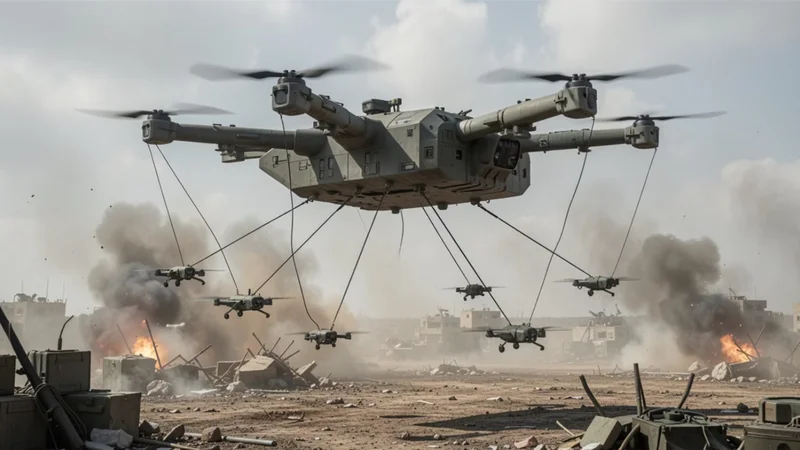
- Russia patented a carrier drone capable of deploying six tethered reconnaissance copters
- One airborne platform controls multiple surveillance drones through physical cable connections simultaneously
- Each tethered copter receives power and commands directly from the carrier aircraft
A newly-patented Russian drone design turns a single aircraft into a mobile hub for up to six smaller spy copters.
Engineers at the Novosibirsk Higher Military Command School, known as NVVKU, filed the patent through Russia's Ministry of Defence.
Rather than flying alone, the carrier drone launches, controls, and later retrieves a fleet of tethered reconnaissance units.
A hub drone that multiplies eyes in the sky
Instead of one aircraft scanning one area, the design lets several copters fan out from a single launch point simultaneously.
Each remote unit carries its own flight controller, gyroscopes, camera, and video transmitter, functioning almost as an independent aircraft.
What separates it from a typical swarm is the physical cable tying every remote copter back to the carrier above.
That cable supplies both power and control signals, removing the need for onboard batteries or independent radio links.
Range becomes a direct function of cable length rather than battery life or signal strength, a trade-off unusual among reconnaissance drones.
The carrier itself hovers as a communication relay, receiving instructions from a ground operator through its own tethered connection to a reel station.
Onboard, it holds a flight controller, power system, camera, video link, gyroscopes, and a protective grille around its propellers.
Landing brackets built into the carrier's frame hold each remote copter until deployment, after which operators can send them toward separate targets at once.
Retrieval built into the design from the start
Unlike disposable scout drones, this system was engineered around full recovery rather than one-way missions.
Reel drives mounted on both the carrier and each remote copter spool the cables back in once a task finishes.
Every unit returns automatically to its designated landing bracket before the carrier itself descends toward the operator.
A separate setting lets the whole formation, carrier included, land together in a single coordinated sequence.
That built-in retrieval suggests the system was designed for repeated use rather than expendable single missions.
Tethered power removes one major weakness of small reconnaissance drones, since jamming radio-controlled units has become common on modern battlefields.
The trade-off is mobility, since a cable-bound copter cannot range nearly as far as an autonomous one.
This design could let one operator cover several observation points at once, cutting the number of separate aircraft a unit needs.
Removing onboard batteries from each remote copter also frees up weight for additional cameras or sensors.
That combination of extended coverage and added payload capacity could ease strain on units running constant reconnaissance in contested areas.
Via 1.ru
Efosa has been writing about technology for over 7 years, initially driven by curiosity but now fueled by a strong passion for the field. He holds both a Master's and a PhD in sciences, which provided him with a solid foundation in analytical thinking.