Number of specialist forest firefighters in NZ drops
The numbers of specialist forest firefighters is dropping at the same time as insurance cover for plantation forests has plunged.
At what might seem a good time to add to fire protections, key measures are going the wrong way.
Three years ago, 500,000 hectares of commercial forest was insured for fire. Now it is 300,000ha, down 40 percent.
There were 215 fire team managers at forest companies in 2022 - now there are 169, down 20 percent.
The annual fire protection expenditure by large-scale forest owners has decreased by over a quarter - 27 percent- since 2022.
The big drops show up in a new survey by the Forestry Owners Association and Farm Forestry Association, the second they've done.
Sean McBride chairs those groups' fire committee.
"For a lot of forest owners, they struggled to be able to obtain insurance," he told RNZ.
"So even if they wanted to, they couldn't find a provider. For others, if they found a provider, it wasn't financially viable for them, the costs that escalated too high."
Significant erosion of capability
The survey said a central concern was around significant erosion of forest-specific fire management expertise within Fire and Emergency's first-response model.
McBride said this has its roots back to the shake-up that set up Fire and Emergency, or FENZ, in 2017, when rural fire authorities were folded in with urban, leaving volunteer brigades as primary cover in the countryside.
"Over the last nine years, we haven't really seen a huge amount of development in the rural fire capability within the FENZ organisation, or forest owners for that matter as well.
"And so it is still a key concern for forest owners, that rural capability."
The survey found forest owners are collectively still spending over $8 million a year on fire protections, such as more than doubling the number of pumps that clip on the backs of utes.
But they've lost about 100 of the crew to man them, down 11 percent since 2022 to under 800 trained personnel nationwide.
"FENZ is relying heavily on deploying community-based volunteer firefighters to contain wildfires in the forest and rural landscape, and has reduced or made minimal or inconsistent use of available partners' expertise and capability," the survey said.
It said forest crews can often best offer the speed that is essential for quick containment, and specialist knowledge of how forest fires behave and how to use heavy machinery against them.
"Some forest owners have observed instances where differences in tactics, resourcing, or local knowledge may have contributed to slower containment than anticipated."
FENZ was approached for comment.
Urgency around super El Niño
Ultimately, the central agency is in charge wherever a fire is. Even in a private forest, it calls the shots.
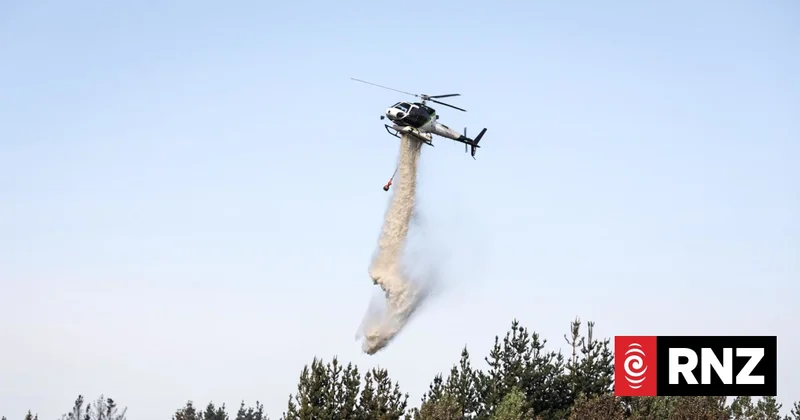
Wildfire firefighting costs have jumped due to more use of helicopters and planes. Chopper spending doubled in two years to over $7m. FENZ has been trying to rationalise this as part of a mass - but still delayed - restructure.
McBride said they're in talks with FENZ, asking for more training and also for it to make much more use of the forest owners' crews to fight scrub or grassland fires - including so they stay sharp and motivated - such as when two such crews helped at the Tongariro wildfire last November.
Changes were needed. "Whether it's quick enough for us ... we wanted it yesterday."
The volunteer fire brigades association agrees on the urgency.
Its chief executive Bill Butzbach said: "We have been engaging with FENZ senior leadership in the past two months ourselves about the super El Niño fire season we expect this year.
"And we have expressed similar concerns to the other stakeholders in terms of our preparedness for that."
A super El Niño carries higher wildfire risks.
They wanted an all-group sitdown to strategise, Butzbach said.
He backed most of the survey's points but rejected its suggestion FENZ's focus on volunteer brigades was to the detriment of forest owners' crews' readiness.
"It's actually the lack of contractors and capability within the forestry sector to deal with those.
"And so I think that there is a big risk there. And over time, we have lost a lot of capability, particularly in incident management in these major fires, but certainly there's a need for more training and a more of a collective approach."
Climate question
Europe's fires might suggest otherwise but the NZ survey says it is too early to say climate change will soon be a big factor here.
Plantation forest fires have decreased lately - though there've been some big scrub and fires on conservation land.
Dougal Morrison, who represents small farmer forest owners, said most wildfires start outside forests by the public, then might spread into them.
"It's that public education is absolutely critical."
He didn't know till the new survey about the resource drop.
"It'd be good to get that better coordination," Morrison said.
"It's using all those sorts of mechanisms, but having the resources there to fight the fires, if need be, is also critical, obviously."
Training review
FENZ said it did not determine resource deployment based on whether personnel are volunteers, career firefighters, contractors, or forestry personnel.
"The objective is to ensure the right resources are used at the right time to achieve the desired operational outcome safely and effectively."
Maintaining specialist wildfire capability could be challenging and factors like workforce turnover and firefighting opportunities came into it, it said.
It was reviewing its training of urban and rural firefighting to make sure it fits the risk and fire types.
In 2024-25, 824 non-FENZ personnel registered on its wildfire training courses, including 264 from the forestry sector and 108 from DOC.
"The programme is also looking to provide clearer development and progression pathways," it said.
The Insurance Council said the new survey does not suggest that insurance is generally unavailable, but that it does highlight the need to maintain appropriate cover.
"It appears a sizeable portion of smaller plantation forests continue to be insured, and that forestry insurance remains available in New Zealand," it said in a statement.
"As natural hazard risks increase and costs rise, some asset owners may reassess the level of insurance cover they purchase."
It is still pushing for a broader funding model for FENZ than the insurance-based one.
But forestry crews might be busier in the near future.
Calls for international help with current wildfires are expected from the likes of Canada soon, McBride said.