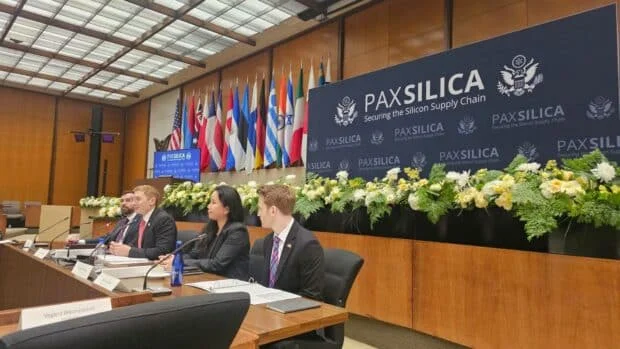
MANILA, Philippines — A leading business group has voiced support for the Pax Silica hub, the Philippine-US joint venture that has drawn both excitement and controversy, describing it as one of the most significant economic opportunities to come the country’s way in decades.
The Management Association of the Philippines (MAP), however, tied its endorsement to a condition: the government must guarantee that the 1,619-hectare project serves Philippine interests and delivers real, measurable benefits to Filipinos.
“The Philippines should pursue Pax Silica, if it is anchored on a clear framework of national interest, shared prosperity, sustainability and accountability,” MAP said in a statement issued.
READ MORE: Talent retention remains a growing challenge for Cebu firms
The group acknowledged that concerns raised about the hub’s environmental footprint and questions of Philippine sovereignty are legitimate. Still, MAP argued the national conversation should move past a simple yes-or-no framing.
“Rather, the critical issue is whether the agreements, governance structures, and implementation mechanisms can be designed in a manner that maximizes value to the Filipino people while effectively managing economic, social, environmental and geopolitical risks,” the group said.
MAP’s statement lands amid intensifying public debate over the artificial intelligence (AI) hub, which was first announced in April and is being led by the state-run Bases Conversion and Development Authority (BCDA) together with US partners.
BCDA president and CEO Joshua Bingcang has said the project could bring in P180 billion in annual revenue and generate between 130,000 and 190,000 high-quality jobs, with roughly 90 percent of those positions expected to go to Filipino workers.
“Proceed, but protected”
MAP framed its position as “Proceed, but Protected,” saying Pax Silica should be built to strengthen domestic industrial capacity — not simply function as a site for low-value assembly or extraction work.
The group called for concrete technology transfer commitments, stronger workforce development programs, defined pathways for Filipinos to take on technical and managerial leadership roles, strict environmental safeguards, genuine community involvement, and firm protections for Philippine sovereignty.
MAP was blunt that these benefits will not materialize on their own. They must be “deliberately negotiated, contractually protected, and institutionally monitored,” the group said.
Independent oversight body proposed
To back that up, MAP proposed setting up an independent oversight body made up of representatives from government, the private sector, academic institutions, labor groups, civil society, and technical experts.
The body would be tasked with tracking commitments across several fronts — investment levels, job creation, technology transfer, environmental performance, and impact on host communities.
MAP said this kind of structured monitoring is the only way to ensure Pax Silica produces lasting gains for Filipinos rather than benefits that exist only on paper.
“The Philippines should neither approach Pax Silica with blind optimism nor reflexive opposition. The country should approach it as a strategic negotiation,” the group said.
“If structured properly, Pax Silica can become more than a foreign investment project. It can become a platform for national development — one that helps the Philippines move up the value chain, strengthen its economic resilience and create lasting prosperity for future generations of Filipinos.” / Logan Kal-El Zapanta
READ MORE: CERA backs uniform 5.5% system loss cap instead of scrapping charge
Disclaimer: The comments uploaded on this site do not necessarily represent or reflect the views of management and owner of Cebudailynews. We reserve the right to exclude comments that we deem to be inconsistent with our editorial standards.