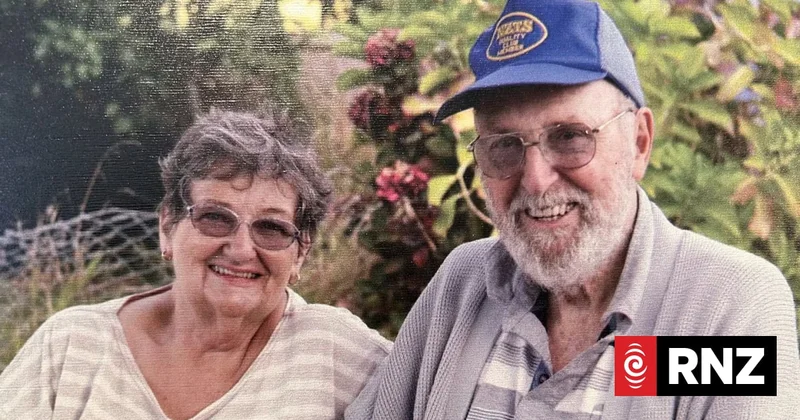
Wife of patient who died at Waikato Hospital says staffing levels and experience remain a concern
A widow of a diabetic and cardiac patient who collapsed and later died while searching for food in Waikato Hospital says he was coherent, talking and comfortable when she'd last seen him just hours earlier.
But somehow, Colin John Clarkson's blood glucose levels [BGL] had managed to drop to a dangerously low level, a couple of hours after having his hospital dinner.
Lois Clarkson told NZME her husband was an independent man, and didn't like to be a bother to anyone, so would have gone to look for food himself but was instead found unconscious in a stairwell near the Cardiac Care Unit [CCU] he had been admitted into on the night of 30 December 2019.
The 79-year-old had been missing from the ward for nearly an hour before the alarm was raised, and soon after he was found, he died.
That sparked a tenacious fight for answers by his wife, and a damning report from the Health and Disability Commissioner [HDC], which found Health New Zealand Te Whatu Ora breached the Code of Health and Disability Services Consumers' Rights in its handling of his medical needs.
Coroner Donna Llewell on Monday announced she had also closed the six-year-old inquiry into Clarkson's death, citing the HDC's thorough investigation, stating she was satisfied it was not necessary.
The coroner found that Clarkson's death was preventable, while Lois Clarkson said she appreciated the numerous recommendations that had already been enacted; it was the hospital's staffing levels that still left her concerned.
'I'm worried about my blood glucose level'
Clarkson, 79, had multiple health conditions, including an extensive cardiac history, longstanding memory loss and dementia, a mild cognitive impairment, and type 2 diabetes.
However, Lois Clarkson was a retired registered physiotherapist and was diligent with her husband's care and monitoring his diabetes.
About 3.10am, on 29 December 2019, he went to Waikato Hospital's emergency department with chest pain, accompanied by his wife.
During triaging, the nurse recorded he had diabetes, but not whether he was on insulin or other medications.
While his blood glucose level was initially measured, there was no further testing while he was in the emergency department [ED].
Lois had brought her husband's diabetic kit, record book, and medications, so she administered his insulin herself.
At 2.30pm, later that day, he was transferred to the CCU.
The next day he had blood glucose testing and insulin administered, but after dinner, at 9.30pm, he returned blood glucose levels [BGL] of 4.4mmol/L.
Clarkson told the CCU nurse he was concerned about his level, and the nurse went to get him a drink and a sandwich.
But there were no sandwiches in the unit's fridge, so the nurse went elsewhere.
When she returned, at 9.44pm, he wasn't in his bed, so she left his food on his bedside table.
She went back 10 minutes later, and he still wasn't there.
She assumed he was in the toilet, so she resumed other duties.
However, CCTV revealed Clarkson had left his room and was trying to get food from a vending machine in the ward hallway at 10.27pm before he got into a nearby lift.
The footage also showed 11 people, including seven hospital staff, walked straight past him without checking on him.
At 11.01pm, he was found unconscious on a stairwell past fire doors and was bleeding from a cut to his head.
He died 21 minutes later, after unsuccessful attempts to revive him.
A coronial inquiry was opened on 9 January 2020, but was adjourned 12 months later for an investigation to be carried out by the Health and Disability Commissioner [HDC].
The HDC found Te Whatu Ora failed to provide Clarkson with a reasonable standard of care, was critical of the care in Waikato Hospital's ED, and the CCU nurse for not checking whether he'd eaten his food or re-checking his BGL levels.
There were also failures by Te Whatu Ora in having inadequate food and systems in place to alert staff to wandering patients.
A number of recommendations were made, and Te Whatu Ora has already instigated many changes.
However, in deciding against resuming her inquiry, Coroner Llewell said the HDC had given an undertaking to Clarkson's family they would be alerted once all of the recommendations had been completed by Te Whatu Ora.
Of particular interest to the family was the outstanding recommendation that they carry out a random audit of 15 diabetic patients admitted into the CCU in the last 12 months.
'He was coherent, he was talking, he was comfortable'
Clarkson's widow told NZME that she was grateful that the result of the HDC and coroner investigations was how she saw it.
"Because I was convinced that the care he received [was poor].
"They have done some staff training and other things, and that's a really good step forward."
However, she felt the problem ran deeper.
"I don't think the hospital has got enough staff and I don't think the hospital has enough appropriately trained and experienced staff."
She had worked at the hospital as a physiotherapist many years ago, so knew how to care for her husband.
Ironically, it was when she left her husband's care in the hands of professionals that he died.
"I had an idea of what should have been happening in relation to the care of my husband.
"Unfortunately, the night it all happened, I had gone back home, and so I just felt terrible about being [home] because if I had been with him, that wouldn't have happened.
"He would not have died at that time if I had been in the hospital with him."
She had previously spoken to her husband's GP who said if his BGL level got below 7mmol/L, he would need urgent assistance.
She said the quickest thing to do when her husband had a low BGL level was to mix up two heaped teaspoons of sugar and half a glass of water, or juice.
"And the recovery time is really quick.
"However, the nurse toddled off to get sandwiches and a drink.
"That all took time, and time was something that my husband didn't have on his side."
She believed the "whole thing was dealt with inappropriately".
"The nurse did not have the understanding or knowledge in order to do something quick, and that was the whole thing.
"He didn't get the aid he needed."
Lois noted evidence in the HDC investigation from an expert, independent nurse, who said someone should have been with her husband to witness him eating the sandwich because, given his condition, that was considered a medicine.
"But of course, he never ate it."
Lois said she and her son visited Colin the evening he died, leaving around dinner time.
"He was coherent, he was talking, he was comfortable.
"Everything looked fine."
But she was shocked how her husband's BGL level was able to drop so low by 9.30pm, especially after having dinner.
"Having that low blood sugar at that time of night was very unusual.
"I don't know what happened, but that was another red flag."
Lois said the family was aware of his health issues, and wondered if he was going to pull through after his suspected heart attack, but for him to get into such a poor state so quickly, and then die, had left her in shock.
"To hear that he had died was a terrible thing, but then to hear how he died, I was very, very angry about that."
She said the fact Waikato Hospital had thrown out her book she'd used to record her husband's BGL levels was unfortunate, as it might have given the family a better idea about how he was doing that night.
Overall, she was grateful for the help from the HDC, the coroner, and her four sons, but hoped that no other family would ever have to go through what they did.
'I acknowledge Lois Clarkson's determination'
Coroner Llewell said Clarkson's death was preventable.
"Had the proper standards of medical care, treatment and services been afforded to him and management of his diabetic condition, it is probable he would have had more time with his family," she said.
She also paid tribute to Lois Clarkson and two of her sons, who had provided her with well-articulated submissions.
"I acknowledge the determination and advocacy of Mrs Clarkson with the support of two of her sons in my inquiry.
"Mr Clarkson's death could be said to be a prime example of the principle that the provision of the appropriate food is in fact a form of medical treatment during a diabetic crisis."