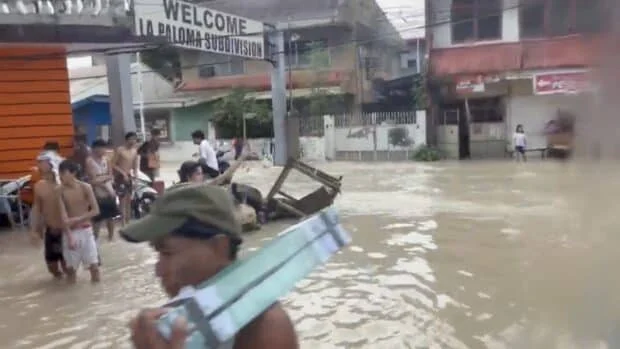
EXPLAINER: Why La Paloma flooded — and Cebu City’s plan to prevent it
CEBU CITY, Philippines — After days of heavy rain inundated roads and neighborhoods across Cebu City last week, many residents of Barangay Tisa were left asking the same question: Why did La Paloma Subdivision and nearby areas flood so severely?
City officials, barangay councilors, engineers, contractors, and homeowners’ association officers sought to answer that question during an emergency meeting on Saturday.
Their discussion identified several factors that likely contributed to the flooding, including runoff from upland areas and neighboring sitios, a drainage bottleneck, and unfinished downstream drainage works. They also outlined the city’s immediate and long-term measures to reduce flood risks in the area.
Where did the floodwater come from?
One of the first issues tackled during the meeting was the source of the floodwater.
READ: WATCH: Flooding in several areas in Cebu on July 30
Engineers from the Cebu City Department of Engineering and Public Works (DEPW) said the water did not originate from Emerald Street or La Paloma itself.
Instead, officials said floodwater coming from upland areas, other sitios, and the market area eventually affected Emerald Street and La Paloma.
According to the DEPW, the volume of water during heavy rains becomes so great that some of it no longer follows its natural waterways, creeks, or drainage canals.
Instead, the water spills onto roads before flowing toward lower-lying communities, including La Paloma.
Why did La Paloma flood?
DPWH engineers said the problem begins once the runoff reaches Emerald Street.
They explained that the city’s drainage system along Emerald Street includes a large detention tank designed to temporarily store floodwater before gradually releasing it downstream.
However, once the water reaches La Paloma, the drainage system suddenly narrows.
According to engineers, the detention tank connects to a drainage outlet measuring around 72 inches in diameter, but the downstream culvert in La Paloma measures only about 48 inches.
Officials likened the situation to an “imbudo,” or funnel.
As the larger volume of water from the detention tank reaches the smaller culvert, the existing drainage system can no longer accommodate the flow, causing water to overflow onto roads instead of remaining inside the drainage system.
Downstream drainage
According to the DEPW, the original plan was to first improve the drainage system in La Paloma before completing the Emerald detention tank so the downstream drainage could already accommodate the additional runoff.
However, engineers said the work did not initially proceed because the city had yet to secure written consent from the La Paloma Homeowners Association (HOA) during earlier discussions.
As a result, the detention tank in Emerald was completed first.
Now that it is operational, officials said it releases a greater volume of water toward La Paloma, where the downstream drainage has yet to be upgraded.
Persistent flooding problem
For La Paloma HOA president Violeta Musngi, the recent flooding was only the latest in a problem residents have been raising for the past two years.
Musngi said homeowners first questioned the flooding in 2024 after noticing that the subdivision, which previously did not experience flooding of that magnitude, suddenly began inundating during heavy rains.
According to Musngi, residents were told at the time that the Emerald detention tank would eventually address the flooding once completed.
Still unconvinced, the homeowners’ association spent its own funds to have the subdivision’s drainage system cleaned after suspecting clogged culverts might be contributing to the flooding.
Workers were hired to clear the drainage, while City Engineering personnel later inspected the area and reportedly found the culverts to be clean.
Despite those efforts, Musngi said flooding continued.
She also said the HOA requested the installation of protective screens at key drainage entry points after residents documented garbage allegedly being carried downstream during heavy rains.
According to Musngi, those screens were never installed.
She likewise said the HOA later agreed to the city’s proposal to continue the drainage connection from Emerald toward La Paloma following discussions with Mayor Nestor Archival and project contractors.
However, Musngi said the continuation of the project never pushed through before last week’s flooding.
Trash, informal settlers
Musngi also claimed that videos gathered by residents appeared to show water overflowing from an old creek that was supposed to drain toward the Labangon River.
According to Musngi, the videos appeared to show garbage and obstructions preventing water from flowing properly into the river, causing water to spill toward Sitio Tambisan and their subdivision.
“Unsa’y atong nakita sa video? Basura. Namabaw ang creek. Gilahos sa video, daghan nang kabalayan, napuno sa kabalayan, wala na’y kaagian ang tubig. Instead ang tubig mulahos sa Labangon River, daghang squatters. Mao na kada habwa sa tubig gikan sa ibabaw, awas sa Tambisan, awas sa La Paloma,” Musngi said.
(What did we see in the video? Garbage. The creek has become shallow. As shown in the video, there are now many houses built there. The area is already crowded with homes, leaving no passage for the water. Instead of flowing into the Labangon River, the water is blocked because there are many informal settler families. That’s why whenever water comes down from the upland areas, it overflows into Tambisan and La Paloma.)
Her observations and allegations have yet to be confirmed by the DEPW or other city officials.
Proposed immediate solutions
During the meeting, residents pressed city officials on what happens next.
Among the concerns raised were whether the existing culvert in La Paloma would be widened, whether funding had already been identified to complete the drainage system, where the drainage outfall would ultimately discharge, whether a Program of Works and Estimates (POWE) had already been prepared, how long the project would take once funded, and whether the city had secured the necessary written consent to proceed.
While a larger drainage rehabilitation is still being planned, the DEPW said several measures could already be undertaken.
Engineers proposed immediately inspecting, declogging, desilting, and cleaning the subdivision’s existing drainage system to determine whether blockages are limiting its capacity and whether the existing drainage system could adequately accommodate water once cleared.
However, officials said they would first need written consent from the La Paloma HOA before undertaking work within the subdivision.
At the same time, DEPW said it would continue preparing the technical plans for the larger drainage rehabilitation project.
What happens after that?
According to the DEPW, preparing the Program of Works and Estimates (POWE) — including measurements, engineering drawings, and cost estimates — could take about two weeks.
If no regular funding is immediately available, officials said they could seek financing from the city’s disaster funds because the flooding is considered disaster-related.
The proposal would then go through the required government processes, including the drafting of a resolution, approval by the City Council, and the issuance of a Certificate of Availability of Funds before it can be implemented.
Officials also discussed the possibility of utilizing remaining funds from the Emerald drainage project through a variation order should funds still be available.
Looking beyond La Paloma
Mayor Nestor Archival said the city’s response would not stop at improving the drainage system inside La Paloma.
He said the city would also inspect the affected areas and meet with developers after residents raised concerns that upland developments may have contributed to the increased volume of water reaching the subdivision.
According to the mayor, if discussions determine that developments uphill contributed to the flooding, the city intends to address the problem at its source rather than relying solely on downstream flood-control projects.
“Atong i-meeting ang mga developers para makahibalo ta, naa’y exchange of ideas. Kung mahibaw-an nato ang problema didto, then let us cure the problem kay sila may hinungdan,” Archival said.
(Let’s meet with the developers so we can understand the situation and exchange ideas. If we identify the problem on their end, then let’s address it, because they are the ones causing it.)
What’s next?
For now, city officials and residents are currently carrying out drainage maintenance while simultaneously preparing the engineering plans for the larger rehabilitation project.
Whether those longer-term solutions move forward will depend on several next steps, including securing the homeowners’ association’s written consent, completing the Program of Works and Estimates, identifying funding, and obtaining the necessary approvals for rehabilitation.
For residents of La Paloma, those steps could determine whether future heavy rains again leave the subdivision inundated — or whether the city can finally move forward with the long-planned drainage improvements discussed during the emergency meeting.
Disclaimer: The comments uploaded on this site do not necessarily represent or reflect the views of management and owner of Cebudailynews. We reserve the right to exclude comments that we deem to be inconsistent with our editorial standards.