The Tekigaisō Gallery Café: Behind the Scenes of History
Food and Drink Architecture Guide to Japan## The Prime Minister’s Other Official Residence
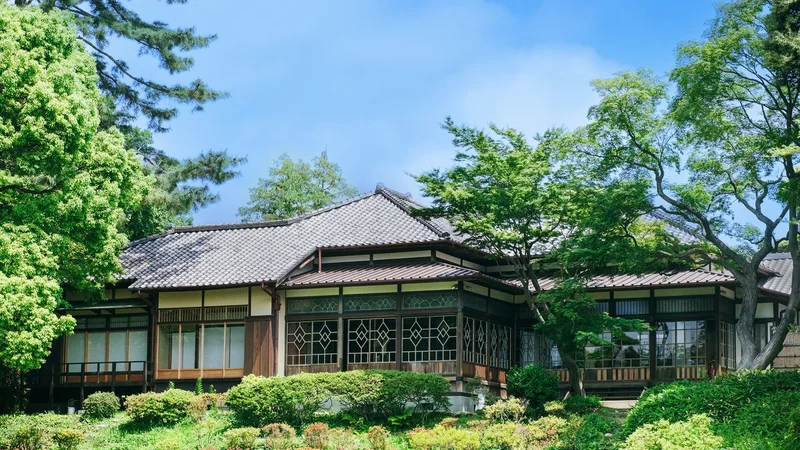
In the quiet residential area south of Ogikubo Station, half-hidden amid a leafy miniature forest, stands a century-old building that was once at the heart of Japan’s tumultuous mid-twentieth century history. The Tekigaisō is the former residence of three-time Prime Minister Konoe Fumimaro, and during his time in office, it was sometimes known as “the prime minister’s other official residence.”
The eastern section of the building was relocated to Toshima for a time, but a decade-long project by Suginami saw the Tekigaisō rebuilt and restored on its original grounds, reopening in 2024 as beautiful as it was when it was built.
In 2025, a new, free-standing gallery wing was added. Designed by Kuma Kengo, the gallery wing also houses a cafe where visitors can enjoy treats from Suginami’s finest confectioners while gazing through the windows at this piece of carefully preserved history. Visit when the weather is mild and the sun is bright enough to filter through the leaves above, and enjoy a stroll rich in historical, architectural, and gastronomical interest.
Before We Pass Through the Gate—Four Dramatis Personae
First, though, let’s meet four key figures in the story of the Tekigaisō. Knowing who these individuals are changes the meaning of what the building has to say.
The Tekigaisō was originally the second residence of Irisawa Tatsukichi, chief court physician to Emperor Taishō. It was designed by Irisawa’s younger brother-in-law, Itō Chūta. Itō was a giant in the world of Japanese architecture, winning acclaim with projects such as Tsukiji Honganji in Tokyo and Heian Jingū in Kyoto. “Put your skills to use as you wish,” were Irisawa’s instructions to Itō, and the result, completed in 1927, was an exquisite residence freely blending Japanese and Western styles.
Ownership of the Tekigaisō passed from Irisawa to Konoe in 1937, not long after the latter became prime minister. This made the Konoe residence the place where Japan’s course was determined, with countless unofficial political conferences held in its reception room. In December 1945, after World War II, Konoe chose to take his own life in his study at the Tekigaisō.
Yoshida Shigeru, who laid the foundations of Japanese governance from the immediate postwar through to the recovery period, rented part of the Tekigaisō from the Konoe family in 1947 and lived there for around a year. Yoshida had much to think about here as he built the framework of postwar Japan. He had originally connected with Konoe through a movement that sought peace through a swift end to the war, and they are said to have shared a mutual respect that transcended their respective positions and beliefs. The Tekigaisō was thus a witness to Japan’s turbulent history before, during, and after World War II.
Dragons in the Reception Room
In the Chinese-style reception room, the eye goes first to the table with mother-of-pearl inlays and dragon motifs on the ceiling and floor tiles. Itō Chūta had traveled to China, India, Turkey, and elsewhere to examine local architecture in search of Japan’s architectural roots, and he used his deep insight and powers of imagination to create something in accordance with the ideas of Irisawa Tatsukichi, a connoisseur of Chinese poetry.
The room’s table and chairs are luxuriously inlaid with mother-of-pearl turban shells. The original furniture was lost, but these reconstructions by Mitsubishi Seisakusho were based on surviving photographs. The inlay gleams with rainbow iridescence when it catches the light, eloquently speaking to the amount of fine handicraft involved.
Lowering one’s gaze reveals that the table’s legs rest on dragons’ claws. Dragons and other fantastical creatures are often hidden away in Itō Chūta’s architecture. Examining the wallpaper or other decorations elsewhere in the Tekigaisō can reveal other minor discoveries of this nature.
The Parlor Where Japan’s Fate was Decided
The highlight of the tour is the Western-style parlor. This room, where many political conferences took place and sometimes even cabinets were formed, is the main reason that the Tekigaisō became known as the prime minister’s other residence.
In 1940, as the Second Sino-Japanese War lengthened, Konoe gathered figures such as Matsuoka Yōsuke and Tōjō Hideki here for discussions which resulted in the policy decisions leading to the formation of the Tripartite Pact with Germany and Italy. Today, scanning the tablet in front of the parlor summons up images of Konoe, Tōjō, and others to reenact this Ogikubo Conference as a work of augmented reality as if the tense debate were taking place before the visitor’s very eyes.
The parlor’s upholstery and tablecloth were faithfully restored based on colorization analysis of surviving black-and-white photographs. The uncompromising attention to detail and masterful technique applied to this recreation extends even to the stuffed animals mounted on the walls and the clothing of the dolls on display in the cabinet.
The Everyday Space of the Dining Hall
The room beside the parlor is the dining hall, a space where the everyday and the extraordinary intersected. Here the family sat around the table to dine together each day; but here was also where key historical figures enjoyed refreshments after their discussions were over.
The corridor’s windows offer views of the dazzling green lawn outside. The wooden frames have intricate artisanal designs, while the windowpanes have the distinct waviness of old glass. Gazing through this century-old glass at the lawn where Konoe is said to have enjoyed golf. I feel the mysterious sensation of being caught between multiple layers of time.
The Study Where Time Stood Still
Beyond the dining room and its dance of light and foliage is a room in the Japanese style where the weight of history hangs somberly in the air.
The study where Konoe chose to end his own life using poison in December 1945 has been preserved by his surviving family members as sacred ground since then. The scroll in the tokonoma alcove was written by Konoe himself. It reads Moto tachite, michi shōzu, roughly meaning “Once the starting point is decided, the way emerges of its own accord.” Standing before the study door, one feels as if time itself were standing still.
Taking a Break in the Tekigaisō Gallery Café (Designed by Kuma Kengo)
After experiencing the historical gravitas of the Tekigaisō residence, a brief break in the newly built Tekigaisō Gallery sounds appealing. This separate wing nestled within the spreading boughs of a zelkova tree was designed by Kuma Kengo to harmonize with the surrounding environment. The design creates a seamless landscape extending from the Tekigaisō proper to the new gallery space.
Along with Roast House Brown Chip coffee, the cafe menu includes a number of delicacies from local stores, selected by staff on visits to these establishments: jumbo monaka from Nishiogikubo Miharadō, mizuyōkan from Kajin Yūto, snowballs from Petit Grace, and seasonal marshmallows from Torajirushi Kashiya. From March through June, the cafe offers a sundae that is effectively a collaboration between local confectioners, using sorbet from Gelateria Sincerita, biscuits from Patisserie en Famille, and sweetened azuki bean paste from the venerable sweets store Toraya.
And so I enjoy flavors that would normally require wandering far and wide across the neighborhood, all in one place—in a building designed by a giant of modern architecture, Kuma Kengo, no less. From the window, I can admire the richly green gardens and the Tekigaisō itself, another work by a master architect a century ago. If you prefer quiet contemplation in cafes, a morning visit is recommended.
A Walking Course Around the Three Gardens of Ogikubo
The Tekigaisō, Ōtaguro Park, and Kadokawa Garden are collectively known as the Three Gardens of Ogikubo. Since all three are within ten minutes’ walk of each other, why not drop by the other two after visiting the Tekigaisō? Each of the three has its own distinctive cultural atmosphere—in Ōtaguro Park, the Steinway piano built in 1900 and used with love by music critic Ōtaguro Motoo; in Kadokawa Garden, the early modern sukiya-style residence owned by Kadokawa Gen’yoshi, founder of Kadokawa Shoten. Together the three gardens convey the multilayered appeal of the Ogikubo area.
Not the main stage of history, yet certainly somewhere that moved the times—this is the category into which the Tekigaisō falls. Visiting this residence deep among the trees, we step softly into the space beyond the words on the page in history textbooks. There we find a room where the powerful spoke freely and privately; a study where one human quietly chose death; and artisanal work from a century ago that still gleams proudly in the sunlight today.
Tekigaisō Park
- Address:2-43-36 Ogikubo, Suginami-ku, Tokyo
- Hours:9:00 am–5:00 pm (last entry 4:30 pm)
- Closed:Wednesdays, New Year holidays (Lawn area closed only during New Year holidays)
- Admission:Adults 300 yen, elementary and junior high school students 150 yen (Free for preschool children)
- Access:15 minutes’ walk from the South Exit of Ogikubo Station on the JR Line and Tokyo Metro Marunouchi Line
- Website:(Japanese)
Tekigaisō Gallery Café
- Address:1F Tekigaisō Gallery Hall (East Side), 2-42-12, Ogikubo, Suginami-ku, Tokyo
- Hours:10:00 am–4:00 pm
- Closed:Wednesdays, New Year holidays
- Access:15 minutes’ walk from the South Exit of Ogikubo Station on the JR Line and Tokyo Metro Marunouchi Line
- Website:(Japanese)
(Originally published in Japanese on May 31, 2026. Reporting, text, and photographs by Kawaguchi Yōko, except where otherwise stated. Banner photo: The Tekigaisō Gallery Café. © Kawaguchi Yōko.)