Listen to this article
Estimated 5 minutes
The audio version of this article is generated by AI-based technology. Mispronunciations can occur. We are working with our partners to continually review and improve the results.
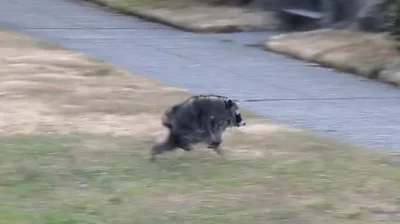
Just a few days after Norway soccer star Erling Haaland made headlines for bringing a taxidermy raccoon back home from the World Cup, a Seattle raccoon with an unusually short body has become an internet sensation after a video of it scampering across a field went viral.
The raccoon nicknamed Jimothy, which is thought to have short spine syndrome, is inspiring murals, art and even tattoos — and has become, for some, a symbol of resilience.
"I initially thought that he was a cat, and just got my phone out because I love cats. And then when he emerged from the car, I realized he definitely wasn't a cat," Kiana Hall, 33, told Reuters. Her video of the raccoon went viral after she caught him on camera July 13 in the Ballard neighborhood in northwest Seattle.
"I think he's just sort of round and a silly little guy, and people just sort of need something silly and fun in their life right now."
And people do seem to be having fun.
Jimothy was celebrated by the Seattle Mariners, the Seattle Art Museum and the Seattle Public Library on social media. The raccoon will be recognized by Seattle councillor Alexis Mercedes Rinck in a ceremony next week. The University of Washington jokingly awarded it an honourary degree.
But Jimothy isn't just a local celebrity. The story made the Manila Times in the Philippines, where Jimothy is described as an "odd-shaped raccoon." Australia's ABC News details the "cult following."
And U.K. charity The Stroke Foundation joked on Threads that seeing Jimothy relax can lower your blood pressure.
A person dressed as Jimothy races mascots during a baseball game between the Seattle Mariners and the San Francisco Giants on Saturday in Seattle. (Lindsey Wasson/The Associated Press)
'He looks like a Jimothy'
When Hall first posted the video, she commented: "What am I looking at?"
"I was seeing some kind of gray, fluffy creature that was shaped sort of like an orb with really long legs," she told Reuters.
But after several commenters pointed out it appeared to a raccoon with a birth defect, she gave it a name.
"He looks like a Jimothy," Hall said.
The name stuck, and despite not knowing for sure whether Jimothy is male or female, so did the "he."
Since then, other Seattle residents have posted videos and photos of their own sightings, including one of the raccoon walking across a balcony, and a post of baby Jimothy from someone claiming the raccoon was born to a loving raccoon family in his neighbour's cedars.
"He was so small and clumsy but his mother and siblings were always so patient and caring, keeping him from falling and sometimes just carrying him," Ben Trammell wrote on Instagram.
"With all the pain in our timelines [right now], I'm really loving how connected so many people feel [with] this funny little creature."
Now, there are subreddits devoted to Jimothy fandom and websites that track its sightings. As of Monday, Hall's video had been viewed more than 18 million times on TikTok alone.
Is Jimothy OK?
Experts have said they believe Jimothy has a congenital condition that shortened its spine.
"It does look quite unusual, but it is a condition that happens in other mammals as well," veterinarian Carrie Schneider told Seattle's KIRO 7 News.
Marcie Logsdon, an associate professor at Washington State University’s Veterinary Teaching Hospital, told the Seattle Times that Jimothy's prognosis seems positive despite its short neck.
"The fact that he’s made it to this age tells me that he’s managing and that he’s adapting," Logsdon said. "I was surprised and honestly a little bit inspired that he’s that resilient."
But another expert, Brian Collins of the Cornell College of Veterinary Medicine, told the New York Post Jimothy might have a shortened life expectancy. Its malformation could make it harder to climb trees, forage for food and escape from predators, he said.
Regardless, the best thing people can do for Jimothy is let it be, a spokesperson for the Washington Department of Fish and Wildlife told CBC News.
Feeding wildlife can cause animals to become habituated to humans, and can also lead to overcrowding, which can spread disease and parasites.
"We do encourage folks to leave the animal alone as it does appear to be getting around fine, unassisted, with [the] apparent congenital defect," the department said in a written statement.
"Feeding raccoons may create undesirable situations for you, your children, neighbours, pets, and the raccoons themselves."