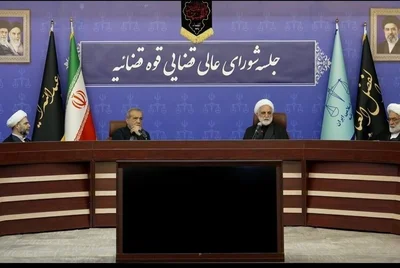
TEHRAN — Judiciary Chief Gholamhossein Mohseni-Ejei has reiterated that there is absolute alignment among the country’s high-ranking officials regarding resistance against foreign hostility, dismissing any claims of internal division over the necessity of defending the nation.
The top judge made the remarks during a high-profile meeting of the Judiciary’s Supreme Council on Monday, which President Masoud Pezeshkian also attended.
Emphasizing the collective resolve to counter external aggression, Mohseni-Ejei stated, "The fact that the Iranian people, driven by a profound sense of duty, remain steadfast and continue to stand firmly against an aggressive and treacherous enemy is undoubtedly a righteous stance. We, as officials, must remain resolute in upholding and reinforcing this position."
He further underscored that the entire establishment stands as a monolithic front against external threats. "There is no disagreement whatsoever among the country's officials on this matter. Our American adversary is utterly untrustworthy. We will not back down in the face of hostility, and we will stand firm until our last breath," the Judiciary chief added.
The head of the Judiciary clarified that there is not the slightest hesitation within any branch of the establishment—particularly within the executive administration and from the president himself—about continuing the path of dignified resistance.
Describing President Pezeshkian as a sincere, devoted, and revolutionary figure, Mohseni-Ejei noted, “The president is doing everything within his power to advance what is in the best interests of Islam, Iran, and the Iranian people. The entire establishment should extend full support and cooperation to the administration.”
He added that President Pezeshkian firmly holds that the Leader's directives are final and binding, and that the country's Armed Forces must receive the strongest possible backing—a stance the Judiciary fully endorses and praises.
Mohseni-Ejei’s comments come amid an escalation in the direct military confrontation between Iran and the United States, following the recent breakdown of the Pakistani-mediated Islamabad memorandum of understanding. Washington resumed its campaign of targeted airstrikes against Iranian infrastructure and military facilities after accusing Tehran of violating maritime protocols in the Strait of Hormuz. Iran subsequently suspended its commitments under the agreement, citing US aggression and a total breach of the diplomatic framework.
Amid the military escalation, US officials have publicly alleged that the conflict is exacerbating deep strategic fractures within the Iranian establishment. They have asserted that the mounting costs of the confrontation have triggered significant policy rifts across branches of government, specifically claiming that certain military wings, such as the Islamic Revolution Guard Corps (IRGC), are acting independently of civilian administrative structures to block potential negotiations. President Donald Trump explicitly claimed that the Iranian leadership is paralyzed by internal policy disputes and division over how to navigate the current state of war. Tehran has systematically dismissed these assertions, categorizing claims of internal division as external psychological operations designed to disrupt national cohesion.
High-ranking officials, including President Pezeshkian, have utilized recent state councils to publicly showcase absolute coordination among the executive, legislative, and judicial branches. The administration maintains that all state apparatuses operate under a monolithic consensus, emphasizing that internal institutional solidarity remains the primary mechanism for defending the state against foreign pressure.