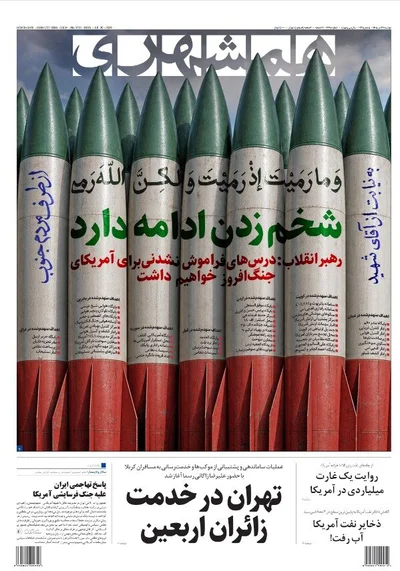
Hamshahri pointed to Iran’s strategic victory against Trump’s blockade. According to the paper, Trump announced a blockade of the Strait of Hormuz, but it was Iran that broke through it and showcased a strategic win to the world.
Four vessels linked to Iran, as reported by the BBC, passed through the claimed blockade, while oil prices simultaneously surpassed $100, pushing the global economy to the brink of a new shock. This was not a tactical victory but a manifestation of asymmetric deterrence in action—a strategy in which Iran, by threatening to close the Strait of Hormuz, raised the cost of war for its adversaries to such an extent that even Israeli security analysts openly admitted: “The damage to the United States and the international economy would be greater than to Iran.” The surge in oil prices and the global economy’s vulnerability demonstrate Tehran’s success in implementing asymmetric deterrence. Any calculation that ignores Iran’s capabilities and resolve is doomed to fail.
Shargh: The US fears a major operation
Shargh devoted its editorial to Trump’s miscalculation, which it argues stems from fear. The editorial states that miscalculation arises more from human psychology than intellect—either from fear or recklessness. Fear of war increases miscalculation. After the agreement, the US forced ships to pass through the lower part of the Strait of Hormuz. This move, the paper argues, was meant to test Iran’s fear of renewed conflict and use that fear-induced miscalculation to permanently remove the strait from Iran’s control. Similarly, the US seeks to gradually inject fear into Iranian decision-makers by slowly degrading southern infrastructure, hoping to avoid a major operation and force quicker concessions. In reality, the US itself fears a major operation because it cannot predict its consequences. Fear leads to underestimating one’s own power or the impact of strikes against the enemy.
Resalat: Countdown to a new phase of conflict
In a commentary, Resalat warned of worsening wartime conditions, writing that the Middle East is experiencing one of the most volatile periods in its modern history. The attacks have entered a new, complex, and highly unpredictable phase. Field dynamics signal tougher days ahead. Military experts believe these conditions may indicate the imminent entry of the confrontation into a far more costly phase. This new phase could include the use of unknown weapons, crippling cyberattacks on vital US infrastructure in the region, broader activation of resistance networks across West Asia, and even a complete and practical closure of the Strait of Hormuz—an apocalyptic scenario with irreversible consequences for the security and economic architecture of the region and the world. The Middle East is now holding its breath, waiting to see whether diplomacy’s voice will prevail over the roar of missiles or whether the region will plunge into a full-scale regional war.
Arman-e-Melli: The secret behind the Iraqi PM’s trip to Tehran
Arman-e-Melli analyzed the upcoming weekend visit of Iraqi Prime Minister Ali al-Zaidi to Iran. According to the paper, the visit is part of Iraq’s diplomatic initiative to strengthen Baghdad’s role in reducing regional tensions. Al-Zaidi will carry an Iraqi proposal aimed at helping end the ongoing military tension between Iran and the United States and opening channels of dialogue between the two sides. He presented this idea during his meeting with US President Donald Trump in Washington, where it was welcomed as a step that could help contain the crisis and prevent escalation. Al-Zaidi’s initiative may pave the way for direct or indirect talks between the two sides as part of Iraq’s efforts to reduce tensions and prevent further escalation that could threaten regional stability.
Etemad: The crisis is moving toward a war of attrition
Afshin Zargar, associate professor of international relations, discussed the current regional tensions in an interview with Etemad. He argued that as tensions between Tehran and Washington enter a complex phase, the main issue becomes managing pressure tools and preventing the crisis from turning into a widespread confrontation. The Strait of Hormuz, regional depth, and asymmetric capabilities remain key factors shaping both sides’ calculations and can influence Persian Gulf security dynamics. In this context, the future of the crisis depends less on confrontation and more on the ability of both sides to control tensions, maintain deterrence, and prevent broader coalitions from forming. As the shadow of tension grows heavier over the Persian Gulf, the central question concerns not only the reasons for conflict but also its form and scope. Zargar emphasizes that differences in the strategic cultures of Iran and the United States could push the crisis toward a prolonged war of attrition, where geography and geopolitical leverage play decisive roles.