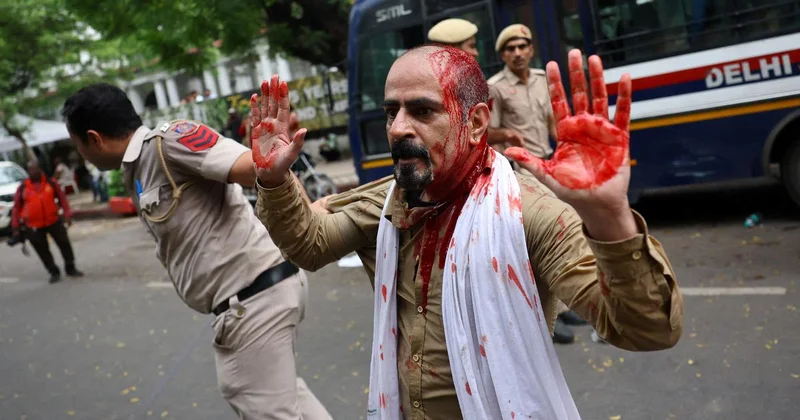
If one looks beyond the merits of the student unrest at Jantar Mantar, beyond the politics, the partisanship and the competing narratives and reflect solely on the conduct of the policing forces at the venue, one is left with a profound sense of unease.
This reflection comes from someone who has worn the uniform, led troops in some of the most challenging circumstances during the height of insurgency in the Kashmir Valley and witnessed first-hand the pressures, provocations and split-second decisions that confront those entrusted with maintaining order in volatile situations.
There is a deep understanding of the difficult circumstances in which uniformed personnel often operate, the dangers they face and the emotional and operational pressures that can arise when confronted by crowds, unrest, or hostility.
Precisely because of that experience, the responsibility of restraint becomes even more significant. The authority of the uniform is immense, but so is the obligation that accompanies it. Those entrusted with the power of the state must always remember that the legitimacy of that power comes from the confidence and trust of the people.
The larger question
The issue is not whether the protesters were right or wrong; reasonable people may differ on that. The larger question is whether the state, acting through its law enforcement institutions, exercised its authority in a manner consistent with the values of a constitutional democracy.
There is also a fundamental principle that must never be lost sight of: the conduct of the police can never be equated with that of a protesting crowd. A crowd, by its very nature, may become emotional, disorderly or even unruly. The police, however, are not another participant in the confrontation; they are the constitutional authority entrusted with maintaining order. The standard expected of them must therefore be higher.
The police must be better – not because their task is easier, but precisely because their power is greater and their responsibility is heavier.
It is understood that those in uniform operate within a hierarchy of command and are duty-bound to execute lawful orders given to them. In difficult circumstances, personnel may find themselves carrying out directions that they may personally question or find uncomfortable. The realities of disciplined service and institutional functioning require obedience to command.
However, this obligation does not extinguish individual responsibility or professional judgement. Within the framework of their training, experience and duty, personnel retain the responsibility to ensure that the manner in which orders are executed does not exceed the limits of legality, proportionality and professional conduct.
The difference between carrying out a difficult duty and exceeding one’s brief is precisely where the character of an institution is tested. Discipline does not mean the absence of judgement; true discipline is the ability to exercise restraint even under pressure.
The fact that the venue of this confrontation was Delhi itself adds another significant dimension. The national capital is not merely another administrative jurisdiction; it is the symbolic centre of the Republic. The policing of the capital, particularly by a force directly under the Union Ministry of Home Affairs, carries an added responsibility to demonstrate the highest standards of professionalism, restraint, and constitutional conduct.
Events unfolding in the heart of Delhi inevitably carry a wider significance. Actions taken there are not viewed only through the lens of a local law-and-order situation; they are seen as a reflection of the state’s approach to dissent, public engagement and the exercise of authority. The expectation, therefore, is not merely effective policing, but exemplary policing.
In an era where events are no longer confined by geographical boundaries, the possibility that such incidents may be witnessed and assessed internationally cannot be ignored. Even if sections of the domestic media choose to underplay or overlook an event, the wider world through independent observers and international media platforms is often able to view and interpret such moments.
The conduct of institutions of the state must therefore be guided not by assumptions of limited visibility, but by an unwavering commitment to professionalism because accountability ultimately extends beyond immediate audiences.
Beyond the optics
Beyond the optics of excesses, whether from protesters or from those tasked with maintaining order – there is another deeply troubling dimension that deserves attention: the apparent presence and participation of individuals who were not clearly identifiable as part of the uniformed establishment, yet were seen engaging with protesters in a manner that raised questions of accountability.
Reports and visuals of non-uniformed persons confronting protesters, refusing to identify themselves, and displaying behaviour inconsistent with professional conduct inevitably create concerns about discipline, command, and institutional responsibility.
Equally concerning are instances where personnel appeared to remove identification markers, or where some were seen displaying behaviour characterised by mockery, laughter or the use of unacceptable and offensive language. Such conduct, if established, should concern every citizen, not because those in uniform are expected to be without emotion, but because the uniform represents the disciplined restraint of the state.
Perhaps the most unsettling image to emerge from such an episode is that of a young girl, visibly distressed and in tears, expressing that after witnessing the conduct of the police, she would never want to join the forces. That sentiment should trouble the citizenry deeply. The strength of any institution of the State ultimately rests not merely on its weapons, powers, or authority, but on the aspiration and trust it inspires among the next generation.
When young citizens begin to view institutions created to protect them as instruments of fear rather than service, the implications are profoundly serious. The greatest danger is not merely a moment of public anger or criticism; it is the gradual erosion of respect for institutions that are essential to democracy. Those entrusted with the coercive power of the State must therefore remain conscious that their actions do not only affect the people before them, they shape how an entire generation perceives duty, service, and the meaning of the uniform.
The Armed Forces defend the nation against external threats across its borders, while policing services protect society from threats within. In both roles, the uniform derives its legitimacy not from fear or intimidation, but from discipline, professionalism, and adherence to the law. The power entrusted to the State is at its strongest when it is exercised with restraint.
If conduct that appears to cross these boundaries is normalised, contextualised, or defended even in the full glare of public scrutiny, only a few kilometres from the seat of Parliament, it raises a larger and more troubling question - what message does this send about policing standards in the hinterland, where citizens may not have the same access to media attention, public oversight, or institutional scrutiny?
The true test of a democratic police force is not how it responds when circumstances are easy, but how it conducts itself when challenged, provoked, or confronted by dissent. The uniform must command respect, not because it can compel obedience through fear, but because it embodies the rule of law, constitutional restraint, and service to the people it is sworn to protect.
Lieutenant General Bhopinder Singh (retired) is a former Lieutenant Governor of Andaman and Nicobar Islands & Puducherry.
We welcome your comments at letters@scroll.in.