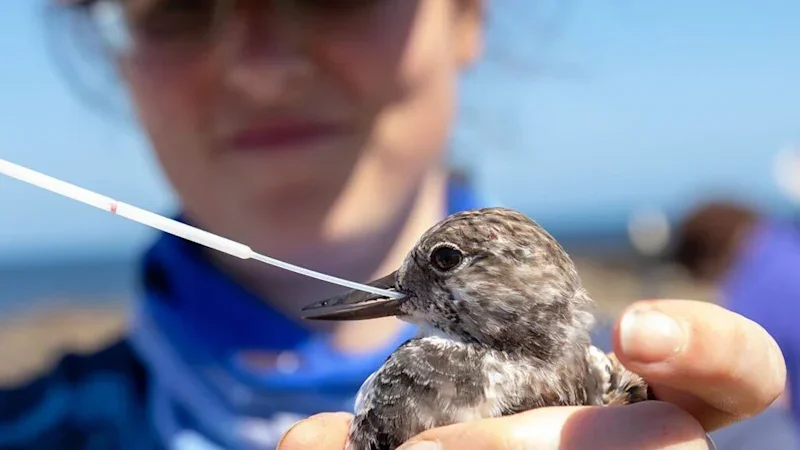
Bird flu has become established on the Australian mainland, with the federal government confirming that dozens of greater crested terns at Boudin Rocks off Cape Jaffa in South Australia have tested positive for the H5NI, which has killed more than 300 million animals around the world.
A seagull collected in Robe, South Australia, has also tested positive to the disease.
“Sadly, we do know that once the H5 bird flu is spreading in wildlife, and the natural environment, it is not possible to avoid significant losses – which is what we are starting to see now,” said Agriculture Minister Julie Collins during a press conference on Monday, adding authorities would continue to monitor the spread of the virus through Australian wildlife.
“Australians should expect to see more spread and larger numbers now of wildlife being affected.”
Environment Minister Murray Watt said the mass deaths in South Australia were “just the beginning” in what is likely to be a “long and difficult journey”.
The poultry industry is bracing for stocks to become infected. While the risk to human health remains low, an outbreak of a different strain in 2024 led to about 2 million chickens being killed, causing egg shortages.
Collins said Australia had improved biosecurity preparations to protect the industry, having learned from the impact of the disease at it hit around the world.
Kate Millar, chief executive of Australia’s largest bird conservation group, Bird Life Australia, likened the mass deaths over the weekend to the moment bird flu first hit South America in 2022. Within months the disease had spread 6000 kilometres along the continent’s coasts, killing millions of birds, as well as seals, otters, dolphins and porpoises.
It is estimated the disease killed more than 13,000 elephant seal pups on Heard Island, one of Australia’s subantarctic islands, before being brought to the mainland, most likely by a large pelagic bird such as a petrel.
Now the disease is onshore it is likely to be spread by scavenging birds and mammals, such as common silver gulls, as well as cats and foxes.
Australians have been warned not to approach or touch birds that show signs of bird flu. Symptoms include being unable to stand, walk or fly properly, breathing difficulties, and mass deaths in one area.
Bird Life Australia said the onset of the virus strengthened the advice against feeding wild birds such as seagulls and magpies, and Chief Vet Dr Beth Cookson also said authorities would call on Australians not to “encourage situations where there might be greater aggregations of wild birds. That’s certainly one context where the disease could spread further”.
Professor John Woinarski, one of Australia’s leading Australian biologists, said heavy monsoons that have seen an inland sea formed in parts of central Australia could also see the disease spread rapidly inland.
“There’s bound to be silver gulls and pelicans and ibis and waterfowl flying into inland Australia and the Murray River system and spreading the infection very rapidly and very extensively, and with dire consequences,” he said.
He also warned the disease was likely to hit scavenging and water mammals in Australia, such Tasmanian tigers, quolls and perhaps even platypuses. He said the disease had not yet caused known extinctions around the world, but had driven many animals closer towards that point.
The Albanese government has committed $113 million to prepare a rapid response, which may involve quarantining farms and restricting transport between locations.