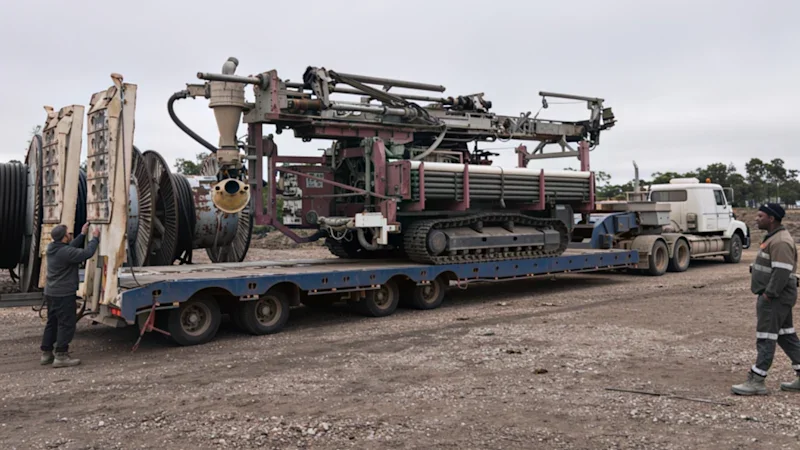
Moonlight Resources has fired up the drill rig for its maiden campaign at its Peak Downs copper prospect, 10 kilometres southwest of Clermont in central Queensland, launching the first modern, systematic evaluation of a forgotten historic high-grade system that has been largely gathering dust for decades.
The company has kicked off an initial 3,000m reverse circulation (RC) drilling program at the prospect, which forms part of its 100 per cent-owned Clermont Project. The campaign marks Moonlight’s first modern, systematic drilling program at Peak Downs since acquiring the project, with initial drilling to be focused on the Central Zone where historical work indicated relatively continuous copper mineralisation within the broader Peak Downs trend.
Rather than drilling blind, Moonlight is setting out to answer the question that has lingered over Peak Downs for decades—does the historic copper field have the scale, continuity and geological foundations to support a maiden JORC-compliant mineral resource estimate.
Peak Downs arrives with serious pedigree. The prospect boasts a historically mined copper lode stretching more than 2.5 kilometres along strike. Between 1862 and 1877, records show about 100,000 tonnes of oxidised carbonate ore were mined and smelted at a staggering average grade of about 17 per cent copper.
‘The commencement of drilling gives Moonlight the opportunity to determine whether Peak Downs can support a future copper Resource and important asset within our broader Queensland portfolio.’Moonlight Resources managing director Greg Starr
Previous drilling also returned a string of broad, decent-grade copper intersections, including a notable 39m at 1.11 per cent copper from 30m, containing a richer 6m core grading 4.04 per cent copper. Other significant past results include 24m at 0.97 per cent copper from just 8m, including 6m at 2.95 per cent copper and 10m at 2.00 per cent copper, 20m at 1.49 per cent copper from surface and 12m at 2.72 per cent copper from 20m. The latter intersection also contained a stellar 6m section grading 4.48 per cent copper.
Beneath the surface, Peak Downs is interpreted as a stratabound copper system with characteristics consistent with a “Besshi-style” deposit, suggesting the potential for broad, laterally continuous copper mineralisation. Shallow oxide mineralisation comprising malachite and azurite sits above primary chalcopyrite and pyrite sulphides, while historical work indicates multiple mineralised horizons remain open along strike and at depth.
Despite its spectacular nineteenth-century production record and encouraging drill results, Peak Downs has barely been touched by modern exploration.
Moonlight Resources managing director Greg Starr said: “The commencement of drilling at Peak Downs represents the first step under Moonlight’s ownership in systematically exploring the potential of this historically significant high-grade copper system. The programme is designed to validate select historical data, improve understanding of the mineralised system and provide the technical foundation for future work.”
The RC program will do far more than simply confirm old drill results. It will also test continuity between historical drill sections, refine the geological model and improve understanding of the relationship between shallow oxide mineralisation and deeper primary sulphides, often the geological layer where the real riches are hiding. It will also combine validation, infill and targeted extension drilling to generate the geological data needed to assess the prospect’s potential to support a maiden JORC-compliant mineral resource estimate.
Following completion of the drilling, Moonlight will interpret assay results, refine its geological model and integrate the new information with historical datasets. The findings will determine the scope of any follow-up work, which could include additional RC drilling, diamond drilling and metallurgical studies.
Peak Downs also fits neatly into Moonlight’s playbook—revisiting historically proven mineral systems with modern geological models and drilling techniques to uncover value previous generations of explorers left behind. It also expands the Clermont Project beyond gold, adding a historically high-grade copper opportunity at a time when AI data centres are creating an exciting environment for copper.
The prospect joins Leo Grande, Goldfinger and Petersens as one of four priority exploration areas within Moonlight’s approximately 268-square-kilometre Clermont project in central Queensland’s prolific Drummond Basin. While Peak Downs anchors Moonlight’s copper ambitions within the Clermont Project, the three gold prospects lie about 15 kilometres to the west. Leo Grande remains the flagship gold discovery, Goldfinger is rapidly emerging as a compelling high-grade target and Petersens provides another largely underexplored structural corridor for future growth.
Meanwhile, drilling is underway at the Goldfinger gold prospect, while assay results remain pending from the completed Phase 2 program at Leo Grande. With gold and copper exploration advancing in parallel across a region credited with more than 6.5 million ounces of historical gold production and endowment, Moonlight has given itself multiple shots at goal and if Peak Downs can back up even half of its remarkable history with modern drilling, Moonlight may have uncovered far more than another exploration target. It could have the foundations of a significant new copper resource story built around one of Queensland’s most forgotten high-grade copper fields at a time when copper is muscling its way onto the international stage.
Is your ASX-listed company doing something interesting? Contact: mattbirney@bullsnbears.com.au