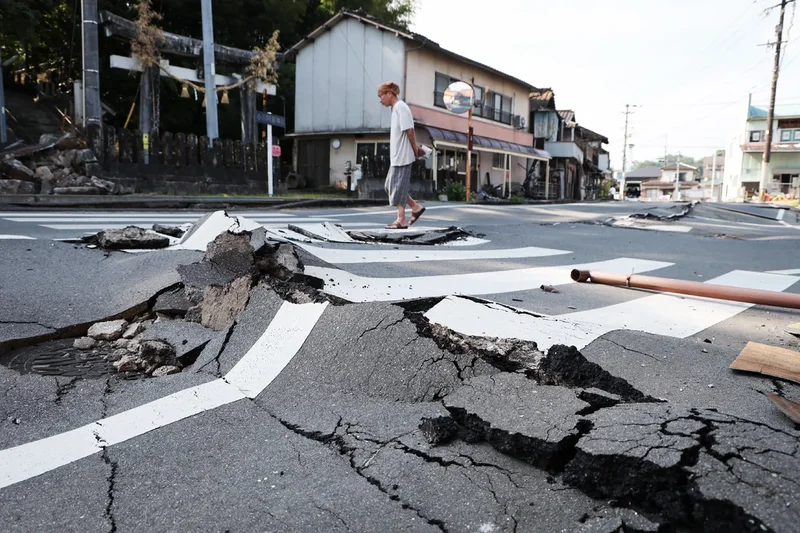
A woman who had been sleeping in her car died of suspected heatstroke in what may be the first death caused indirectly by the disaster.
The woman, in her 70s, was found on 30 July in a vehicle that had run out of petrol in Kumamoto prefecture. She later died, the prefectural government said.
Officials believe hers may be the first fatality linked to the aftermath of the magnitude 7.1 quake rather than the quake itself, which struck on 28 July.
The death toll from the earthquake that struck south-western Japan last week has risen to 38 now.
Many survivors have been sheltering in their cars to use the air conditioning, after the quake cut power and water to parts of the region during a spell of extreme summer heat, with temperatures above 35C. More than 8,000 people remain in evacuation shelters or other temporary accommodation.
Japan has been gripped by dangerous heat this summer.
Last month three cities passed 40C on the same day, triggering the country's first "cruelly hot day" under a new warning term introduced by the weather agency this year to alert the public to extreme heat.
Hundreds of people have been taken to hospital with heatstroke, and several deaths have been recorded across the country.
The revised toll of 38 includes the woman and two other deaths still being assessed to determine whether they were caused by the earthquake, the prefecture said. Thirteen people are in a serious condition, up from 11 the day before.
The worst losses were at two sites. Nine people died at a Nippon Paper Industries mill in the city of Yatsushiro, where a chimney collapsed, and seven at an Aeon shopping mall in the town of Kashima, where an explosion tore through the building shortly after the quake struck.
Aeon said on Saturday that a male customer found unconscious at a separate mall in the city of Uki, after its ceiling collapsed on 31 July, had since died in hospital.
The heat compounds the danger for those displaced by the quake, many of them elderly and cut off from power and water. Older people are more vulnerable to heat illness, and officials have urged evacuees to drink water before they feel thirsty and to avoid long periods sitting still in parked cars, which raises the risk of blood clots. Japan's summers have grown hotter and more deadly in recent years, a trend scientists attribute to climate change, which is warming the country faster than the global average
Prime minister Sanae Takaichi was due to visit Kumamoto on Sunday to assess the needs of those affected and set out the government's support measures.
The quake registered the highest level on Japan's seismic intensity scale in Uki and Hikawa. At that level, people cannot stay standing or move without crawling and may be thrown through the air, according to the Japan Meteorological Agency.
The prefecture is the same one struck by a pair of earthquakes in 2016 that killed more than 270 people and damaged the historic Kumamoto Castle, whose stone walls were brought down again by last week's tremor.