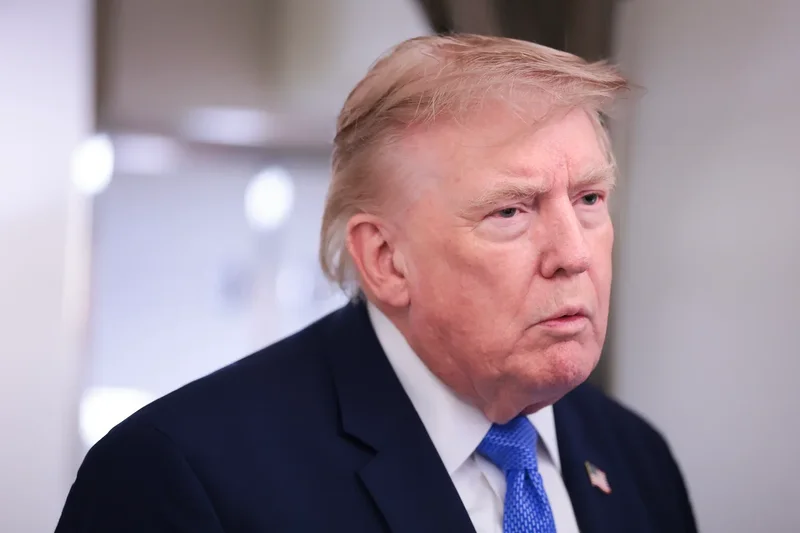
President Donald Trump said peace talks with Iran will take place on Monday after calling off what he described as World War II-level strikes.
“Obviously they don’t want to be attacked. They knew the extent of the attack because they saw it forming,” Trump told reporters aboard Air Force One on Sunday. “Now what we’re doing is we’re talking to them in the form of a negotiation. It begins tomorrow afternoon.”
Trump said a deal will be reached with Iran on the Strait of Hormuz and an agreement to denuclearise Tehran will follow. He said Saudi Arabia, UAE and Qatar had asked him to call off the strikes.
"When the allies ask to call it off, you’ve got to sort of say, well let's see," he said.
"The reason they asked is they think there's a deal, there's a deal on Hormuz and there will be a deal on the nuclear – or you might call it the denuclearisation of Iran, I call it the denuclearisation of Iran."
His comments followed a Truth Social post on Saturday in which Trump wrote that the US military was “locked and loaded” for what he cast as an unprecedented campaign against Iran.
Blast near tanker off Oman coast
The UK Maritime Trade Operations (UKMTO) said there has been an explosion in close proximity to a tanker off the coast of Oman.
The UKMTO yesterday said the incident took place about 20 nautical miles northeast of Khasab, Oman. The ship and its crew were safe, the UKMTO added.
Minister says Israel closely coordinating with US
Israel's energy minister Eli Cohen said there was close security and intelligence coordination between Israel and the US on everything happening in the region.
But he added: "With or without an agreement, and regardless of any external commitments, if Iran attempts to renew its nuclear program or advance its ballistic missile industries, we will be there. We will take action, and we will strike.
"US president Donald Trump and Israel's Benjamin Netanyahu met on Tuesday in Washington, with an Israeli official saying they had explored all possible paths to curb Iran's nuclear program, including diplomacy, economic pressure and force. Tehran denies it is seeking a nuclear weapon
Iranian minister calls Saudi and Pakistani officials
Iran's foreign minister Abbas Araqchi held phone calls with his Saudi counterpart Prince Faisal bin Farhan and Pakistan's army chief Asim Munir to discuss diplomatic efforts, Iran's state media reported.
Local media reported earlier that negotiations between Tehran and Oman over the Strait of Hormuz were in their final stages, citing Iran's Araqchi.
Iranian foreign ministry spokesperson Esmaeil Baghaei said negotiations were focused on agreeing on a new route through the strait, adding that it had "no link to the Strait of Hormuz being opened or closed. That is a separate discussion."
Oil slumps to $82 a barrel
Oil prices skidded and stocks wobbled this morning as hopes of peace in the Middle East grew.
Brent crude futures sank more than 6 per cent to $82.41 after US president Donald Trump said talks with Iran will happen today. He had earlier called off an imminent attack on Iran to reach a deal to reopen the Strait of Hormuz and resolve the impasse over Tehran's nuclear capabilities.
Trump says Gulf leaders' input weighed heavily in decision to hold off strikes
US president Donald Trump said he decided to hold off on ordering American forces to carry out new strikes against Iran at the urging of Gulf allies Qatar, Saudi Arabia and the United Arab Emirates.
Trump added that a plan was in place for US forces to carry out "the biggest attack since World War II".
But he decided to scrap the plan and give diplomacy more time to play out after hearing from key Gulf leaders — including Saudi Crown Prince Mohammed bin Salman — as well as at the request of unnamed Iranian officials.
"I said to the crown prince, 'What would you rather do? Would you rather us do this or not?"' Trump told reporters on Air Force One as he flew back to Washington. "They said we would much prefer a deal as opposed to an attack, because you don't know where these attacks lead."
Trump declines to provide deadline for negotiations with Iran
While speaking to reporters aboard Air Force One on Sunday, President Trump declined to provide a deadline for negotiations with Iran.
"We'll just see how it is. We're ready to go any time we want. Would I rather make a deal? I'm not looking to kill people,” Trump said. “We don't want that."
Iranian president says MOU will remain 'center of gravity'
On Sunday, before President Trump announced negotiations would take place on Monday, Iranian President Masoud Pezeshkian said the June memorandum of understanding would be the focal point of Iran’s foreign policy.
“I believe this memorandum will be the center of gravity of our foreign relations in the future,” Pezeshkian wrote on X on Sunday, according to a translation. “We must strive to compel the enemy to remain committed to what it has signed. The security of the country, the region, and our allies will be enhanced by this memorandum.”
Pete Hegseth says US military remains 'ready to go'
Defense Secretary Pete Hegseth said the U.S. military remains primed for action against Iran after President Trump called off this weekend’s planned attacks.
Writing on X on Sunday night, Hegseth said the Pentagon “was ready to go — and remains ready — at levels not seen since World War 2.”
Trump says Middle East allies have reached outline of deal to end Iran war
Here’s what Trump said about Iran aboard Air Force One
On Sunday, President Donald Trump said that peace talks with Iran would take place on Monday after calling off planned strikes this weekend.
On upcoming negotiations: “What we’re doing is we’re talking to them in the form of a negotiation. It begins tomorrow afternoon.”
On why he called off the attacks: “I was asked to by Saudi Arabia, by UAE, and by Qatar, and by Iran…We were all set to go, but when the allies ask to call it off, you gotta sort of say ‘well let’s see.’ And the reason they asked [to call it off] is they think there's a deal. There's a deal on Hormuz and then there will be a deal on the nuclear — or you might call it the denuclearization of Iran…So, we’re holding it. We’ll just see.”
On whether or not he was prepared to hit energy targets: “I don’t want to say that; I can't say that. It was going to be a massive attack. It was going to be an attack that would have been by far the biggest attack since World War II. But they’ve asked us not to do it.”