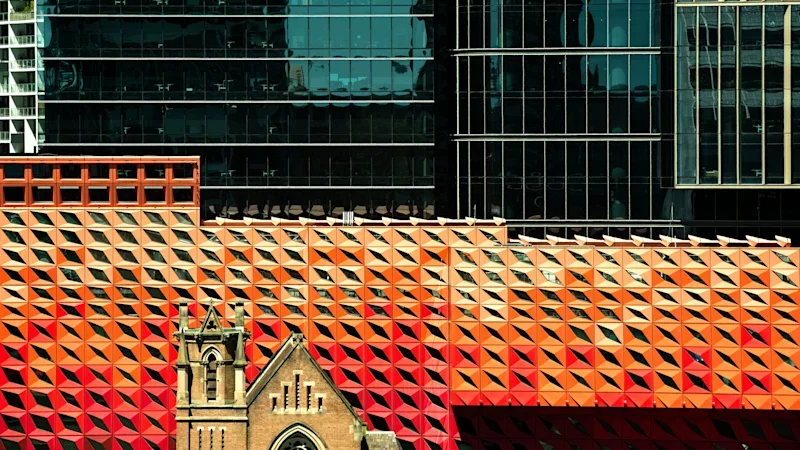
There’s something about the way Italians love their cities that’s always stayed with me. It’s not just affection, it’s reverence. They walk through their piazzas like they’re moving through living history, stone and stories intertwined. They see their cities as something noble. I wanted that for Parramatta.
I’ve lived most of my life here. My mum moved to Parramatta many years ago and I came down to be closer to her. I never left. I saw something special: a city with great bones and even greater potential. I met my wife across a crowded Young Labor meeting in Paul Elliott’s electorate office, back when he was the federal MP. We bought our first home, a fibro place in North Parramatta opposite the All Saints Cemetery, and that’s where we raised our two amazing daughters. Life here has always been real, grounded, a mix of history and possibility.
Back in the 1980s, the city centre was a little rough around the edges. Think Dallas on the cheap – a few curtain-wall office blocks surrounded by older buildings that had seen better days. In those years, Parramatta was going to be the next big thing. And then it stalled. The momentum didn’t quite match the ambition. I often say Parramatta is an overnight success story that’s taken 30 years.
As a teenager, I had the nagging feeling that something was missing. I devoured books on architecture, staring at the elegant geometry of European buildings and wondering why Parramatta didn’t have anything like that. Meanwhile, the Shell Oil refinery still pumped away, its workers living just down the road. Schoolkids would scrap outside the Westfield shopping centre. This was a manufacturing city, tough and practical, not polished.
Parramatta was slowly shifting from a place that made things with its hands to a city built on services and ideas. Pub rock still rattled the walls of War and Peace and Kicks nightclub at Parramatta Leagues, but new sounds were slipping through – Grandmaster Flash, Run-D.M.C., the early pulse of hip-hop making its way from the Bronx to Sydney’s western suburbs. My mates and I all had dog-eared copies of Subway Art (1984) – the graffiti bible – passed around like contraband. On weekends, we’d head to the Roxy cinema to watch Breakdance and Back to the Future, dreaming of other worlds, restless in a city on the verge of becoming something else.
And then came the year 2000. The Olympic torch was making its way through the city. I walked down to Parramatta Park, and as I got closer, I saw people pouring out of their homes, filling the footpaths, joining the crowd. By the time we reached The Crescent, 50,000 people had gathered. It was electric. The air buzzed with pride and energy. In that moment, you could feel something essential about Parramatta – its spirit, its confidence, its sense of community. This wasn’t a city on the sidelines. It was a city stepping into its own.
Today, Parramatta is one of the most multicultural and educated areas of NSW. Young professionals, families, students and entrepreneurs are drawn here by opportunity and affordability. Walk down Church Street and you’ll hear languages from every corner of the globe, smell a dozen cuisines in a single block, and feel the thrum of a city that’s truly global.
There are now places here that didn’t exist back then, places that speak to a different kind of confidence. Take Nick & Nora’s, perched high above the city. It’s one of my favourite vantage points. In the late afternoon, with a cocktail in hand, you can watch the sun set over Parramatta as the city centre rises and heaves below you. The cranes, the towers, the people spilling out onto the streets.
And then there’s Parramatta Square – the city’s “good room” at the front of the house. It’s the place you show off when the guests arrive. A civic space that reflects the city’s aspirations, where people gather, celebrate and connect. It’s a symbol of Parramatta’s maturity and momentum, a statement that this city has finally built a heart worthy of its size and ambition.
On the banks of the river, the rise of the Powerhouse Museum is one of the most significant changes we’ve ever seen. For too long, western Sydney has been shortchanged when it comes to cultural infrastructure. The Powerhouse is a bold gesture, a statement that our stories, our creativity and our communities matter. It’s not just another building. It’s a cultural anchor. It’s going to change the way people see Parramatta, and perhaps even more importantly, the way we see ourselves.
It’s a turning point: a declaration that the cultural life of NSW doesn’t end at the Sydney Harbour Bridge.
Parramatta has never stood still. It’s transformed from a scrappy industrial town to a cultural crossroads, from factory floors to Olympic celebrations, from local subcultures to new skylines. And that’s what I love about it. It’s not perfect, and it never pretended to be. But it’s alive. Restless. A place where stories collide and new chapters are always being written. That’s the city I grew up in – and the one I’ll always believe in.
David Borger is executive director of Business Western Sydney. He is also a former state MP, minister and lord mayor of Parramatta.