(ATTN: RECASTS paras 7-8 to clarify that U.S. text message contained flight altitude detail, as corrected by S. Korean military)
By Kim Seung-yeon
SEOUL, Aug. 3 (Yonhap) -- Last week's mix-up between South Korean and U.S. militaries over a U.S. drone flight occurred due to a communication error at the working level, a South Korean military official said Monday.
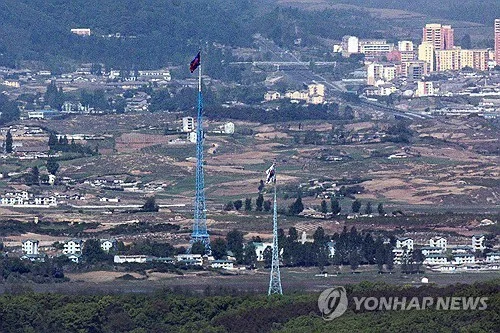
The incident came after South Korean forces detected the U.S. spy drone flying over the inter-Korean border area Thursday, mistaking it for an enemy threat and almost preparing to shoot it down.
The unmanned flying vehicle was with a U.S. Marine Corps taking part in a routine combined exercise with the South Korean Marines at a U.S. training site in Paju, north of Seoul.
The South's military conducted an inspection of the Army's 1st Corp, which has jurisdiction over the firing range.
"The inspection confirmed that the incident occurred due to a communication error between working-level personnel regarding on-site airspace control procedures," an official from the Joint Chiefs of Staff (JCS) told reporters.
"The command reporting system did not function properly, and it was also due to a customary practice of failing to comply with official flight authorization procedures," the JCS official said.
The inspection revealed that a working-level soldier with the 1st Corps had received a text message from the U.S. military notifying the unit of its drone flight plan and firing altitude the day before the exercise.
The U.S. military had also attached an image of its written advance notification, which included the expected flight altitude, suggesting the Korean soldier likely overlooked the detail and failed to report it up the chain of command, assuming the drone would fly within the altitude range governed by the Army Ground Operations Command.
In fact, the drone flew higher than expected, at an altitude that would have required prior notification to and approval from the South Korean Air Force.
Upon spotting the drone, the South Korean military had briefly activated Durumi, a military alert system issued in the event of an enemy drone incursion.
The JCS official's remarks indicated that the customary practice of allowing an advance notice to be put through text messages may have led to such procedural shortcomings from both sides.
By protocol, such flight plans must be informed in advance in writing, before being approved by either the Army or the Air Force, depending on the altitude.
The JCS official said the South's military will work with the U.S. side to improve the bilateral coordination system on airspace control.
"This case has demonstrated the need to strictly comply with regulatory airspace control procedures between the South Korean and U.S. militaries," he said. "We will enhance the coordination framework for airspace control through closer communication with the United States."
elly@yna.co.kr
(END)
- Fans, celebrities support BTS' Grammy boycott
- Police drop underage dating charge against actor Kim Soo-hyun
- S. Korea formally completes development of homegrown KF-21 fighter jet
- S. Korea in talks with U.S. military over air base access following white phosphorus leak: sources
-
New U.S. Ambassador Steel to arrive in S. Korea this week amid pileup of bilateral issues
-
Fans, celebrities support BTS' Grammy boycott
- S. Korea formally completes development of homegrown KF-21 fighter jet
- Police drop underage dating charge against actor Kim Soo-hyun
- S. Korea in talks with U.S. military over air base access following white phosphorus leak: sources
-
(3rd LD) Temperatures soar to record 42.5 C in southeast
-
Navy's ROKS Daejeon awarded 'top gun' honor at RIMPAC
- (3rd LD) Temperatures soar to record 42.5 C in southeast
- Lee arrives in Frankfurt for meeting with members of Korean community
- (LEAD) Seoul stocks open sharply lower after record surge on profit-taking
- (LEAD) Defense ministry launches new counterintelligence unit in overhaul