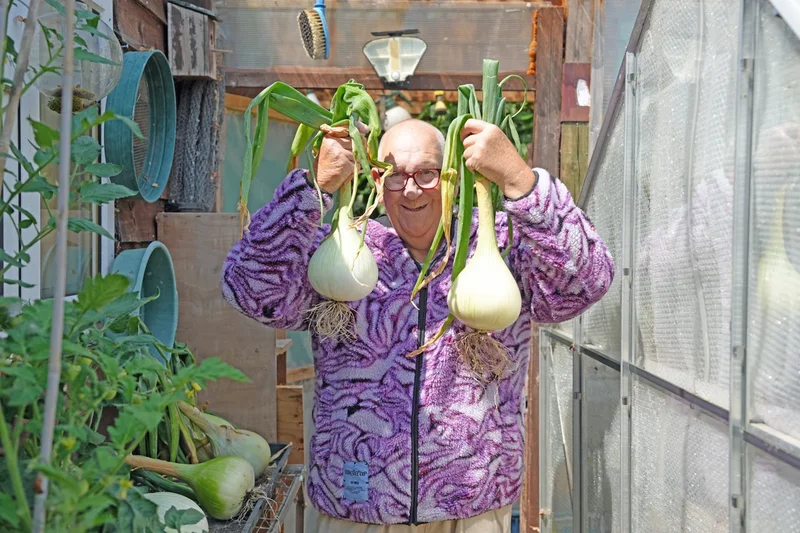
Five years ago during lockdown, keen septuagenarian veg grower Gerald Stratford was persuaded by a friend to have a go at posting bits and pieces about his edibles on social media.
He wasn’t familiar with online communities, so his nephew helped him get to grips with it.
Less than six months later, a post the former sports club caretaker shared about the potatoes he was harvesting, with photos taken on his phone by his partner Elizabeth, went viral.
“I gave Elizabeth my phone, she took a couple of photographs of me just harvesting these potatoes and I put them on Twitter (now X), with a caption, ‘My first early ‘Rocket’, well pleased.’”
“’Rocket’ is the variety,” explains Stratford, now 77 and a great grandfather.
“The phone started pinging, pinging, pinging, and it wouldn’t stop. I’m not the world’s best when it comes to computers. I didn’t know how to silence or mute, so I hid the phone in the bedroom and about four hours later it was still pinging.
“In panic I phoned my nephew – he came back a few minutes later and said, ‘Gerald, you’ve gone viral with your spuds.’ I’d gone from 96 (followers) to 9,000. It was so quick, and it’s been a juggernaut ride since.”
He now has more than 714,000 followers over social media, has had to employ an agent and is always busy with TV (he’s been on Gardeners’ World) and other media, or social media projects, has appeared in British Vogue, while Gucci and Alexander McQueen have featured him in campaigns. His TikTok bio describes him as ‘heavy into big veg’.
With three children, five grandchildren and three great grandchildren, the celebrated veg king and author is keen to make sure that future generations are encouraged to grow their own and has partnered with HelloFresh to launch The Curious Kitchen, a free immersive family experience running until August 30 at the Natural History Museum in London to spark children’s curiosity about the journey from seed to plate.
The experience invites families to harvest ingredients, discover how everyday foods grow and explore where the food on their plates really comes from.
His garden in the Cotswolds is, he says, about the size of one-and-a-half tennis courts, where he has installed two greenhouses, a workshop, a lawn, a tree giving plenty of shade and a series of raised beds where he grows onions, chillies, sweet peppers, tomatoes, potatoes, courgettes, marrows, pumpkins, squashes, parsnips and other edibles.
His own family were keen gardeners, but he recognises the difficulties faced in engaging children in gardening in the 21st century.
“It’s no good pointing a finger at a blackboard in a school, saying ‘This is how you do it’. A youngster needs action. Just having a go is worth 1,000 reference books.”
Raised beds which children can walk around are ideal for young beginners, he says, as are the following crops:
1. Radish
Spicy radishes may be a bit hot for the young palate, but there are many varieties which are milder, such as ‘Cherry Belle’, or the deep purple Radish ‘Bacchus’, he suggests.
2. Potato
Youngsters could even now be planting out seed potatoes which should be ready for Christmas, says Stratford.
“Just get a standard sized bucket, put some holes in the bottom for drainage and fill it up with compost. Put one seed potato in that compost and within 90 days you could have enough potatoes to feed Mum and Dad and you and your sister for a couple of days,” he says.
You’ll need to find a frost-free patch to protect the new potatoes at the start of winter, covering the crop with horticultural fleece if frost is forecast or putting them in a sheltered, south-facing position during the cooler months, he advises. He recommends a second early variety called ‘Nicola’, which is blight resistant.
3. Tomato
Some might see this as a tricky crop for young beginners, but Stratford insists: “There are varieties now where you can plant the tomato and you haven’t got to bother with pinching out sideshoots and looking after it. Just feed it and let it grow.”
He recommends the varieties ‘Black Opal’ with its sweet flavour, and the popular ‘Sungold’. Plant them in a bucket the same size as your potatoes and put them in the sun, making sure they don’t go dry, he advises.
“You can sow seeds, but if you go to a garden centre in March, April or May and buy a tomato plant, the hard work of germinating the seed is done for them.”
It can be planted out after all danger of frost has passed in June, but you may need to remind the children to water the plant and give them gentle encouragement rather than making it a chore, he says.
4. Cucumber
“Buy them from garden centres as small plants. There are lots of varieties of cucumber which only grow to the size of my pen. One I grow is ‘Mini Munch’, which is fabulous for packed lunches for children because it can be picked, washed and can go into the lunchbox and the children can eat all of it.”
Plant them about the same time as tomatoes, and they will either climb a frame or spread out over the ground or trail over the raised bed, he explains.
“If you planted a plant in June, you’d be harvesting now,” he says.
5. Carrot
They are among children’s favourite vegetables – colourful and crunchy when raw, sweet when cooked – and the secret is not sowing the seeds too close together, says Stratford.
“They take a little more time, but if you have a raised bed for your child, sow a few seeds. I’m a firm believer in planting individual seeds because so may people make a drill and sprinkle a packet of seeds along it – and there are just too many seeds. You’ll get lots of foliage and no bottom.
“If you plant one individually there’s a better chance you’re going to get a good fruit from it. If you plant 12 carrot seeds in a bucket, it will give you 12 good carrots.”
The fast-growing ‘Early Nantes’ could be a good bet, or an unusual round one called ‘Paris Market’, he suggests.