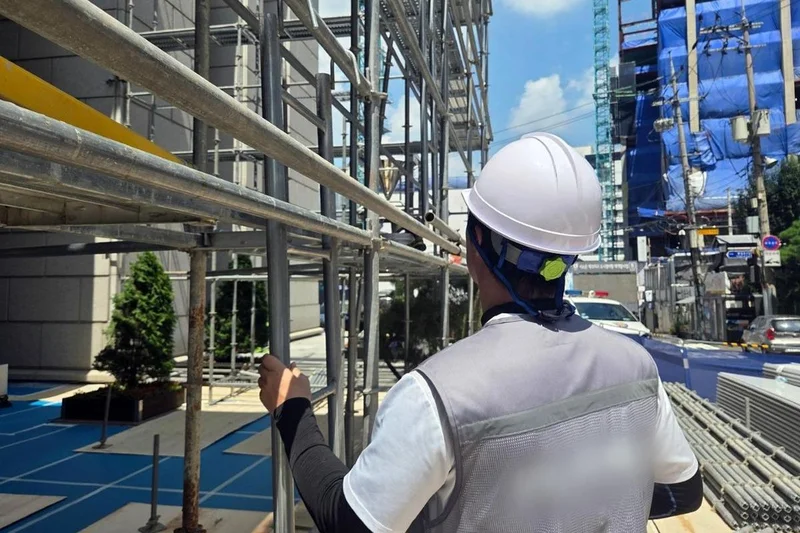
When a heat warning was issued across Seoul on Sunday, 50-year-old Lee stood gasping for air at a construction site in central Seoul. His attempt to cover his arms and neck with sun-protective sleeves proved futile against the scorching heat, and his work clothes were drenched in sweat.
“It’s literally raining sweat here,” Lee said. “I’m soaked through to my underwear. But I’m dreading next week, which they say is going to be even worse.”
Temperatures in Seoul peaked at 35 degrees Celsius that day. For construction workers surrounded by sun-baked concrete walls and steel frames, conditions were even more unbearable. A thermometer placed on an exterior wall read 39 degrees.
Nearby construction sites in central Seoul offered similar scenes. Exhausted workers sat in the shade with bottles of ice water in their hands, but even those did little to fend off the heat.
“We take a 10-minute break every hour, but there isn’t even a fan here, so all we can do is sit in the shade,” said Kim, 41. “I sweat so much that my clothes rub my skin raw wherever they touch.”
But workers say asking for sufficient breaks is not an option when they are working under tight deadlines.
“If you say you’re feeling unwell and need a break, what you’ll probably hear is, ‘You don’t have to come back tomorrow,’” said a construction worker at a site in Gwacheon. “That’s why everyone just keeps their head down and works.”
**Delivery workers also face growing risk of heat-related illness **
Workers who spend much of their time on the road are also suffering in the heat. On the same day, Yoon, a 40-year-old parcel delivery driver, repeatedly wiped the sweat from his forehead as he unloaded some 200 packages from his delivery vehicle at an apartment complex in Seoul’s Mapo District.
“In summer, the temperature inside the cargo area easily exceeds 50 degrees Celsius. Just loading and unloading packages is an ordeal even before the actual deliveries begin,” he said.
“But I can’t stop working. Failing to meet the required quota results in a penalty, while taking a day off means a cut in pay.”
Similarily, food delivery riders ride across scorching asphalt while taking the heat. For them, summer is the most important yet dicey part of the year, because delivery orders surge in hot weather, but so do the risks of accidents and heat-related illness.
Shin, a 33-year-old delivery rider in Seoul’s Seodaemun District, had covered nearly his entire body with sun-protective clothing and fitted a sunshade over his motorcycle. But his eyes and the bridge of his nose, the only parts of his body left exposed, were beaded with sweat.
Shin said the only break he could manage was to take off his helmet and sip an iced coffee that had long since melted.
“It is suffocating to feel heat rising from the engine beneath me as I wait for the light to turn green,” he said.
Delivery riders receive an additional 500 won per delivery in weather like this, but the extra pay is not worth risking their lives for, Shin said.
As with construction workers, chafing caused by sitting on a motorcycle for hours in sweat-soaked clothes is one of the biggest difficulties delivery riders face. Lee Sae, 39, who makes deliveries in northern Seoul, said slathering protective skin care products over his body before leaving for work has become part of his daily routine.
Kim Yo-el, another rider working in Gyeonggi Province, said he occasionally feels the world spinning when he gets off his motorcycle during the day.
“But all I can do is find some shade and rest briefly by the roadside or on my motorcycle,” he said.
**Calls grow to guarantee workers’ right to rest **
Equally suffering from the heat are indoor parking lot staff, who have to endure the heat from car engines and sauna-like thick warm air.
"Internal feels-like temperature goes as far as 50 degrees celsius. Lacking ventilitation makes the experience feel like being inside a sauna," said Lee, 55, who manages the parking lot and collects shopping carts at a large supermarket in Gwangmyeong, Gyeonggi Province. He said he works eight hours a day in the parking lot, walking as many as 30,000 steps each day.
Experts agree that measures to protect these workers are urgently needed.
“Day laborers at construction sites have no choice but to endure the heat because they fear they will be fired the moment they say it is too hot to work,” said Park Se-jung, head of occupational safety and health at the Korean Construction Workers’ Union. “The right to take breaks must be guaranteed by law so that workers can rest without worrying about losing wages.”
Song Ki-sun, head of the Nationwide Delivery Riders Association, also echoed a stronger safety measures for riders.
“There are rest shelters operated by local governments, but they are often difficult to access because they are located far from areas with high delivery demand or inside subway stations,” he said. “What riders need are rest areas along their delivery routes, even if they are small.”
This article from the Hankook Ilbo, the sister publication of The Korea Times, is translated by a generative AI system and edited by The Korea Times.