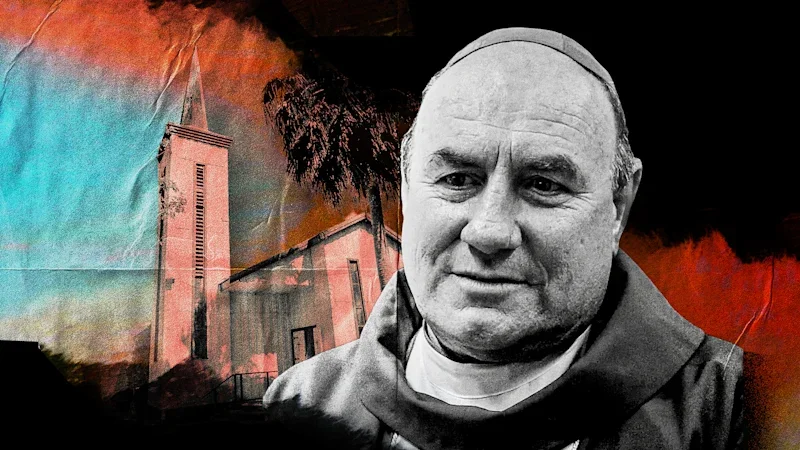
The Bishop of Geraldton has told a court the allegations against former Broome bishop Christopher Saunders are inconsistent with the standards expected of Catholic clergy, as he continues to fight accusations he abused young Aboriginal men while working for the church.
Michael Henry Morrissey, who is a serving bishop covering a region south of Leeman up to Port Hedland, was called to provide evidence in the ongoing trial of the former Broome Bishop, who has been accused of indecently assaulting three young Aboriginal men between 2008 and 2017.
In extraordinary testimony requiring him to speak openly about the conduct expected from those serving in the Catholic Church, Morrissey said he and Saunders had been students together in an Adelaide seminary at the same time before they entered the priesthood.
“It’s more than a job, it’s an entire way of life,” he said.
Morrissey spoke about the vow of celibacy they both took when embarking on the journey to priesthood, and prosecutor Adam Ebell used a document called “Integrity in Ministry” to point to the expectations the community has for priests and the clergy.
The document had been printed after a number of people came forward to make complaints about the Catholic Church, and it acted as a code of conduct for the clergy. It outlined how to maintain appropriate behaviour and boundaries.
Morrissey was taken to different passages of the document to help establish the code of conduct Saunders should have operated by.
“Because of the trust they are given and the visibility of their witness and leadership, they are conscious of the unique power and responsibility they have in pastoral relationship,” it reads.
Ebell said the document, printed in 2004, was endorsed by the Australian Bishops Conference - which Saunders was a member of at the time.
However, defence lawyer Tony Hager emphasised the document was not a “one-size-fits-all” code, and priests may not strictly abide by the code of conduct to help reach parishioners in different walks of life.
Hager previously argued Saunders had simply taken up unorthodox methods of pastoral care as it was more helpful to people living in regional areas.
During questioning, Morrissey agreed less formal settings could help some parishioners, and agreed he had occasionally helped churchgoers out “over a beer”.
However, he said there were still strict boundaries in place, and he would always attempt to see them in a more formal capacity.
“Would you ever provide instance in that context one-on-one to someone with alcohol?” Ebell asked.
“No,” Morrissey said.
“Would you ever engage in pastoral care with someone who appeared to be intoxicated?” Ebell asked.
“No.”
Also on Monday, a woman employed as Saunders’ former secretary said she often oversaw bills for mobile phones and alcohol purchases exceeding $3000 when she was responsible for reconciling his credit cards.
Cherrille Quilty worked for the bishop for less than a year, and said the majority of expenses were related to drugs and alcohol.
“It was excessive,” she said.
Quilty also told the court she was often sent out to give petty cash to young Aboriginal men - ranging from $50 to $200 - and she needed to inform the bishop “immediately” when the money had been spent. This was an allegation repeated by another former secretary during evidence earlier on Monday, when she said she was frequently sent to the local prison to give men behind bars money.
Quilty said she had also been sent out frequently to buy mobile phones and SIM cards, and the bishop would hand them out as he saw fit. She gave evidence she bought about 15 in tenure, and said she only saw one given over to a young Aboriginal man.
“One [phone] wouldn’t work and it got thrown back at me- ‘make this work’ [he said],” she said.
Defence lawyer Tony Hager has previously warned the jury about making judgments around the bishop’s interactions with his staff, saying he was “not on trial for being a good boss”.