- See more Daily Mail on Google - save us as a Preferred Source
A rail firm has launched a new clampdown on fare dodgers travelling to London more cheaply thanks to a ticketing loophole.
South Western Railways, serving stations in and out of London for Surrey, Hampshire and Berkshire, found 95 per cent of barcode tickets bought between Vauxhall and London Waterloo were being used fraudulently.
The trick has been described as 'short faring' or 'short ticketing' - and involves commuters purchasing a digital ticket for only the final part of their trip, allowing them to scan out of their destination station.
Yet there have been some already caught out and made to pay back tens of thousands of pounds - while the overall risked cost has been put at £1million.
SWR said today the company had cut fare evasion by 67 per cent since 2017.
Since the latest operation was launched by SWR in June, revenue protection teams have identified 153 short-faring offences - significantly higher than just the seven cases during the same period last year.
Both SWR and Network Rail Wessex have been targeting so-called 'short faring' offenders and stepping up operations in recent weeks.
SWR says its 'data-led' analysis has helped curb fare evasion by 11 per cent over the past year.
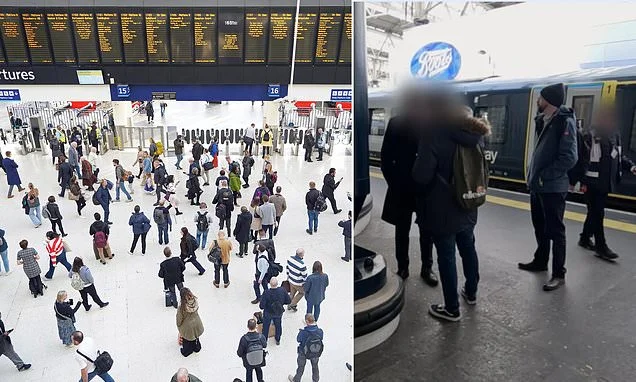
A passenger is spoken to by investigators at London Waterloo station after only buying a ticket from Vauxhall, as he is finally caught after evading nearly £20,000 in ticket costs
The man was intercepted by investigators at London Waterloo railway station (file picture)
While most customers pay the correct fare - yet about an annual 6.5million journeys are made without a valid ticket, costing SWR close to £40million per year.
The Rail Delivery Group, representing train operators, says the cost to the industry annually comes to £400million.
SWR says the recent operations have led to one third of former fare dodgers now paying the correct prices, saving the company an estimated £45,000 in four weeks.
Yet offenders have been found to be altering their tactics, with some trying to buy barcode tickets from alternative SWR London stations instead - with one seeing an 89 per cent rise compared to last year.
Examples highlighted by investigators include one customer who owed more than £11,000 after repeatedly travelling from Hampshire to London without purchasing the correct ticket across four years.
Footage last year revealed the moment a rail fare dodger was finally caught by investigators after evading nearly £20,000 in ticket costs in one of Britain's biggest cases of its kind.
The offender had been paying for only a small part of his full journey from Surrey to London Waterloo, when he bought an e-ticket only from Vauxhall to Waterloo.
While this made his ticket much cheaper, the passenger was also using a 16-17 Saver Railcard to which he was not entitled, for a half-price discount which further reduced the price.
A passenger is caught without a ticket by revenue protection officers at the gates at Waterloo
A South Western Railway revenue protection team identified him through CCTV and then eventually caught him in the act at Waterloo station to pursue a prosecution, after finding he had been evading an average of £35 each day going back to 2022.
The man is one of many 'short farers' seen on the network and had bought a ticket from Vauxhall, which is known as a notorious fare dodging hotspot for such commuters.
SWR passengers often travel into London from much further afield but buy an e-ticket from a stop near Waterloo such as Vauxhall for a significantly cheaper fare, so they can try to go through the barriers without issue and avoid paying for the full journey.
The man also allegedly tried doing 'doughnut tickets', which is where you buy a short ticket for the first part of the journey, to scan the QR code on your entry barrier - and then another short ticket for the last section, to scan out at your destination station.
This can lead to a cheaper fare because you do not pay for the lengthier middle section of the trip - meaning there is a hole in the journey, hence the 'doughnut'.
But you still have a valid ticket to enter at a starting point and exit at the destination and can therefore try to go undetected if not caught out by an inspector.
The latest figures come as SWR’s revenue protection team features in a new series of Channel 5’s behind-the-scenes documentary Fare Dodgers: At War with the Law, due to be broadcast on Monday at 9pm while also being available on the 5 app.
A revenue protection officer confronts a man at Waterloo who cannot produce a railcard
Matthew Winnie, South Western Railway and Network Rail Wessex chief customer and commercial officer, said: 'The overwhelming majority of our customers pay the correct fare.
'However, there's growing evidence of some people deliberately exploiting the system - a criminal offence that deprives the railway of hundreds of millions of pounds each year.
'We know our customers don't like seeing blatant fare evasion, whether that's tailgating through ticket gates or simply travelling without a ticket.
'But we're also tackling the less visible forms of fare fraud, including short-faring and misuse of e-tickets.
'Every fare avoided is money that can't be reinvested into improving the railway and delivering the best possible service.
'We have a responsibility to protect revenue and our specially trained teams work around the clock to check tickets on stations and trains to improve fairness for the millions of customers who do the right thing.'
The new Channel 5 programme also features the moment an Elizabeth Line fare dodger was finally caught by investigators after racking up more than £2,200 in unpaid journeys in one year.
The man was tracked down at Whitechapel station after using an unauthorised bank card to get around the Transport for London network for free.
Another fare dodger is confronted by officers at Preston Road station in north-west London
The fraud team had difficulty finding the passenger because of his uneven travel pattern, given he used the station at different times each day.
They did however know he travelled to Tottenham Court Road, Southall and Swiss Cottage, and would often pass through Whitechapel in the evening.
A group of three investigators spent one night at the station without seeing the man, before spotting him on a second night while waiting in the cold for four hours.
The moment they intercepted him is shown in the first episode of a new series of 'Fare Dodgers: At War with the Law' which airs on Channel 5 tonight at 9pm.
But the documentary also reveals later on that the passenger pleaded guilty at court, where he was fined only £40 plus £100 compensation and £100 costs.
The programme explains how the man was using a card which is one of more than 10,000 frozen, stolen or blocked cards that are being tracked by TfL investigators.
They use a system called the Irregular Travel Analysis Platform (Itap), which checks ticket taps, travel times and digital footprints on Oyster and contactless cards.
It comes after TfL revealed in June that the number of passengers handed £100 penalty fares across the network had surged over the past year.
An Elizabeth Line fare dodger (wearing brown jacket) is finally caught at Whitechapel station in east London, in new scenes shown in Monday's new Channel 5 documentary
TfL inspector Lisa speaks to the man who admits that he has been avoiding paying for fares
Penalty fares are £100, reduced to £50 if paid within 21 days. Some 69,001 of them were issued in the year to March, up 9 per cent from the previous 12 months.
TfL claimed its ongoing crackdown on fare dodging had also seen a further 21,533 cases result in reports for possible prosecution, up 19 per cent year-on-year.
Around 400,000 journeys on a normal weekday are evaded across the network – which costs TfL an estimated £200million a year in income.
The Department for Transport said last month that new ticket barriers will be installed at railway stations across England in a crackdown on fare evasion.
A £33.4million investment will fund taller gates to prevent passengers jumping over them, and more standard waist-high gates.
Earlier this year a wealthy HSBC banker who dodged £5,900 in train fares using a 'doughnutting' ticket scam was banned from using his local railway.
Joseph Molloy used what prosecutors described as a 'sophisticated' ticketing ruse to slash thousands of pounds off the cost of commuting from his £2million home into London.
He bought tickets covering the start and end of his route, but not the stations in between, in the 'doughnutting' tactic exploiting ticket barriers.
Joseph Molloy used what prosecutors described as a 'sophisticated' ticketing ruse to slash thousands of pounds off the cost of commuting from his £2million home into London
Molloy carried out the scam at least 740 times, saving £5,911 over 11 months on Southeastern services, Inner London Crown Court heard (stock image)
Molloy carried out the scam at least 740 times, saving £5,911 over 11 months on Southeastern services, Inner London Crown Court heard.
The 53-year-old travelled from near his £2million home in Orpington to London Bridge before continuing to his Canary Wharf office.
He admitted fraud by false representation and was handed 10 months' imprisonment, suspended for 18 months, ordered to complete 80 hours of unpaid work, banned from Southeastern for a year and told to pay £5,000 compensation.
Recorder Alexander Stein said Molloy was 'a man of some financial means' who could afford his fares, branding the offending 'persistent and serious' and said its sophistication merited jail, but suspended the sentence due to strong mitigation.