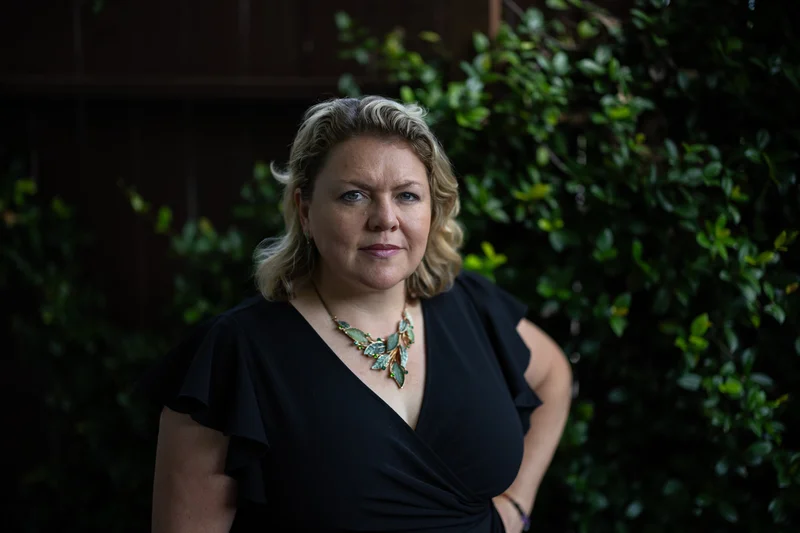
Víctor Salgado has relived the immigration raid in which his older brother Lorenzo Salgado Araujo died, and he has done so before various authorities, from the Texas Rangers to the Harris County District Attorney’s Office, the Department of Homeland Security and the FBI. Almost every time he has been in the presence of his lawyer, Ruby L. Powers. The latter says that Víctor has been strong, that he wants the story known and justice served. For that reason, cautiously, she unveiled in an interview with EL PAÍS what she has heard from her client.
At 6.30 am on July 7, Lorenzo Salgado Araujo picked up his last passenger, his own brother Víctor, 44. Seated in the rear of the white van were José Trinidad Rojas, 51, and Daniel Tirado Pantoja, 43. All were heading to work at a construction site. They were driving toward Interstate 10 when suspicious vehicles began a “dangerous” pursuit on Wayside Avenue and Canal Street in Houston.
One of the cars “got too close, almost hit them. Lorenzo said that person was crazy, asked what they were doing and then tried to evade the driver. They weren’t sure who they were. There were no markings, logos, nothing,” the lawyer recounted from her office in the Texas city. The chase ended when Lorenzo Salgado pulled the van to the side on Canal Street.
“A person quickly approached the vehicle on the passenger side, shouted ‘stop’ at them and soon after, almost simultaneously, fired through the open window. The shot hit Lorenzo in the lower back. Víctor was in shock. Both were in shock,” Powers said.
Víctor Salgado thought he had been wounded and began looking around trying to understand what was happening: “That’s when he realized Lorenzo was bleeding, holding his hand over his wound and screaming in pain. He said: ‘They killed me’ or ‘They’re killing me.’ At the same time, the person opened the door and dragged Víctor out of the vehicle. At that moment he definitively realized it was ICE, because he saw the badge on the collar.”
Immigration and Customs Enforcement (ICE) agents knelt Víctor down on the asphalt and he felt pain when he fell onto the pavement stones. They handcuffed him with his hands behind his back. He recalls that one of the agents put his hands into the pockets of his shorts and, upon seeing his ID, shouted “Mexicans!”.
Hours later, the Department of Homeland Security would say in a statement that the agents who pursued these four migrants that Tuesday morning were looking for other people (media reported they were from Guatemala) and that the shooter acted in self-defense because Lorenzo tried to ram the officers. Víctor said there were never ICE cars or officers in front of the van; they all appeared from behind.
On the driver’s side, Lorenzo was handcuffed with his hands behind him and forced onto the ground despite the bleeding. Desperate, with the little English he could manage, Powers says Víctor begged: “Call the police to help my brother!”
“He didn’t have access to his phone, he was handcuffed, watching and hearing his brother scream in pain. He told me it was about 20 or 30 minutes before the ambulance arrived, while he and the other men were moved from one ICE vehicle to another,” the lawyer says. “By that time, he believes Lorenzo was already unconscious, in a state where he no longer moved.”
When the ambulance took Lorenzo, his three companions were taken to the ICE detention center in Montgomery.
That day, Salgado’s blood stained Canal Street for hours, until a torrential downpour washed it away at night and swept away the first bouquet of flowers two young people had left.
This testimony makes Víctor—and the other two van passengers—material witnesses to the operation and to Lorenzo’s death. Pressed by members of Congress and an outraged community, the Department of Homeland Security had to admit days later that there was no evidence of the events because none of the agents involved wore body or vehicle cameras. At a press conference days later, Democratic Congresswoman Sylvia García said that on July 7 the federal agency reassigned the ICE officer who fired the shot to another city in the country.
“He was his brother and his best friend”
Powers says Víctor always carries an air of sadness about him. As she gets to know him, she notes that Lorenzo “was his brother, his best friend and like a father.” “He lost all of that in a single moment,” his lawyer says.
The week of the operation, Víctor was in shock. The second week was one of suffering, knowing his family would come from Mexico and from other U.S. cities to say goodbye to Lorenzo together while he remained in detention.
With support from the Mexican Consulate in Houston, the lawyer secured a moment for Víctor with his brother on Friday, July 17, at the funeral home where the formal wake would be held on Saturday. He was supervised by an employee of the funeral home and ICE officials. Despite the presence, Powers says the moment was special for Víctor: “He spoke to his brother. He hugged him.” She believes the real grieving will come when he can be free with his family.
“I am very grateful he could have that moment. Still, he committed no crime and yet he has been detained for three weeks, separated from his friends, trying to understand why he lost one of the most important people in his life,” the lawyer notes.
On Saturday, July 18, the family gathered for a private wake and burial. Powers says she attended not only to accompany the Salgado family, but so she could tell Víctor about the dancing horses with which they saw his brother off, as is done in Mexico; he was pleased and spoke about how much Lorenzo loved horses and how much they enjoyed them as children: “I think that gave him a bit of peace.”
The goal: freedom
—Why is Víctor Salgado still detained?
—That is the million-dollar question. When ICE found him on July 7 without a more permanent status, they detained him and placed him in immigration proceedings.
—Yes, you can call it that.
Freedom for Víctor is Powers’s objective. So far, only one of the three material witnesses has been released from the Montgomery detention center, José Trinidad Rojas. One of the lawyers on the team working on his case, Gabriela Rivero, told EL PAÍS by phone that he was released on Wednesday through a habeas corpus petition and was freed with an electronic ankle monitor. His brief media appearances align with the account the lawyer for Víctor recited to this newspaper.
Powers has opened several avenues for Víctor to leave the Montgomery center and receive immigration protection: a habeas corpus petition before a district judge; a request for parole because he has a pending U Visa application for being a witness to his brother’s killing, and a prior decision says U Visa applicants should not be detained or deported; and a motion to terminate the case before immigration court, because he already has pending petitions and cannot be deported until they are resolved.
For the lawyer, operations like the one in which Lorenzo died make immigrants stay locked in their homes: “They are living as if in another pandemic.” “We need to stop ICE brutality; we cannot continue down this path and that shows in the public outcry. People don’t want this to keep happening,” she says.
Two of Lorenzo Salgado’s children, Ronaldo and Lorenzo Jr., announced Thursday on social media that the banners and other items that had been on the sidewalk for more than 20 days at the street where their father died were removed by them. Ronaldo said they want to place them somewhere they will be preserved “so future generations know my dad and the facts behind his unjust death.”