Minnesota Lynx coach Cheryl Reeve was permitted to wear a "Trans kids belong" shirt on the sideline during Sunday’s game against the Indiana Fever.
Fans throughout Target Center held signs supporting their favorite WNBA players.
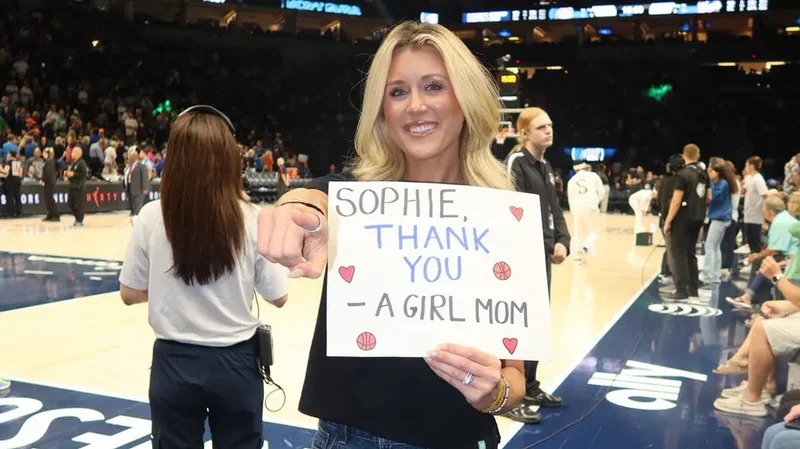
But when Riley Gaines displayed a small sign reading, "Sophie, thank you — a girl mom," an arena staffer tried to make her put it down.
According to Gaines, the staffer told her the problem was that the sign contained Fever guard Sophie Cunningham’s name.
"I checked all the sign policies before I went in there," Gaines told OutKick. "I made sure it was like 11 by 17. That’s the sign size you could have. So, I got a ruler out. You better believe I was measuring it."
Gaines attended Sunday’s Fever-Lynx game to support Cunningham, who has faced intense criticism since publicly stating that women’s sports should be reserved for women.
Cunningham was loudly booed throughout Indiana’s 108-100 loss in Minneapolis, while Reeve used the game to make her opposing position clear.
ESPN’s broadcast highlighted Reeve’s shirt and encouraged viewers to listen to the Lynx coach’s previous comments on transgender athletes.
Meanwhile, a staffer inside the arena apparently decided Gaines’ simple message of support for Cunningham needed to disappear.
Arena staffer confronts Gaines over sign
Gaines arrived at Target Center around 11:40 a.m. local time, approximately 20 minutes before tipoff.
She had initially planned to attend a rally outside the arena but remained at her hotel after her personal security team advised her that the situation had become too hostile.
Gaines was not present for a confrontation outside that was was described by some social media users as an "assault." Video reviewed by OutKick showed one person ripping a T-shirt from another person’s hands, but did not appear to show anyone being struck or injured.
As Gaines entered the arena, however, she said a protester stationed near the entrance put a bullhorn near her face, sounded it and shouted at her.
Once inside, the response was mixed.
Gaines said some people directed insults and hostile looks toward her, but many others requested photographs, thanked her, offered fist bumps and quietly expressed support for her position. She said some people even brought copies of Gaines' book into the arena and asked her to sign them.
Around halftime, Gaines said families and young girls formed something resembling a photo line near her seat.
"There were so many people stopping me, asking me for photos, ‘Thank you for doing what you’re doing,’ winks and whispers and fist bumps, people buying me drinks," Gaines said.
At some point during the game, she held up her sign.
"I see an arena staffer, someone who’s on the court wearing the all-black official clothing, who points at me and mouths something," Gaines recalled. "I can’t hear him because he’s so far away, but he appeared to say, ‘Put your sign down.’"
At first, Gaines wasn’t sure the staffer was addressing her. Numerous other people in the arena were holding signs, including signs containing the names of players.
The staffer eventually approached her and repeated the instruction.
"He comes over and he says, ‘You have to take your sign down.’ I’m like, ‘No, I don’t. I checked all the sign policies before I went in there,’" Gaines said.
Gaines asked why her sign was prohibited.
"He said, ‘Well, because it has her name on it. It has Sophie’s name on it, so you can’t have that,’" Gaines recalled.
The explanation immediately drew objections from other spectators in Gaines’ section.
"My whole section at that point, they were outraged," Gaines said. "They were like, ‘You can’t tell her she can’t have that. There’s a hundred signs right here with people’s names on it. What do you mean she can’t have it?’"
Gaines refused to lower the sign.
"What are you going to do, kick me out?" Gaines recalled thinking. "Go for it."
She said the staffer eventually returned after the game and apologized. Gaines interpreted the apology as a possible indication that he had been directed by someone else to confront her, though she did not know who may have issued that instruction.
Target Center’s policy generally allows small signs
Target Center’s published poster and signage policy does not prohibit signs merely because they contain a player’s name.
The policy states:
"As a general rule, posters/signage under 11 x 17 inches are allowed in Target Center, pending individual tour/promoter approval. All posters/signage must be handheld, may not be mounted on sticks or poles, may not be lit or constructed using lighting elements, may not contain offensive language or graphics and may not prevent other guests from seeing the stage/event."
The venue reserves the right to confiscate signs it considers inappropriate and says the policy may change based on requirements for a particular event. But the policy does not state that a sign is prohibited simply because it includes a player’s name.
Gaines said her sign was handheld, smaller than the maximum dimensions and contained no offensive language or graphics. She also said she made certain it complied with the published size restriction before bringing it to the game.
More importantly, Gaines said the staffer didn't tell her that the sign was oversized, offensive, obstructing another fan’s view or violating an event-specific restriction.
He allegedly told her she could not display it because it contained Cunningham’s name.
OutKick contacted the Minnesota Lynx and asked whether an event-specific signage policy was in place, why Gaines was instructed to lower her sign, whether any policy prohibited Cunningham’s name and whether the direction originated with the Lynx, Target Center, arena security or the WNBA.
The Lynx did not respond to our email.
Gaines says private response differed from public hostility
Cunningham was booed when she entered the game and frequently when she touched the basketball.
But Gaines said the public hostility didn't match many of the private interactions she had with fans inside Target Center and said she believes many people inside the arena agreed with Cunningham but didn't feel comfortable expressing that support openly.
"I absolutely think she had more fans there, or people who at least support her sentiment, than are willing to admit," Gaines said.
Cunningham eventually made a 3-pointer late in the third quarter and received a noticeable cheer despite playing for the visiting team.
Gaines viewed that reaction as another sign that the loudest people in the arena didn't necessarily represent everyone in attendance.
Cunningham meets Gaines after game
After the game ended, Cunningham came out to meet Gaines near the tunnel.
Most of the players had already left the court, but Gaines said several young girls remained nearby calling Cunningham’s name.
Cunningham spent approximately 15 minutes with Gaines and posed for a photograph while holding the same sign the arena staffer had attempted to make Gaines lower.
Gaines described Cunningham as completely unshaken by the hostile reception.
According to Gaines, Cunningham said she knew her position was right and remained confident that she could defend it intellectually and morally. Because of that confidence, Cunningham said the reaction did not bother her.
While the loudest voices inside Target Center spent the afternoon condemning Cunningham, young girls waited near the tunnel chanting her name. Fans quietly approached Gaines to thank her. And Cunningham came back out after the loss to greet them.
The arena allowed Reeve to promote her message from the sideline. Fans were free to boo Cunningham every time she touched the ball. But when Gaines held up a small sign thanking Cunningham, a staffer told her it had to come down because it contained the player’s name.
Gaines refused.
By the end of the afternoon, Cunningham was holding the sign herself.