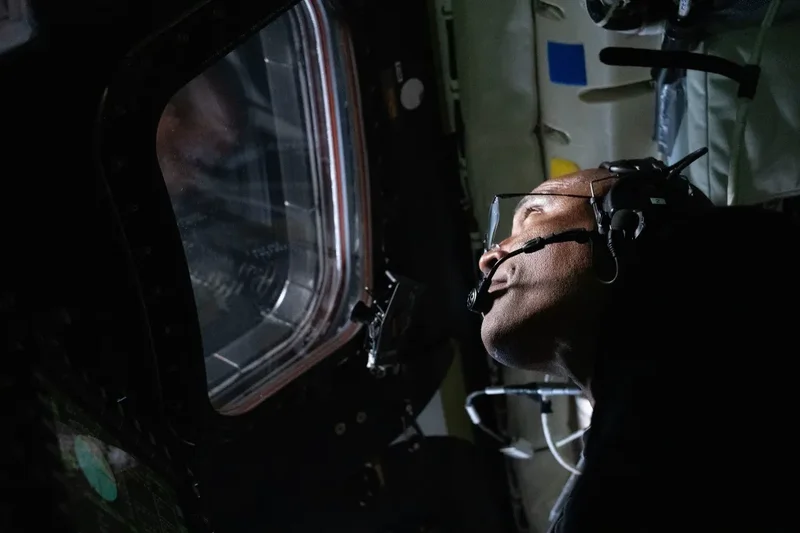
WASHINGTON — The pilot of the Artemis 2 mission says NASA’s return to the moon should start with human landings in less challenging equatorial regions rather than go directly to the south pole.
Speaking at the NASA Exploration Science Forum at Ames Research Center on July 21, Victor Glover made a plea to NASA Administrator Jared Isaacman to reconsider plans to have the first Artemis crewed landings go to the lunar south pole because of the difficulties of accessing that region.
Asked in an extended discussion with conference attendees about his preferred landing site for the first crewed landing of the Artemis campaign, Glover emphasized the importance of “familiar” locations like those closer to the lunar equator used by the Apollo missions more than half a century ago.
“If you want to go fast, go familiar,” he said. “We want to get to the surface. If we want to land soon, familiar, daylight, equator.”
One reason he preferred equatorial regions is the ease of getting there and back. NASA’s plans for landings at the lunar south pole had involved the use of a near-rectilinear halo orbit, a highly elliptical orbit that would also have been used by the Gateway. However, that orbit would have required astronauts to spend up to a week on the lunar surface before Orion or the Gateway would be in position for them to depart.
Glover cited a hypothetical case of an astronaut who suffers a burst appendix during an Artemis landing mission. “If it ruptures on landing day, you’re stuck for a week. That’s a big deal to me, and I don’t like that plan,” he said. “The equator gives me opportunity to save that person.”
Polar landing sites pose other challenges. The sun is low on the horizon there, casting long shadows that can hamper landings and also make it difficult to walk or drive in the direction of the sun.
“You think driving home into the sunset is challenging? Imagine being on another celestial body and going from this room to low sun angle in a suit,” he said.
He advocated for a more stepwise approach that would start with landings closer to the equator to build up experience toward polar landings, comparing it to test flight programs that incrementally expand the envelope in speed and altitude. “You have a process for accepting risk more and more, but also retiring it right,” he said.
“I think we need to be realistic and work our way to the south pole, and maybe not try to go there first,” he said.
While the lunar south pole has been the target of Artemis crewed missions for several years, in large part because of the potential for ice deposits in permanently shadowed craters, Glover’s comments are not the first time an agency official has suggested that alternative sites closer to the equator could be considered.
“We have opened up the performance specification for the early landing missions in as many ways as we can,” Amit Kshatriya, NASA’s associate administrator, said during a session of the Lunar and Planetary Science Conference in March.
That included different orbits around the moon from which the landing would be staged, as well as other, unspecified constraints, “to make it as agile as possible” and give the landing providers freedom to propose alternative approaches.
“We’re not yet giving up on the south pole, and I don’t think we will,” he added. “We need to challenge ourselves and we need to go to some place we’ve never been.”
NASA has since announced it will no longer pursue the lunar Gateway and will consider other orbits for lunar landings on at least the initial Artemis missions. At the Artemis 3 crew announcement event in June, for example, SpaceX said its revised approach involves its Starship lunar lander docking with Orion in low Earth orbit and then going to the moon, entering a low lunar orbit rather than a near-rectilinear halo orbit.
During a panel discussion at the NASA Exploration Science Forum shortly before Glover spoke, Jacob Bleacher, chief exploration scientist in NASA’s Human Spaceflight Mission Directorate, said the Artemis 4 and 5 missions are still planned for the south polar region of the moon, but added that specific landing locations will depend on the capabilities of the landers.
“We don’t know exactly what the lander capabilities will be as they’re developing, so we’re keeping that trade space open until we have that information in hand and can really narrow down exactly where we’re going,” he said.
Glover said his desire to land first in equatorial regions was just his opinion, and one that had not found an audience within the agency. “That’s just me, and nobody’s asking me those questions,” he said.
“I think the way we’re attacking it is going to have some challenges,” he said later. “So, if Jared listens to this recording, I mean, I had this conversation with your predecessor, and we should talk.”