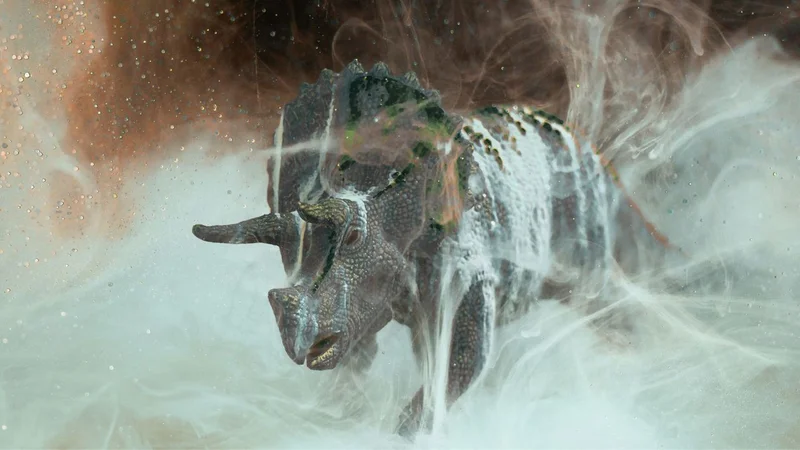
When the famous Chicxulub asteroid struck what is now Mexico's Yucatán Peninsula 66 million years ago, it ended the reign of the nonavian dinosaurs. As ecosystems recovered, small, adaptable mammals rapidly spread into newly vacant niches, evolving new diets, larger bodies and more diverse ways of life until they dominated the land within a few million years.
Now, new evidence suggests that even before the asteroid hit, Earth was already beginning to rot.
A study published May 12 in the journal PNAS found evidence of environmental fungal blooms before and after the Cretaceous-Paleogene (K-Pg) mass extinction event. Looking at microscopic fossils from rocks dating to the K-Pg event in North America, a team of researchers led by Dr. Arturo Casadevall, chair of the Molecular Microbiology and Immunology Department at Johns Hopkins University, identified an earlier fungal bloom dating to roughly 30,000 to 100,000 years before the asteroid hit, during a period of cooling linked to intense volcanic activity in the Deccan Traps in what is now India.
The researchers also found a fungal spike immediately after the Chicxulub impact exactly when dead plants and animals would have littered devastated ecosystems. The finding adds to earlier evidence from New Zealand that suggests the fungal bloom wasn't just a local event.
This idea feeds into a controversial idea called the fungal infection-mammalian selection (FIMS) hypothesis. First proposed two decades ago by Casadevall and subsequently updated in 2018 and 2026 papers, the FIMS hypothesis suggests that the abundance of fungus before the asteroid impact may have helped mammals gain an evolutionary advantage over the dinosaurs that remained after that cataclysm.
The hypothesis doesn't argue that fungus wiped out the dinosaurs. Instead, it proposes that mammals' live births and immune systems may have helped them withstand the rise of fungus in ways egg-laying reptiles and nonavian dinosaurs could not, thereby giving them the upper hand in disrupted ecosystems full of rot, cold, starvation and polluted air.
"The fungal infection mammalian selection hypothesis is focused on how the mammals became the dominant land animals," Casadevall told Live Science via email, "not dinosaur extinction."
But not all experts are convinced. Mary O'Connell, the Chair of the Zoology department at the University of Manchester told Live Science via email that the hypothesis doesn't fit all the evidence and that "it emerges from a chain of plausibility arguments rather than direct evidence, and the links in the chain are weaker than the framing may suggest."
A fungal world before the asteroid
To find this pre-asteroid fungal bloom in their new study, Casadevall and Rosanna Baker, who researches fungus at Johns Hopkins, focused on palynomorphs — tiny fossilized organic remains, including fungal spores, fungal hyphae and plant pollen — preserved in ancient sediment layers from the Denver Basin in Colorado dating back to the K-Pg extinction.
Baker counted between 100 and 500 microfossils per sample across sediment layers spanning about 60,000 years before the K-Pg mass extinction event to 30,000 years after it. Most samples were dominated by plant material, but some layers contained 50% or more fungal spores. The researchers interpreted this high proportion of fungal spores as a sign of ecological disturbance — more dead material and more fungi feeding on it, especially after the dinosaur-killing asteroid.
Baker and Casadevall also found an earlier fungal bloom dating to roughly 10,000 to 30,000 years before the asteroid impact.
"What surprised us was the proliferation in association with Deccan volcanism, which implies ecological disruption prior to [the] meteor impact," Casadevall told Live Science via email.
In other words, ecosystems may have already been under stress — and faced with a fungal overgrowth — before the asteroid delivered the final blow.
The case for FIMS
When Casadevall first proposed the FIMS hypothesis, it rested on a simple observation: Mammals are unusually resistant to invasive fungal diseases.
Fungi are major pathogens of plants, insects, amphibians and many reptiles, but life-threatening systemic fungal infections are relatively rare in mammals with healthy immune systems. Casadevall argued that mammals' relative resistance to fungi came from their sophisticated immune systems. In mammals, first-line, relatively nonspecific defenses such as neutrophils recognize fungal cell walls, engulf spores and attack invasive filaments, while the adaptive arm of the immune system excels at building customized antibodies that selectively target specific fungi, and then creating immune memory so the invaders are recognized the next time they're encountered.
Casadevall also initially believed that mammals' high, stable body temperatures — generally around 97 to 104 degrees Fahrenheit (36 to 40 degrees Celsius) — could prevent many environmental fungi from growing well enough to establish an infection.
"The success of mammals made no sense given their high energy needs and this idea provided a plausible mechanism for their success," Casadevall said.
After the asteroid hit, forests burned, plants died, darkness fell and dead matter piled up, providing a feast for fungi. If fungal spores filled the air, surviving animals may have inhaled enormous, possibly dangerous doses.
However, the FIMS hypothesis proposes that mammals had several possible adaptations against these fungal invaders that other animals did not. In addition to having warm body temperatures and complex immune systems, mammals who could maintain stable body temperatures could forage during the cold "impact winter," when ash and dust blocked out the light of the sun. Meanwhile the dinosaurs, who were originally thought to be the "cold-blooded," would have struggled to stay active and find food, leading them to become weaker and more susceptible to disease.
Differences in gestation may have mattered, too. Many mammals protect developing embryos inside the mother's body, where warmth and immunity could shield them from fungi. In contrast, all dinosaurs laid eggs. Those eggs developed in nests, which were often in contact with soil and decaying plant matter — the exact environments where fungi thrive. Modern fungi can invade reptile eggs, and fossilized hyphae, a type of fungus, was described in dinosaur eggshells in a 2008 study.
That does not prove fungi wiped out dinosaur nests. Fossilized hyphae could suggest either that fungi invaded a living egg, or that fungi colonized the egg after death. Still, eggshells provide one clue that fungi were a problem for the survival of dinosaur young..
A sick sauropod
Another potential line of evidence to buttress the FIMS hypothesis came from dinosaur bones that showed evidence of fungal infection.
In 2022, a team led by Cary Woodruff, curator of vertebrate paleontology at the Phillip and Patricia Frost Museum of Science in Miami, described __a Late Jurassic __sauropod fossil from Montana with unusual lesions in its neck vertebrae. The dinosaur, an immature diplodocine known as MOR 7029, lived roughly 150 million years ago, long before the asteroid impact.
Sauropods had long, air-filled neck bones connected to their respiratory system. In fossils of healthy sauropods, the places where air-sac tissue met bone are smooth, sometimes glass-like, Woodruff told Live Science.
But in this animal, the normally smooth sockets were rough and irregular. "Coming out of the socket — like imagine coming out towards you —it looked like fossilized heads of broccoli florets," Woodruff said. "And I had never seen that."
Unsure what he was looking at, Woodruff posted a photo online and asked whether anyone had seen anything similar. Other anatomists and paleontologists quickly weighed in. Their response, he recalled, was essentially, "That's exactly what we would have predicted a respiratory infection to look like," he said.
By comparing the fossil lesions with respiratory diseases in modern birds, which are living dinosaurs, the team tentatively flagged the condition as airsacculitis with associated osteomyelitis — air-sac inflammation that had spread to nearby bone.
However, the researchers could not identify the exact disease that caused the inflammation. In modern birds, airsacculitis can be caused by fungal infections such as aspergillosis, but also by bacterial infections. Without preserved soft tissue or fungal structures, they stopped short of confirming a fungal infection diagnosis.
Either way, Woodruff thinks the sauropod was probably sick enough that the infection contributed to its death. It may have become too weak to keep up, too ill to eat or drink properly, or too vulnerable to escape predators.
The case against FIMS
Even so, many experts remain skeptical of Casadevall's hypothesis. For one thing, the asteroid and its aftermath already explain a tremendous amount. The impact triggered tsunamis, earthquakes and a global food-web collapse. Those disasters alone would have killed off large dinosaurs at the top of disrupted food chains.
Another problem revolves around body temperature. In 2005, when Casadevall first proposed his hypothesis, dinosaurs were often thought of as "cold-blooded," while mammals were "warm-blooded." But over the years, research has uncovered that many nonavian dinosaurs, such as Velociraptor, T. rex and ____ Brachiosaurus,
were likely warm-blooded, too — so body temperature wouldn't explain why fungus would have been a big problem for many dinosaurs.
Complicating the picture, birds — the only surviving dinosaurs — often have higher body temperatures than mammals do. So the FIMS theory rests on an assumption that living examples of dinosaurs don't support, Flynn said.
Around the time of the asteroid impact, cold-blooded creatures like turtles and crocodilians that lived in the water "don't really suffer as severely as other groups, even including mammals," Andrew Flynn, an assistant professor of paleobotany at New Mexico State University, told Live Science. "Clearly this fungal thing is not probably what's causing mammals to rise up and go on to dominate the ecosystem."
The FIMS hypothesis also has a contradiction at its heart, said Jingmai O'Connor, a paleontologist at the Field Museum in Chicago.
"It's just a hypothesis I had vaguely heard about but was not popular, not often mentioned, and I guess I would say 'out of favor,'" O'Connor told Live Science via email. "If everything we know that suggests dinosaurs are more susceptible to fungal infections is based on living dinosaurs (birds) and they survived, doesn't that rather undermine this hypothesis?"
Dr. Isabel Jimenez, an assistant professor at Johns Hopkins University and a proponent of FIMS, agrees that this discrepancy must be explained.
"For the FIMS hypothesis to still hold water, we have to consider alternative mechanisms by which dinosaurs could have been more susceptible to fungal diseases than mammals," Jimenez told Live Science in an email.
Modern-day birds are avian theropods — the surviving branch of the dinosaur family tree — and likely faced the same fungal pressures as their extinct relatives. More recently, in 2026, Jimenez and Casadevall have suggested a tweak to their theory: that some of the small-bodied, beaked, flying or semiflying theropods may have been able to pull through, despite some baseline higher susceptibility to fungal disease. That's because they were small, had feathers to better insulate their bodies, and maintained generalist diets that enabled them to use more food sources than the dinosaur lineages that died out.
Working with Jimenez, Casadevall outlined an updated version of the FIMS hypothesis in a paper published earlier this year. In it, they propose that dinosaurs' respiratory systems may have made them more at risk than their mammalian counterparts.
Whereas mammals breathe by expanding and contracting flexible lungs filled with blood-rich alveoli, modern birds — and probably many dinosaurs — have rigid lungs ventilated by a network of thin-walled air sacs. The air sacs act as bellows, maintaining one-way airflow through the lungs, but they perform little gas exchange and have relatively poor blood supply. This system could have also carried inhaled fungal spores deep into the respiratory tract, where they may have settled in air sacs that are harder for circulating immune cells to reach and clear.
While birds have a similar sophisticated immune system as mammals — including macrophages and antibodies — their air sacs extend throughout the body and sometimes into the bones, making fungal infections easier to spread beyond just the respiratory system.
This possible weakness is what Jimenez and Casadevall suggest is what made air-sac-bearing dinosaurs vulnerable to fungal infections, similar to modern birds.
After the asteroid strike, there would have been soot and sulfur polluting the air and dinosaurs would have been nutritionally stressed. "So secondary fungal infections are certainly possible," Jimenez said, referring to infections that take root after the body's defenses are weakened.
But skeptics argue that even with these updates in the FIMS hypothesis, more evidence is needed to show it's not just possible but likely.
The idea that their air-sac respiratory systems made them more vulnerable to fungus is "a more testable claim," but its likely impact on dinosaurs would also be more limited, because of competing environmental factors, O'Connell said.
Related stories
And because only a handful of fungal species actually cause disease in animals, to show that fungi worsened dinosaur deaths, researchers would need to find evidence of elevated fungal disease in dinosaur fossils from right after the asteroid struck, O'Connell said.
"We would also need to be able to identify elevation of pathogenic fungal spores in the sedimentary record at that boundary, rather than just more spores," she said.
Overall, "the fungal infection-mammalian selection hypothesis feels like a conjecture in search of any supporting evidence," paleontologist and science writer Riley Black, told Live Science in an email.
How much do you know about the king of the dinosaurs? Test your knowledge with our T. rex quiz!
Kenna Hughes-Castleberry is the Content Manager at Live Science. Formerly, she was the Content Manager at Space.com and before that the Science Communicator at JILA, a physics research institute. Kenna is also a book author, with her upcoming book 'Octopus X' scheduled for release in spring of 2027. Her beats include physics, health, environmental science, technology, AI, animal intelligence, corvids, and cephalopods.