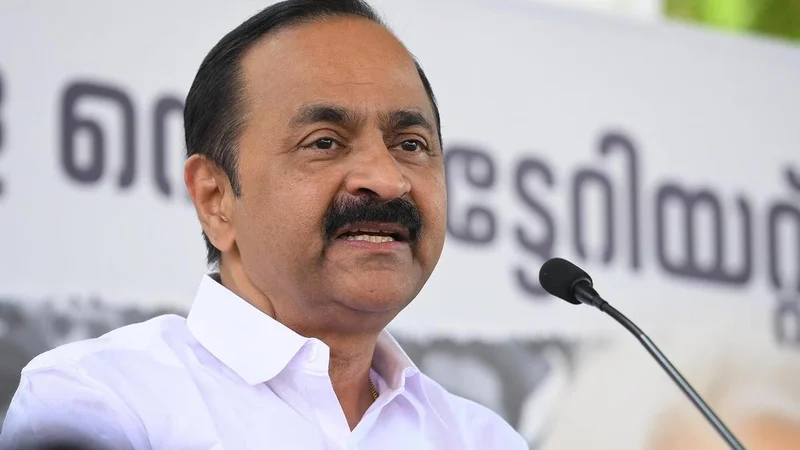
Kerala Chief Minister V.D. Satheesan has said the government would transform Supplyco into a financially self-sustaining market intervention agency by investing in modern storage infrastructure and scientific supply chain management. Such steps will enable the agency to procure essential commodities during harvest seasons at lower prices and supply them to consumers at affordable rates throughout the year, he pointed out.
He was speaking while formally launching the distribution of 73,024 Priority Household (PHH) ration cards and 2,000 Antyodaya Anna Yojana (AAY) ration cards in Thiruvananthapuram on Monday. The initiative formed part of the UDF government’s ongoing 100-day action programme.
The Chief Minister said Supplyco should evolve into the country’s leading market intervention agency by adopting modern procurement, storage and marketing practices. The government has studied successful supply chain models in other States, where commodities are purchased in bulk during the crop season at lower prices, stored in large modern warehouses and released into the market during the lean season, he added.
According to Mr. Satheesan, Kerala would adopt a similar strategy for the main subsidised commodities by creating storage facilities capable of holding large quantities of essential goods. Such a system would reduce procurement costs, enable Supplyco to supply commodities at prices below the market rate without depending heavily on government subsidies, and improve the corporation’s financial sustainability.
He asserted that the government viewed market intervention as one of its foremost priorities, particularly in the run-up to the Onam festival when both natural and artificial price increases were common. He said additional funds has already been sanctioned to strengthen both the Food and Civil Supplies Department and Supplyco despite the state’s financial constraints in order to ensure that price stabilisation measures and timely distribution of essential commodities would not be affected.
Clearing backlog
Referring to the ration card distribution, Mr. Satheesan said many deserving applicants had remained outside the priority category because of changing socio-economic conditions and delays in processing applications. Presiding over the function, Food and Civil Supplies Minister Anoop Jacob said clearing the backlog of priority ration card applications was identified as one of the department’s flagship initiatives under the government’s 100-day programme.
He said the department had initially targeted issuing 50,000 priority cards, but intensive follow-up enabled the number to be increased to 73,024 PHH cards, besides 2,000 AAY cards, all of which would become effective from this month. The minister added the government has sanctioned ₹253 crore to strengthen Supplyco’s market intervention activities despite financial challenges. Additional rice allocations have also been arranged through the Open Market Sale Scheme (OMSS), with all categories of ration card holders eligible to purchase rice at ₹27 per kg through Supplyco’s Maveli stores.
He also pointed out that the government has made available 1.65 lakh metric tonnes of rice for the festive season. Onam fairs are set to begin on August 8 in the cities, followed by district-level fairs from August 12, while Assembly constituency fairs had been extended to six days to improve market intervention and stabilise prices.
Health Minister K. Muraleedharan, who delivered the keynote address, said the Food Safety department has already held meetings with hotel owners and industry representatives and issued detailed guidelines to ensure the supply of safe and unadulterated food during the festival season. As part of such measures, food safety officials would intensify inspections of hotels, eateries and roadside food stalls across the State. He also indicated that the government was considering stricter penalties for food adulteration, while observing that existing punishments were inadequate to deter offenders. The government’s objective, he said, was to eliminate food adulteration through stronger enforcement and tougher legal action.
Published - August 03, 2026 04:28 pm IST