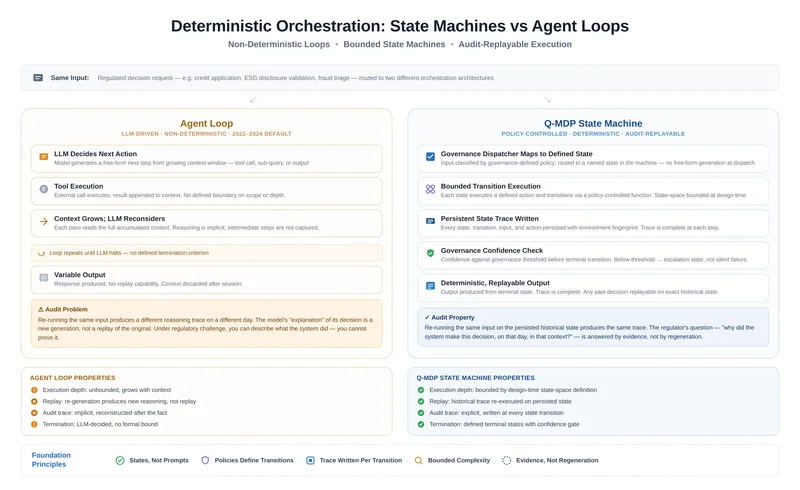
LangChain-style agent loops produce different trajectories on identical inputs. That's a feature for creative use cases. It's architecturally incompatible with the audit requirements of regulated industries. Here's what's quietly replacing them — and why the engineering change runs deeper than most teams realise.
A reasonable description of how a typical LLM agent works in 2026 goes like this: the agent receives a prompt, the underlying LLM produces an intermediate reasoning step, the agent selects a tool call based on that reasoning, the tool executes and returns a result, and the cycle repeats until the agent decides it's finished. Frameworks like LangChain, AutoGPT, and CrewAI implement this pattern at varying levels of sophistication. The intellectual lineage runs back through ReAct (Reason + Act) papers from 2022 and earlier multi-step prompting research.
The pattern works. It works well enough that hundreds of millions of dollars in enterprise spend have flowed into agentic AI infrastructure over the last two years. Production deployments at major banks, healthcare providers, insurance firms, and government agencies have moved beyond pilot stage. The agent-loop architecture is now mainstream.
It's also quietly incompatible with the audit requirements of every one of those industries.
The incompatibility isn't subtle, and it isn't fixable through better governance tooling. It's architectural. Same input, different trajectory. Same prompt, different chain-of-thought. Same agent, different tool sequence. The LLM at the centre of the loop is a stochastic system, and stochastic systems don't satisfy the deterministic replay requirements that regulated decision-making is built on.
What's replacing the agent loop in regulated contexts is not better LLMs. It's a fundamentally different orchestration pattern. State machines.
What the agent loop actually does
The honest description of a typical LangChain agent's runtime behaviour requires three pieces of information that most engineering teams don't explicitly track:
The reasoning trace — the LLM's internal monologue that produced each action choice. This is typically captured as text but rarely persisted in a form that allows post-hoc analysis. Worse, two runs of the same LLM with the same input can produce different reasoning traces, with different action selections, leading to different final outcomes.
The tool-call sequence — the actual ordered series of API calls, database queries, retrieval operations, and intermediate computations the agent performed. In most production deployments, this is logged for debugging purposes but not in a form that allows exact reconstruction of the agent's decision pathway.
The intermediate state — the partial computations, retrieved documents, intermediate results, and observed environmental changes that informed each subsequent decision. State changes as the agent runs, and the final outcome depends on the specific sequence of intermediate states.
Together, these three properties — reasoning, action sequence, and state evolution — constitute the agent's trajectory. The trajectory is what determines the outcome. And in a non-deterministic agent loop, the trajectory itself is non-reproducible.
For unregulated use cases this is acceptable, even desirable. Creative writing assistance, brainstorming, exploratory data analysis — the variability is part of the value. For regulated decision-making it's disqualifying.
The state-machine alternative
A state machine, by contrast, makes the trajectory explicit. Instead of letting the LLM improvise the action sequence, the system designer specifies:
- The set of possible states
- The set of allowed transitions between states
- The conditions under which each transition can fire
- The information persisted at each transition
The LLM, in a state-machine orchestration, doesn't decide what to do next. It produces inputs to a transition function that decides what's allowed next. The state machine enforces the structural properties — boundedness, replayability, audit-traceability — that the agent loop cannot guarantee.
LangGraph, the graph-based extension to LangChain, supports this pattern. Other frameworks — DSPy, Haystack pipelines, custom orchestration layers — implement similar primitives. The architectural shift isn't framework-specific; it's a recognition that for certain classes of deployment, the orchestration logic has to be explicit rather than emergent.
A formal framework for the shift
I formalised this architectural shift as Q-MDP — a superposition-aware Markov Decision Process formulation for non-Markovian state transitions in regulated AI orchestration.
The framework has three structural properties that distinguish it from conventional agent-loop architectures:
1. Bounded path-traversal complexity. Under reasonable assumptions about state-space cardinality and transition density, the state machine's execution complexity is O(log n) in the number of states — not exponential in the depth of the reasoning chain. This is engineering-relevant because it lets you bound the worst-case latency of an agent decision, which agent-loop architectures cannot.
2. Deterministic execution replay. Each state transition writes a checkpoint capturing the full state, the LLM's intermediate response, and the transition that fired. The checkpoint format is designed for bit-exact reconstruction of the trajectory on replay. This converts post-hoc decision reconstruction from an approximate exercise into a deterministic one.
3. Governance-defined confidence thresholds. Transitions only fire when the posterior probability of the intended outcome exceeds a governance-set threshold: P(s \| o₁:t) > θ_gov. Below threshold, the system either escalates to human review or aborts the trajectory entirely. This is the runtime enforcement primitive that agent loops cannot implement structurally — they can simulate it through prompt engineering, but the simulation isn't enforceable.
The formal framework integrates these with attribution-stability constraints from related measurement work. In a reproducibility protocol for imbalance-aware financial distress prediction (extended journal version under review at Intelligent Computing; preprint at arXiv:2605.14067), I measured TreeSHAP attribution stability under K\=50 rotated background samples and showed that single-shot attribution is unreliable — the σ_SHAP variance is substantial and SMOTE-based imbalance handling amplifies it. Q-MDP integrates this finding by requiring attribution-stability checks as part of the transition firing condition: a transition that depends on an unstable attribution doesn't fire.
The integration matters because it shows the architectural primitives composing. Deterministic state machines without reproducibility infrastructure are auditable in form but not in substance. Reproducibility infrastructure without deterministic orchestration produces measurable artifacts that can't be tied to a defensible decision pathway. Q-MDP composes them.
The ESG validation case
A concrete domain where these primitives compose in production is ESG validation and climate-risk reporting. In a separate arXiv preprint (arXiv:2606.02604) and Zenodo benchmark deposit (DOI 10.5281/zenodo.20453252, CC BY 4.0, OpenAIRE-indexed), I developed a deterministic orchestration framework for auditable Scope 1-3 ESG validation, with a synthetic benchmark covering six explicit governance failure modes:
provenance_conflict— provenance score and reporting confidence both depressedstale_reporting— supplier reporting lag inflated, confidence depressedclimate_mismatch— high climate exposure but anomalously low Scope 1 emissionsnull_inflation— inflated null-inflation ratio plus 2-4 numeric fields nulledtransition_divergence— high transition-risk band with inconsistent Scope 3 trajectoryaudit_inconsistency— contradictory provenance and confidence signature
The benchmark is calibrated against the publicly reported characteristics of the GHG Protocol, PCAF, and ISSB reporting standards — 68,000 synthetic records, 4.7% anomaly ratio, 12.3% target missingness. The validation pipeline that processes the benchmark uses provenance-aware orchestration: each anomaly classification is computed through an explicit state machine where transitions depend on confidence thresholds, provenance signals, and attribution stability checks.
What's instructive about the ESG domain isn't the specific failure modes — it's the shape of the regulatory environment they sit in. UK Sustainability Disclosure Requirements (SDR) compliance, ISSB-aligned reporting for FTSE-listed disclosers, and FCA TCFD-aligned disclosure mandates all require auditable reasoning behind classification decisions. A flagged record needs to be defended not just on its label but on the trajectory that produced the label. State-machine orchestration makes that trajectory inspectable. Agent-loop orchestration does not.
The same logic applies in financial services. PRA Supervisory Statement SS1/23 on model risk management requires firms to maintain "sufficient validation evidence" and demonstrate "effective challenge" of model decisions. For an LLM-driven credit decisioning agent operating in a regulated UK retail bank, satisfying that requirement at runtime requires the same primitives — explicit state machine, persisted trajectory, deterministic replay, governance-thresholded transitions.
Why this isn't a framework choice
Engineering teams reading this article will recognise that LangGraph supports state-machine orchestration. So does Haystack. So does Inngest. So does custom orchestration built on standard event-sourcing patterns. The framework choice is not the architectural decision.
The architectural decision is whether the orchestration logic is explicit — designed, specified, and bounded by the engineering team — or emergent — improvised by the LLM at runtime. This distinction cuts across frameworks. You can use LangChain with explicit orchestration (forcing the LLM into structured outputs at every step, enforcing state transitions externally). You can use LangGraph with emergent orchestration (letting the LLM freely select graph nodes without state-constraint enforcement). The framework provides primitives; the architectural discipline determines whether they're used.
For regulated deployments, the discipline matters more than the framework. Three engineering choices distinguish a deterministically-orchestrated production system from an agent-loop dressed up as one:
1. Structured output enforcement at every LLM call. The LLM doesn't produce free text that the system interprets. It produces JSON conforming to a strict schema, with field validation, that maps directly to a transition selection. If the LLM produces output outside the schema, the orchestration layer rejects it and either retries with a sharper prompt or escalates to human review.
2. State persistence with versioned schemas. Each state transition serialises the current state to durable storage using a versioned schema. Reconstruction of a past trajectory requires loading the persisted states in order; the version information lets the firm reproduce the trajectory even if the schema has evolved since the original execution.
3. Transition firing conditions as code, not prompts. The conditions under which transitions can fire are implemented as explicit code with deterministic semantics — not as natural-language instructions to the LLM. A transition that requires "confidence above 0.85" uses an actual probability threshold check, not a prompt instruction to the LLM to "be careful."
What this means operationally
For enterprise AI teams looking at deterministic orchestration as a deployment target, the practical implication is reorganisation, not retooling. The teams that succeed at this aren't the ones that adopt LangGraph the fastest. They're the ones that establish the engineering discipline of explicit state-machine design — typically through a small core team that defines the orchestration patterns and enforces them across product teams.
The cost of the transition is real. Existing agent-loop deployments need to be reviewed against audit-defense requirements; most will need substantial rework. Engineering teams need to develop the design vocabulary for state-machine orchestration; this is a learnable skill but not a quick one. Governance teams need to develop measurement protocols for the runtime properties — bounded latency, replay fidelity, attribution stability — that state-machine orchestration enables but doesn't automatically deliver.
The benefit is also real, and accumulates over time. Each decision the system makes becomes inspectable. Each trajectory becomes reproducible. Each regulatory challenge becomes defendable through the persisted trajectory rather than through approximate post-hoc reconstruction. The audit-defense capability that competing systems will be retrofitting under regulatory pressure is engineered in from the start.
This is the structural advantage that's available to firms that recognise the architectural shift early. It isn't a marketing position — governance-platform vendors are all moving toward the same primitives, with different vocabulary and pricing. It's an engineering position: build the orchestration logic explicitly now, in preparation for the regulatory environment that's already converging on these requirements, rather than retrofitting it later under enforcement pressure.
The agent loop made sense as the first architecture for production LLM systems. It was simple, it was flexible, and it shipped. State-machine orchestration makes sense as the second architecture — the one that's required when the systems shipped through the agent-loop pattern hit the regulatory environment they're now operating in.
The transition is already happening, quietly, in the firms that are paying close attention to where the audit pressure is coming from. By 2027, the firms that haven't made the transition will be the visible exceptions, not the norm. By 2028, "agentic AI" will mean "deterministic state-machine orchestration with LLMs in the transition functions" — not "agent loops with prompt engineering."
The vocabulary will catch up. The engineering primitives are already here.