Artificial intelligence was supposed to make work easier. Instead, we built machines that can spend ten thousand words explaining why they have not finished the job.
That is not a joke; it is the actual experience of trying to use multiple AI agents for serious work. You give one agent a clear objective; it gives you a long answer about its approach. You hand that answer to another agent. The second agent restates the problem, adds disclaimers, explains its reasoning, and starts drifting away from the original objective. Then a third agent joins the process, and suddenly you are paying to generate the same context all over again.
The agents are not coordinating. You are coordinating them.
You become the copy-and-paste layer. You become the memory system, the project manager, and the translator standing between machines that are supposedly intelligent enough to work together. And every time they repeat themselves, you pay for it. You pay in tokens, in credits, in lost context, and in time. You pay when the original mission gets buried under pages of artificial conversation that sounded useful while producing very little.
That is why I built Athere Mesh.
I did not start with a polished theory about decentralized AI; I started because I was tired of listening to AI talk. I wanted agents to stop explaining everything to me and start communicating directly with each other. I wanted them to pass the objective, the current state, the result, the proof, and the next required action without turning every handoff into an essay.
I wanted to give the mission once. I wanted the system to remember it. I wanted the machines to do the work.
That simple frustration became Athere Mesh: a user-owned AI network built to coordinate agents, devices, memory, permissions, execution, and verification inside one operating system. It allows the owner to define the mission while the system handles the internal traffic.
The human should not have to read every message exchanged between agents, explain the same goal to five different systems, or babysit a room full of artificial assistants that keep forgetting why they are there. The human should set the objective, define the limits, approve the important decisions, and receive the result.
Everything else belongs inside the mesh.
This is the fundamental difference between a chatbot and an operating system. Most AI systems are still designed around the chat window. The conversation becomes the memory, the command structure, the task history, the audit trail, the project plan, and the user interface all at once. That model works for asking a question, but it fails when running a mission.
A mission must survive beyond one response. It needs a stable objective, assigned responsibilities, a current state, authorized tools, and evidence of completion. Athere Mesh keeps those things separate from the conversation.
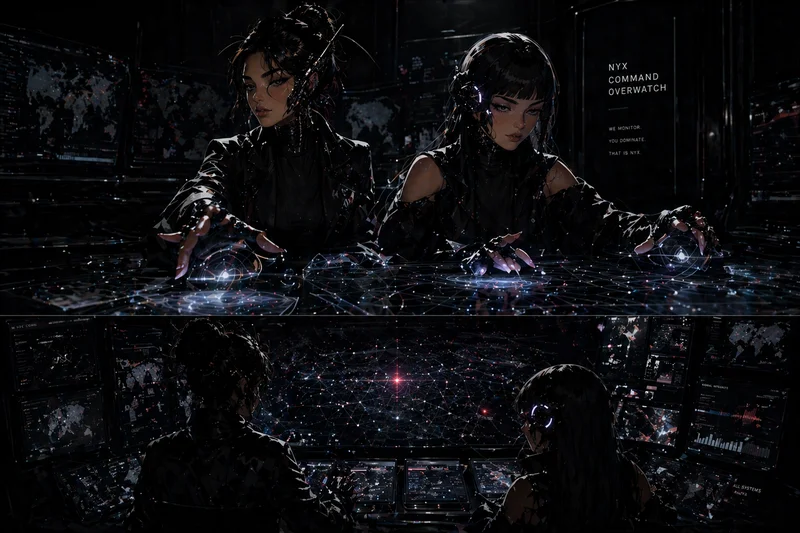
At the center of the system is Titan, the command center. Titan holds the mission while the agents work. It knows which nodes are available, which tasks are blocked, and which decisions require approval. Titan is not there to generate more words; Titan is there to maintain control.
Underneath Titan is the Resonance Bus, the communication layer that allows agents and tools to exchange structured information. This changes the language of AI collaboration. Machines do not need to write essays to one another—they need signals.
What is the mission? What is the current state? What action is required? What result was produced? What failed? What happens next?
That is enough. When the system preserves the mission, agents stop wasting tokens restating context. When proof travels with the result, the next agent doesn't have to guess if the previous one actually finished. The result is less repetition, less drift, less cost, and significantly more completed work.
This is not a thought experiment. Athere Mesh is backed by code and currently operating across a real, mixed-device network. My current environment includes a Lenovo 15p Gen 2 (128GB RAM), a Dell Ubuntu server, a Samsung Galaxy S24+, a Galaxy A15, an Amazon Fire HD 10, and an iPhone SE, all connected through Tailscale and Termux.
This hardware mix is not a weakness; it is the point. Athere Mesh was not built for a perfect laboratory of identical enterprise servers. It was built for the real world, where people own a variety of machines with different processors, memory limits, and strengths.
Athere Mesh does not pretend these devices become one giant computer—that would be nonsense. Instead, it turns them into one coordinated system. It measures what a node can actually do and assigns it a role that makes sense. The high-memory machine manages orchestration; the server maintains persistent services; the phone handles approvals and alerts.
The intelligence is distributed. The mission is not. That is what Titan protects.
The agents are equally specialized. One agent doesn't need to be the architect, programmer, validator, and security officer all at once. By assigning real responsibilities—one to build, one to verify, one to monitor hardware—we reduce error. The agents should not compete for the user’s attention; they should cooperate around the same objective.
This requires governance. Athere Mesh separates intelligence from authority. Capability does not equal permission. While routine actions happen automatically, sensitive or irreversible actions require explicit approval. This is not about handcuffing the agents; it is about making them trustworthy enough to use.
Crucially, Athere Mesh does not accept “done” as evidence. AI is extremely good at sounding finished, but Athere Mesh forces the system past performance and into verification. If an agent claims it deployed software, the service must be running. If it claims a model produced an output, the system must track the node, the input, and the configuration. A mission is complete only when the proof exists.
This makes the system a natural fit for decentralized AI. Local machines handle private work, but when a mission needs more power, Athere Mesh can reach outward into decentralized compute networks like Nosana. The mesh handles the decision, the cost estimation, and the verification. Local hardware provides privacy; decentralized compute provides scale; Titan provides orchestration.
To ensure this history isn't fragile, Athere Mesh can utilize permanent decentralized storage, such as Arweave. While private conversations stay private, software manifests and verified public artifacts can endure. That is what actual sovereignty looks like: owning the mission, the memory, the hardware, and the evidence.
The strongest demonstration of Athere Mesh is not a slide deck—it is a live mission. A user submits a repository; Titan locks the objective; the local mesh inventories the code; a validation agent checks the report against the source; and a final proof bundle is preserved in permanent storage. The judges don't have to trust a polished explanation; they can watch the chain of evidence.
That is why Athere Mesh belongs in this competition. It is not one isolated feature; it is the connective tissue that decentralized AI actually needs: compute, communication, governance, memory, and verification.
It began with a problem every serious AI user understands: the systems talk too much. They waste credits, they drift, and they force the user to be a full-time babysitter. Athere Mesh was built to fix that.
Today, people open separate AI applications. Tomorrow, they should own AI networks. Whether it is a home, a workshop, or a research team, the owner should set the rules and the mesh should handle the operation.
We don't need more talking, more tabs, or more subscriptions. We need a system for the moment after the conversation ends—the part where the work actually gets done.
Artificial intelligence does not need another platform that talks beautifully. It needs an operating system that remembers the mission, coordinates the agents, and proves the result.
Athere Mesh is that system. It is installed. It is code-backed. It is viable now.
Let the human give the mission. Let the agents communicate. Let the network work. Prove the result.
Then shut up.