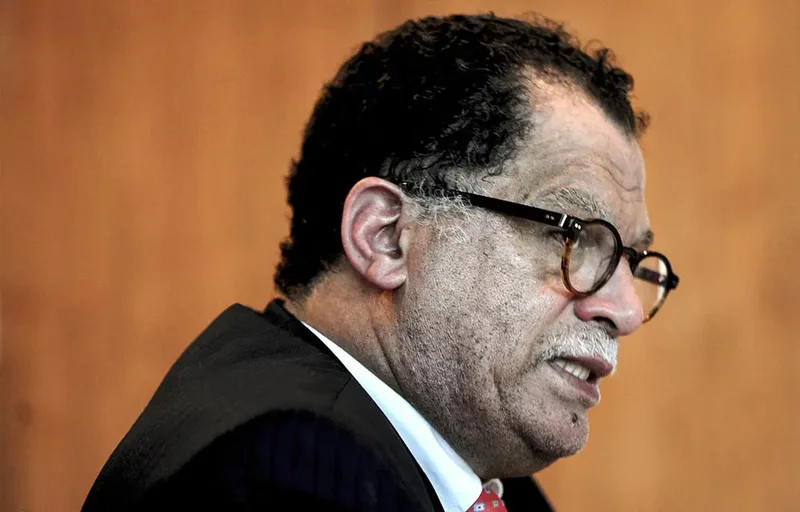
As the race for the presidency of the South African Football Association (SAFA) gathers momentum, South African football stands on the threshold of major possibilities. Delegates are being presented with competing visions for the future of the game, each claiming to offer the leadership required to restore South African football to greater heights.
Against this background, a familiar media script has been unfolding. Much of the media coverage has focused on presenting Sandile Zungu as the candidate of renewal while portraying Danny Jordaan as the embodiment of South African football's failures. Judging by some of the coverage, one could easily conclude that Jordaan has presided over a catastrophe of biblical proportions and that South African football is teetering on the brink of collapse, awaiting a messiah endowed with near-miraculous powers to rescue it. Such narratives may generate compelling headlines and animated television debates but they are a poor substitute for sober analysis grounded in facts, evidence and a balanced assessment of SAFA's record.
Every democratic institution benefits from robust debate and leadership contestations. However, elections should not become exercises in selective memory, where achievements are erased and shortcomings exaggerated. Campaign rhetoric that ignores measurable progress while magnifying weaknesses does little to advance honest and constructive debate.
The election of a SAFA President should never be reduced to a popularity contest. At its core, this election is about leadership, governance and the future direction of South African football. Delegates are not simply choosing between two individuals. They are choosing between two leadership profiles, two sets of experience and two competing visions for one of Africa's most complex sporting institutions.
That choice demands an objective and rigorous assessment of the qualities required to lead SAFA. Football administration requires constitutional leadership, financial stewardship, stakeholder management, international diplomacy, commercial negotiation, regulatory compliance and the ability to rally diverse interests behind a common vision for the game. Measured against those requirements, Jordaan and Zungu bring distinctly different credentials.
Jordaan's experience has been forged over more than three decades at virtually every level of football administration. His contribution spans the unification of South African football following apartheid, the successful bid and delivery of the 2010 FIFA World Cup, the leadership of SAFA and active participation within FIFA and CAF governance structures.
Under Jordaan's leadership, SAFA has transformed both women's and men's football through sustained investment in development, stronger coaching structures and improved talent pathways. Banyana Banyana won the Women's Africa Cup of Nations title in 2022 and is now ranked second in the latest CAF Women's Rankings, behind Nigeria. Bafana Bafana have also re-emerged as a continental force. These achievements are only possible where there is stable governance, sound administration and long-term planning.
Ultimately, football administrations are judged by what happens on the field. Administrators do not score goals or make decisive tackles but they create the conditions for success. That is why Bafana Bafana's disappointing performances in previous AFCON and FIFA World Cup campaigns remain difficult to excuse. Jordaan and the entire SAFA leadership must accept responsibility for those failures.
Beyond national teams, SAFA has strengthened grassroots football through the SAB League, Regional Leagues, Local Football Associations, Kay Motsepe Schools Championship, CAF and FIFA-accredited coaching programmes, referee development and expanded youth competitions, laying the foundation for sustainable success. Along the way, Jordaan has negotiated broadcasting and commercial partnerships, engaged governments and international football bodies, navigated constitutional disputes, managed complex stakeholder relationships and represented South African football on the global stage.
A balanced assessment of Jordaan's tenure reveals a federation that has recorded significant achievements while continuing to grapple with genuine challenges. School football requires focused attention. Grassroots infrastructure remains uneven. Commercial partnerships could be strengthened. However, acknowledging shortcomings is different from declaring SAFA a failed institution requiring wholesale reconstruction. It is recognition that football development is an ongoing journey rather than a destination.
Whether one agrees with every decision taken during Jordaan’s tenure is beside the point. Leadership should never be measured by perfection but by competence, institutional development and demonstrable results.
Zungu presents a different leadership profile. He is an accomplished businessman whose achievements are widely acknowledged. His stewardship of AmaZulu FC has brought greater organisational stability and improved the public profile of one of South Africa's historic football clubs.
The reality, however, is that governing a professional football club is fundamentally different from leading a national football association. A football club exists to advance its own competitive interests but a national federation exists to govern impartially in the interests of every club, province, player and football stakeholder. Unlike corporate organisations, national federations operate through democratic constitutions, stakeholder consensus, committee processes, international regulations and public accountability.
Effective leadership therefore demands not only executive decisiveness but also diplomacy, patience and the ability to build broad consensus. These distinct constitutional, regulatory and governance responsibilities are particularly relevant when evaluating campaign promises.
Zungu’s campaign has been accompanied by commitments to rebuild SAFA, unlock major sponsorships, strengthen commercial partnerships and usher in a new era for South African football. The critical question is whether these undertakings are practical, financially sustainable and supported by a credible implementation strategy.
History across many sectors demonstrates that highly successful business leaders do not always transition seamlessly into public or sporting institutions. Football administration is littered with examples of leaders who entered office with bold promises only to discover that institutional realities are considerably more complex than campaign platforms.
Take sponsorship as an example. Corporate sponsors do not invest simply because a new president has been elected or because a respected businessperson occupies the office. They invest where there is sound governance, competitive football, growing audiences, commercial value, media visibility, institutional credibility and confidence that their investment will generate measurable returns. Commercial investment is earned through a strong football ecosystem, not the profile or business credentials of any individual leader. Personal reputation may open doors but does not, on its own, secure long-term commercial partnerships.
Similarly, promises to rebuild South African football should be assessed against his own track record at club level. If the proposed reforms have not yet been demonstrated at Amazulu, delegates are entitled to ask how they would be implemented across a national federation that is exponentially more complex.
We must also consider the governance implications of this election. Modern sports administration is founded on transparency, accountability, independence and the careful management of actual and perceived conflicts of interest. A national football association must not only govern fairly but must also be seen to govern fairly. This principle lies at the heart of good corporate governance. For that reason, the prospect of a serving professional football club owner leading SAFA is deeply troubling. The issue is not one of personal integrity but of institutional credibility and public confidence.
A SAFA President makes decisions affecting clubs, provinces, disciplinary matters, commercial agreements and the strategic direction of South African football. Even where decisions are entirely impartial, perceptions of competing interests can undermine confidence in the federation.
South African football has long grappled with overlapping governance roles. The controversy surrounding Irvin Khoza's positions within both the PSL and Orlando Pirates illustrates why perceptions matter. It reinforces a fundamental governance principle that institutions are strongest when they minimise even the appearance of conflicts of interest. As the legal maxim reminds us, justice must not only be done, but must also be seen to be done. Football governance should aspire to no lower standard.
Every institution benefits from succession planning, fresh perspectives and new ideas. However, continuity should not automatically be equated with stagnation, just as change should not automatically be mistaken for progress. Ultimately, SAFA delegates must look beyond campaign rhetoric and personalities and make their decision on the basis of proven leadership, sound governance and a clear vision for strengthening South African football for generations to come.
**Cornelius Monama is a Strategic Communication Specialist, Public Affairs Commentator and Writer. **