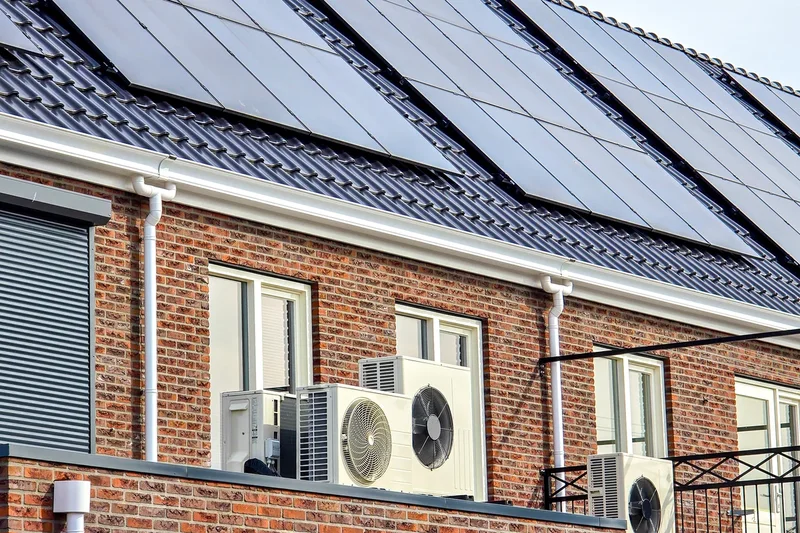
Solar panels are usually advertised by their peak power rating, but that figure doesn’t tell you how much electricity they will generate on your roof over a full year. Real-world output varies according to the size of the system, your solar panel’s efficiency, where you live, the direction and pitch of your roof, shading and even how efficiently the panels and inverter perform.
A typical UK home system is now around 4.5kWp, but two systems of the same size can produce noticeably different amounts of electricity if one is south-facing in southern England and the other is shaded or installed farther north. Solar generation also changes sharply with the seasons, with most electricity produced between spring and early autumn.
If you’re weighing up whether solar panels are worth it, understanding these variables helps you assess installers’ projections, estimate how much of your household electricity demand solar could meet and decide whether adding a battery would improve how much of that power you use at home.
Get a free quote for solar panels for your home
Use our comparison tool to get a range of free solar panel quotes from leading installers across the UK and find out how much you could be saving on your energy bills.
How much electricity do solar panels generate?
Several factors affect how much electricity a solar panel produces in the UK. Here’s how each one influences your total generation.
Panel wattage
Most residential solar panels today are rated between 350W and 450W. This figure represents the maximum output under ideal conditions. A 400W panel, for example, can generate up to 400 watts of power when exposed to full sunlight.
Efficiency
Most current residential panels have efficiencies of roughly 19 to 23 per cent, although some premium models exceed this. Efficiency matters most where roof space is limited, because a more efficient panel can generate more power from the same area.
Sunlight hours
Southern regions of the UK receive more sunlight than the north, influencing total output. Locations such as Cornwall or Kent might see up to 1,200kWh per kWp annually, compared with 850-900kWh in northern Scotland.
Orientation and tilt
Panels facing south at an angle of 30-40 degrees typically produce the most electricity. East- and west-facing installations still perform well, though output can drop by 10-15 per cent compared with a south-facing array.
Temperature and shading
Solar panels perform best in cooler conditions. Excessive heat can reduce efficiency slightly, while partial shading from trees or chimneys can lower total generation by as much as 10 per cent or more.
System losses
Inverters, cabling, and general wear can cause small efficiency losses, usually around 5-10 per cent. Dirt and debris on the panels can also reduce sunlight absorption.
To learn more about these factors, see our guide: Solar panel efficiency explained: how much power do panels really produce?
Estimated solar panel output: worked examples for different UK homes
These modelled scenarios use the MCS-style calculation to show how annual generation can change with system size, location, roof direction/pitch and shading, even before you factor in day-to-day weather.
| Scenario | UK region | System size (kWp) | Orientation / pitch | Shading | Assumed yield (kWh/kWp/yr) | Estimated annual generation (kWh/yr) |
| Typical south-facing semi | Midlands | 4.0 | South, ~30–40 | None | 950 | 3,800 |
| Same system, partially shaded | Midlands | 4.0 | South, ~30–40 | Moderate | 950 × 0.8 | 3,040 |
| Bigger system, east/west split | South England | 5.0 | East/West split | Low | 1,000 × 0.9 | 4,500 |
| Roof-space limited, higher efficiency panels | North England | 3.2 | South, ~30–40 | None | 900 | 2,880 |
| Flat roof, suboptimal tilt | London/South East | 4.0 | Flat (low tilt) | None | 1,000 × 0.85 | 3,400 |
How we estimated solar panel output for the scenarios
To keep the comparisons consistent, the table uses the same methodology that MCS-certified installers are expected to use when producing a first-year generation estimate in the UK. In plain terms, the calculation works like this:
Estimated annual generation (kWh) = System size (kWp) × Regional yield factor (Kk) × Shading factor (SF)
- System size (kWp) is the “peak” capacity of your array (essentially the total of your panels’ rated output under standard test conditions).
- Kk (kWh per kWp) is a lookup value taken from MCS irradiance tables based on your postcode region, plus the array’s orientation (which way it faces) and inclination (roof pitch).
- SF (shading factor) reduces the estimate if the roof is affected by chimneys, trees, neighbouring buildings, or other obstructions.
Because sunlight varies year to year (and because roof layouts differ), MCS is very explicit that this is guidance only and not a guaranteed performance.
Case study: How one homeowner uses solar to cut more than just his electricity bill
When Justin Webb installed solar panels on his home in Wiltshire, he wasn’t just looking to generate some of his own electricity. He wanted more control over what his home costs to run. His 4.5kW system now produces around 30kWh to 35kWh a day in summer, dropping to roughly 5kWh to 6kWh in winter. To smooth out that seasonal gap, he pairs it with a battery that he can top up overnight on a cheap EV tariff.
That setup means solar is only part of the savings. In summer, excess generation helps heat his hot water via an iBoost, cutting out the need to use gas for much of the year, while surplus electricity can also go towards charging his electric car. In winter, he uses off-peak electricity at 9p per kWh to top up the battery overnight, helping him run the house at a much lower effective rate during the day. “Over the summer months, we don’t usually have a bill at all,” Webb says, because export payments typically cover the standing charge.
For Webb, the value of solar isn’t just the electricity it generates, but the way it reduces costs across the home. “It’s not just doing the one basic job,” he says. “It’s paying for our gas bill because we’re not using the gas to heat the water, and it’s paying our petrol bill because it’s putting miles in the car.”
How much electricity does a solar panel produce per day?
Daily generation varies widely between seasons. Averaged across a full year, a well-sited 400W panel might generate roughly 1.0 to 1.3kWh a day, although actual output could exceed 2kWh on a bright summer day and fall to a fraction of that in winter.
In real-world use, the total depends heavily on household habits and system setup. Wiltshire homeowner Justin Webb, who runs a 4.5kW solar system with a home battery, says his array produces around 30-35kWh per day in summer and 5-6kWh in winter. “In summer, the panels feed directly into the battery during the day and we run the whole house on free solar,” he explains. “By evening, the battery’s full, and it powers everything through the night.”
These variations show why daily generation figures are best considered seasonally – solar performs at its peak between April and September, while smart battery management helps maintain energy independence through the darker months.
Can solar panels power your whole house?
Solar panels can supply most or all of a home’s electricity at certain times, particularly on bright summer days. Achieving year-round independence from the grid is much harder because generation falls sharply in winter. A battery can shift daytime solar into the evening, but many households will still import electricity overnight or during prolonged cloudy periods.
Justin Webb’s setup in Wiltshire is a good example of how this works in practice. During the winter, he uses his battery to stabilise his costs by charging it overnight on a low-cost EV tariff at around 9p per kWh, storing about 10kWh for roughly 80p per night. “That battery plus the daytime solar covers the house for the whole day,” he says. “It means I’ve fixed my winter electricity price.”
In the summer months, Webb’s panels generate enough to fill the battery each day and power his house, while also heating water through an iBoost immersion system that diverts excess solar energy. “For eight months of the year, I don’t need gas for hot water at all,” he says. “The panels run the house, heat the water, and even charge the car.”
His exported electricity during summer often offsets standing charges, meaning he pays little or nothing for energy over that period.
This combination of solar panels and battery storage enables households like Webb’s to achieve near-total energy self-sufficiency for much of the year, particularly when coupled with smart tariffs and efficient appliances.
Read more: Octopus solar panels review
How much electricity do solar panels produce in winter?
Solar panels produce significantly less electricity in winter than in summer. Monthly generation in December or January can be several times lower than in May, June or July because the days are shorter, the sun sits lower in the sky and cloudy weather is more common.
Panels still generate electricity during winter and do not need direct sunlight to work, but their output will usually be much lower. Snow can temporarily block generation if it settles on the panels, although the UK’s relatively mild winters mean this is unlikely to be a frequent problem for most households.
How to calculate your potential solar output
You can estimate how much electricity your solar panels will produce using this simple formula: system size (kW) × annual solar yield (kWh/kWp) = annual generation.
In the UK, the solar yield averages between 850 and 1,100kWh/kWp, with higher solar irradiance in the south. For example: a 4kW system × 950kWh/kWp = 3,800kWh/year.
Webb used this approach when planning his system. Before installation, he researched historical solar data for his area using free online tools, comparing multiple installers’ generation estimates against local sunlight averages. He then sized both his battery and solar array around his daytime winter electricity use to ensure his home could run primarily on solar year-round.
“I worked out how much I used in a typical day and built the system around that,” he says. “The key is to size the battery for your daily usage, not more than that, otherwise you’ll overpay for storage you don’t need.”
The Energy Saving Trust has a free online calculator, as do most firms that install solar panels. Professional solar panel installers can also refine these estimates based on your postcode and roof layout.
How solar panel type and technology affect output
Not all solar panels are created equal.
- Monocrystalline panels: most efficient (up to 23 per cent), ideal for limited roof space
- Polycrystalline panels: slightly less efficient (around 18-20 per cent) but more affordable
- Thin-film panels: lightweight and flexible solar panels, but generally lower output
Newer technologies such as heterojunction (HJT) and TOPCon solar cells offer even greater efficiency and durability. The Perlight Black Grid, for instance, is among the most efficient panels on the UK market and was our pick for the Best for Efficiency in our round-up of the best solar panels in the UK.
How to maximise your solar electricity generation
To make the most of your system:
- Keep panels clean and free of debris
- Install a solar battery to store excess energy for later use
- Use smart meters and monitoring apps to track output
- Run appliances during daylight hours to use your own solar power directly
Verdict: How much electricity can you really expect from solar panels?
Each solar panel in the UK typically produces between 350 and 450kWh per year, depending on its rating and location. A well-sited 4kW system may generate an amount comparable to a typical household’s annual electricity use, but that does not mean the home will be powered entirely by solar. Some electricity will be exported when generation exceeds demand, while grid electricity will still be needed at night and during darker months. A battery can help the household use more of its own generation.