Roadside parking payment via OBU now underway for 1,000 trial users
AI generated
SINGAPORE – A trial involving 1,000 motorists using their vehicle’s on-board unit (OBU) to pay for roadside parking started on Aug 3.
Some 644 designated carparks across Singapore, with about 19,000 spaces, are being used for the test. This represents the majority of roadside parking spaces managed by the Urban Redevelopment Authority.
The roadside electronic parking pilot is one of the features introduced by the Land Transport Authority (LTA) to participating motorists ahead of the transition to the satellite-based Electronic Road Pricing system, or ERP 2.
The Straits Times is among those participating in the trial, which runs from June to November.
The parking payment function is accessible only through the touchscreen display that is part of the OBU set-up in vehicles. Smartphone mobile apps, which can display ERP charges and traffic information, do not have the function.
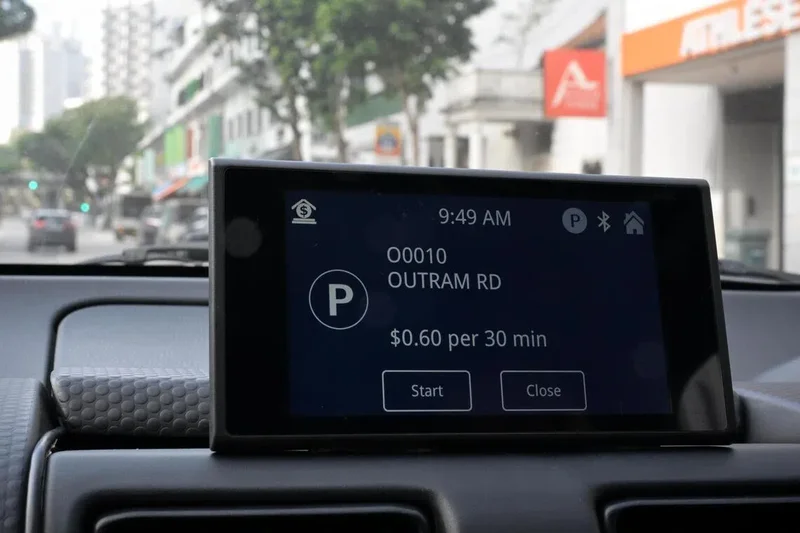
To start a parking session, motorists can tap on the small “P” icon on the top right corner of the touchscreen display. Alternatively, a prompt will appear on the screen when the engine is turned off, allowing them to start the session.
In cases where more than one carpark is detected, the screen will show a list of carparks for motorists to select.
The display, which also shows the parking rate, will remain illuminated for around two minutes before the OBU shuts down.
If motorists want to start a parking session after the screen has turned off, they can restart the vehicle’s ignition to bring up the screen again. Alternatively, they can use existing carpark payment methods such as the Parking.SG app.
There is no option to manually end the parking session. Instead, the session ends automatically when the vehicle is driven out of the parking space. LTA said that this is meant to give motorists a more seamless parking experience. It added that the Parking.SG app will remain in use even after the roadside electronic parking feature is fully rolled out.
On the two occasions when ST tested the feature – at Upper East Coast Road and Outram Road – the parking charge appeared on the screen a few moments after the car was driven out of the parking space.
Payment is made through the CEPAS card in the OBU’s processing unit. Alternatively, motorists can pay through backend payment services, namely AXS Drive, EZ-Link Motoring Services, and the Nets Virtual CashCard.
Other features being tested by the motorists include “ERP Ahead” notifications on their OBU displays, as well as various road markings and signage designed to serve as visual cues for ERP toll charging.
In its response to ST’s queries in June when the trial was announced, LTA said that it wanted to gather user feedback on the various features and user interfaces before refining them ahead of the rollout of ERP 2 to all motorists.
With the transition from Jan 1, existing ERP gantries will be progressively removed.
Information such as ERP rates and operating hours, currently displayed on the gantries, will instead be shown on the OBU touchscreen displays or compatible ERP 2 smarphone apps.
The gantry-based system, in use since 1998, has reached the end of its life and is due for a technology refresh.