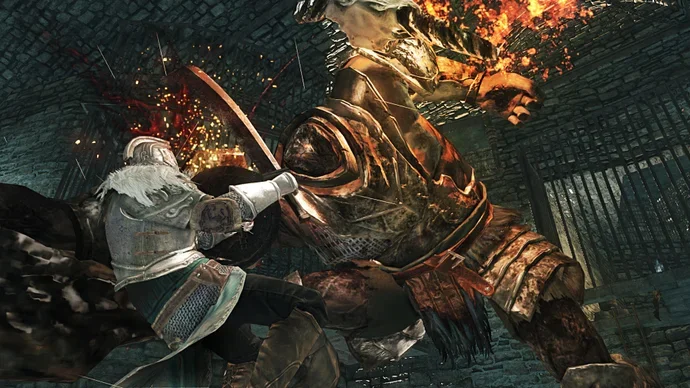
Sometimes I have to remind myself that I’m a cliché, a person first compelled to write about games because I slew Dark Souls’ Gwynn, Lord Of Cinder and sat quietly for a moment before thinking to myself, “Hit me, come on, hit me!”. No, I was not okay. But my understanding of games shifted in that tiny university room: they could be overcome, not just completed. FromSoftware’s dark fantasy lands, with their puzzle-box intricacy and dribbly residents, ushered in the "Soulslike" as other developers sought to cash in on masochists like me.
Here I am, still a masochist, still someone who adores a Souls and/or ‘like, but who stares at the offerings nowadays and thinks, "Please, someone hit me". These games have stagnated, to the point where it feels like we’re all waiting for FromSoftware to emerge from the fog and beat our asses in a way we’ve not quite seen before.
To sum up a Soulslike for you, it’s not necessarily a 1:1 attempt at cloning Demon’s Souls or its later Dark Souls compatriots. It’s an inspiration or interpretation of its cursed DNA, like how in the fragrance community you might have, say, Louis Vuitton’s Imagination: a £300 bottle of juice that smells a bit like an expensive bar of soap. Other fragrance houses notice its popularity and complexity, then churn out ‘dupes’ inspired by the signature smelly. Some step away from Imagination’s citrus and dial up the soap. Some dial down the tea note. Others add a spritz of bug spray into the mix. The best dupes take the original formula and produce some juice that elevates certain elements, even if they’re working with less expensive ingredients.
It’s no secret that Souls games contain facets of other popular games that came before them. Third-person combat, dodge-rolling, checkpoints, punishing combat, a throaty witch who bookends her sentences with croaks of "He he he". I’d say the things that make a Soulslike distinct, the notes if you will, are its tug of war with tension. As you slay baddies, you’ll collect Souls that you can spend to level up at bonfires, except that: 1) If you die, you’ll lose all of your moolah and have only one chance to scoop it back up; 2) Bonfires act as checkpoints, except they’ll vary in how generously they’ll pop up.
I’d also argue that a playful map completes the trifecta of a Soulslike. Pretty much all of the signature Souls games see you unpick maps that bury secrets in labyrinthine caverns, or whirl you skywards until you arrive at a cliff edge, look across the ruined landscape, and realise you’ve come oh-so-very far. It’s probably the closest you’ll ever get to a pat on the back or a light jostle of "Well done pal" from FromSoftware.
So as Souls become more popular, how did the first likers emerge? Team Ninja’s Nioh is a prime example of a dev house applying their own strengths to the formula while reducing the potency of others. Out went the knotty world, replaced by missions and a map. Out went cackling witches and subtle environmental storytelling, replaced by crystals and cringe. Out went fairly simple menus, in went crashing waves of loot lapping at your tabis and bioluminescent shores swimming with stats. Crucially, out went dodge rolling and average sword swings, and in went Team Ninja’s signature approach to scraps that made FromSoft’s fluidity seem languid by comparison. Demons are ingredients, to be minced through dizzying fighting game combos and a Ki (stamina) bar you can Active Reload like a prime "Eat shit and die" Marcus Fenix.
Others followed, like The Surge and Mortal Shell and Lords Of The Fallen (2014) and Wo Long: Fallen Dynasty. All of them scrabbling for that singular gimmick, like robotic limbs and hardening carapaces and knocking over lads with shields. Somewhere in-between them all, FromSoftware added Dark Souls 2, 3, Bloodborne and Sekiro, in what I’d consider an era where iteration from the OGs lay in fine readjustments, thematic excellence, rhythmic groove and a foray into extra-curricular dungeon crawling.
Then, like a Patches kick to the nuts, FromSoftware dropped Elden Ring in 2022. Arguably the biggest reinvention of the Souls genre in years, they’d stretched their smaller puzzle boxes of yore outwards like fresh pizza dough, topped it with a frightening array of locations and stuffed the crusts with murderous goblins. Sites of Grace replaced bonfires, whose glistening trails would point in the direction you’re meant to go, so you’d naturally seek the opposite trail in search of hot honey and pepperoni.
Arguably, though, Elden Ring was FromSoftware pushing Souls further into the mainstream in what felt like a natural, if predictable, evolution of the formula. 'Open world' is an easy sell on the store page, and entices a huge new market of non-Soulsers who respond to scope and scale and bombast if presented to them through a simpler lens. Not that Dark Souls didn’t have all of these things - Elden Ring, of course, upped the anté - but it just didn’t feel quite as beholden to revenue targets.
Since then we’ve had the stellar Black Myth: Wukong, a blockbuster open-world-ish adventure where a monkey with a staff clatters his way through gods. Team Ninja shrugged Nioh 3 into a superb open-world blend. Dark-fantasy-Pinnochio-like Lies Of P was an outlier in the sense it felt like a Soulslike from the previous generation of Soulslikes, although it did toy around with 'Lying' to wiggle the narrative around (meh) and switching out your robotic limbs (pretty cool).
Delve into Steam Next Fest, or just Steam in general, and you’ll find a plethora of Soulslikes that largely take one gimmick and run with it. Look at The Lords Of The Fallen (2023), which introduced a cool interdimensional death lamp but largely played like any other Soulser. Look at Thymesia, with its zippy combat and - you get it.
FromSoft are now shifting their frozen needle towards multiplayer antics, given their co-op roguelike Elden Ring: Nightreign launched not too long ago and their upcoming Nintendo Switch 2 exclusive The Duskbloods isn’t far off. What will it have to offer? All we know as I’m writing this is that it’s a PvPvE deal, very probably their take on the extraction shooter boom, with a fairly self-evident hope that it’ll print money like those battle royales once did. What I’m trying to say, with some sadness, is that Duskbloods looks like a symptom of the game industry more than a game I’m interested in.
Have Soulslikes, then, reached Smartphone Mountain? Where the peak is Sen's Fortress and the next frontier is another fortress that folds outwards? Yes, for now. Mistfall Hunter is another PvPvE special that’s due out soon, and although James has been liking FPSoulslike Valor Mortis it still feels like most developers are chasing industry trends, while the rest of us sit hoping that Miyazaki's off feeding some singleplayer monstrosity that'll break containment soon.
None of this is to say Soulslikes are on the way out, or that their cadence of sameyness is entirely a bad thing, I just think the best chance of true innovation lies in a creative twist courtesy of the original creators. Honestly, I hope FromSoft shift away from the expansiveness of Elden Ring, shrink things down and instead push its ghostfriend-conjuring summon systems further and deeper. Take cues from JRPGs, perhaps, where we're commanding a small party for the first time, or toy around with bonfires as less of a resting spot and more of a fleeting chance to commune with other players in an otherworldly marketplace.
All we can do is wait, which means in the meantime, I'll dip into some The First Berserker: Khazan. Maybe the key is anime. FromSoft should go full anime. Cheers.
Read this next
- Stop judging games by their sales figures, says Tekken's Katsuhiro Harada: “That’s exactly what you’d expect from someone who’s never actually developed games"
- Despite investors moaning that Elden Ring's success hasn't been milked hard enough financially, FromSoftware parent company's CEO has kept his job
- Morrowind in Elden Ring mod is now "mostly playable", despite the fact its creator's "entire existence has been consumed with interpreting gibberish code"