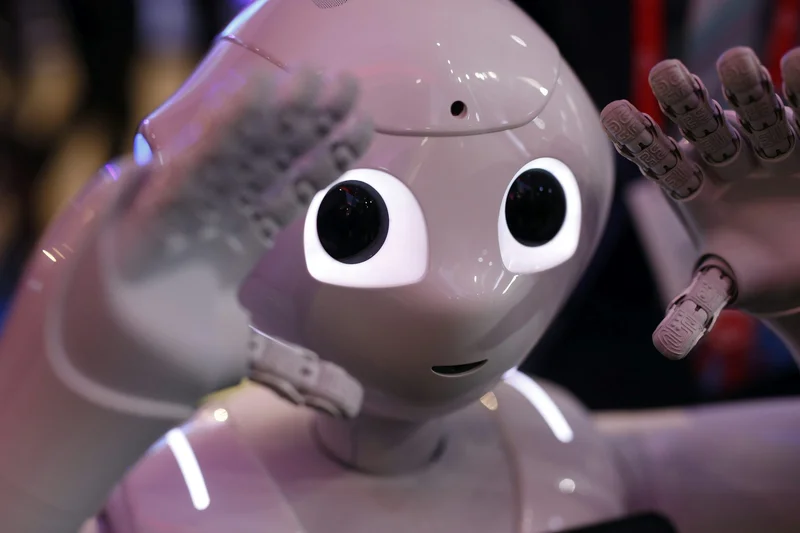
People become more suspicious of a humanoid robot that makes errors, especially when the robot is an expressive conversation partner.
In our new study published in the journal Science Robotics, we had 50 people hold conversations and make joint decisions with the commercial humanoid robot Pepper, which is designed to be expressive and recognize emotions. Sometimes we had the robot give sound advice. Sometimes we had it make conversational mistakes, interrupting people or pushing illogical suggestions.
For some participants, the robot was animated, using gestures, eye contact and nods. For others, it stayed motionless.
We measured four things: brain activity, levels of the hormone oxytocin, self-reported trust and our observations of the robot’s influence on participants’ decisions.
We found that when people interacted with an expressive robot that violated interaction norms, their oxytocin levels increased. Oxytocin is popularly known as the “love hormone” for its role in social bonding, so the straightforward prediction is that it declines when a partner disappoints you.
Instead, the higher a person’s oxytocin during an expressive robot’s errors, the less they trusted the robot and the less often they took its advice. It turns out that the hormone was tracking with suspicion, not affection.
Errors damaged trust and diminished influence whether or not the robot was expressive. What expressiveness in the robot changed in participants was how their brains handled the moment.
Reading someone’s brain during a real conversation is hard because the conventional method requires lying motionless inside an MRI scanner. Instead, we used functional near-infrared spectroscopy, a portable sensor worn on the forehead that tracks oxygen levels in the brain while people move and talk normally.
The two brain regions we closely watched were the dorsolateral prefrontal cortex and the medial prefrontal cortex. The dorsolateral prefrontal cortex monitors uncertainty and flags when expectations or norms get broken. The medial prefrontal cortex supports “mentalizing,” the everyday work of inferring what another party intends.
When an animated robot erred, people seemed caught off guard and had to work harder to make sense of an awkward social situation. Activity rose in the two brain regions, and the two started working together more closely. That closer teamwork predicted the rise in oxytocin levels, which itself predicted falling trust and less influence on participants’ behavior. In contrast, this coordinated brain activity was absent in participants who interacted with expressionless robots.
Why it matters
Robots are moving into homes, hospitals and workplaces, where trust in robots determines whether people use them at all. A common design assumption has been that lifelike, socially expressive robots earn more trust, which protects a robot’s “reputation” even when it makes mistakes.
However, research is beginning to show that that assumption is faulty. Our work shows that expressive cues appear to shift how people perceive a mistake out of the category of technical malfunction and into the category of social violation, like those that happen between people.
A motionless robot’s error looks mechanical, while the same error from an animated robot engages the machinery you use to judge people.
What other research is being done
Researchers increasingly treat trust as a multilevel phenomenon – spanning individuals, relationships, networks of people and societies – rather than a single attitude.
Much research on oxytocin involves humans interacting with humans, where the hormone is tied to bonding, though a growing body of work shows that those effects depend on the context, uncertainty and perceived threat.
Others are using wearable brain imaging systems to study social cognition in natural encounters between people, which isn’t possible when subjects are in scanners like MRI machines.
What’s next
The participants in this study were all young men, and we used one robot design. A key next step is testing whether the same oxytocin-linked vigilance appears in women, mixed groups, other cultures and other robot designs. Our brain sensor also reached only the front of the brain, leaving deeper regions involved in social processing unmeasured.
We also want to examine whether robots can repair trust after a mistake by acknowledging the error, apologizing or signaling good intent, the way that people do after awkward or uncomfortable interactions.
The Research Brief is a short take about interesting academic work.