As I flew in to join the tourists in Dubai, missiles started flying again
Greg Dickinson
July 21, 2026 — 5:00am
Save
You have reached your maximum number of saved items.
Remove items from your saved list to add more.
AAA
When I clicked on to the live news channel on my Emirates in-flight screen, it was as if my anxieties had manifested as pixels.
Military activity in the Gulf had resumed. The Strait of Hormuz was closed. Iran had fired missiles at strategic sites in Jordan, Qatar and Bahrain.
Tourists were starting to return to Dubai when conflict in the region escalated again.iStock
And crucially, for me and my fellow passengers at 35,000 feet on this flight from London to Dubai, the United Arab Emirates (UAE) had used its air-defence systems for the first time since May.
My goal, to find the best deals and assess the state of tourism halfway through Dubai’s annus horribilis, had taken a new twist. And I was barrelling towards that geopolitical twist at 928 km/h.
How the unthinkable happened
Sign up for the Traveller newsletter
The latest travel news, tips and inspiration delivered to your inbox. Sign up now.
“So how has it been, since…” I wasn’t quite sure how to finish this question, as my Uber cruised past dazzling Tetris skyscrapers into Dubai city centre, air-con tickling the hairs on my arms.
“The situation?” the taxi driver interrupted. “It’s OK now. It’s normal.”
I asked whether he had heard anything about the latest missile interception, and his eyes caught mine in the rearview mirror. That morning (Sunday, July 12), citizens in some parts of the UAE had received their first emergency mobile phone alert in more than two months.
“No. Nothing.”
Earlier this year, the unthinkable happened in the UAE. In retaliation for a military offensive by the US and Israel on February 28, Iran took the unprecedented step of targeting a series of sites in the Gulf, including Abu Dhabi and Dubai.
Most of the Iranian missiles and drones were intercepted by the UAE’s air-defence systems. But as war played out in the skies, debris scattered across central Dubai. The Fairmont Palm Jumeirah was struck, along with the Burj Al Arab, Dubai International Airport and some other sites. If Dubai had been living in a bubble of assumed safety, that bubble had burst.
Sheikh Zayed Road: the backbone of Dubai.iStock
Gulf airspace was temporarily closed, leaving tens of thousands of tourists stranded for many days. The Australia Department of Foreign Affairs and Trade issued a “do not travel” warning to the UAE, and it was only on June 17 that it finally lowered the warning level (to “reconsider your need to travel”).
Now, Dubai’s tourist board and hospitality businesses are doing everything they can to tempt international tourists to return, and to reassure the world that the city is open for business. After the events of this week, those efforts will have to stretch even further.
The return of tourists
Some tourists are heeding the call. At the top of the Burj Khalifa, almost a kilometre into the sky, I met Dan and Ellie, a British couple from Birmingham who cashed in on the precarious state of tourism in the Gulf. After the warning advice change, they found a good package deal and decided to go for it.
That morning, the news had emerged that Iran had struck two UAE tankers in the Strait of Hormuz. On a clearer day, the smoke from these blazes would have been visible from our vantage point. Were they worried?
“Not really,” said Dan. “We’re having a great time. Enjoying the air-con.”
Dubai is seeking to tempt international tourists to return.Bloomberg
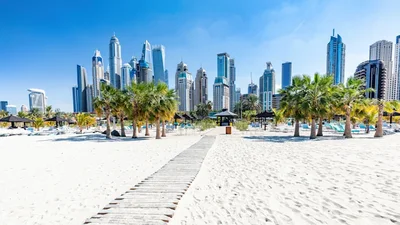
With temperatures hovering between 40ºC (uncomfortable) and 50ºC (impossible), summer is the low season in Dubai. Spending 10 minutes on JBR Beach, occupied almost exclusively by sun-ripened Russians, I understood why most people prefer to visit in December. Every year there are deals, but this year’s are better than usual.
At the Lana, part of the Dorchester Collection, prospective guests are being offered 18 per cent off room rates paired with a guaranteed upgrade. The swish rooftop bar with infinity pool, High Society, has what is probably the most complete view of downtown Dubai. Sitting up there, alongside some cheery selfie-takers, it was hard not to peer upwards as planes glided overhead, to double-check the nature of the flying object.
July temperatures are sweltering on JBR Beach.iStock
Emirates is currently operating 49 flights a week from Australia to Dubai, including daily flights from Sydney and Melbourne. The airline is also offering free stays at five-star hotels in the emirate and significant discounts for passengers at restaurants, shops and other venues across the city.
The picture at ground level
While the hospitality industry jostles to fill seats and rooms, the war has also affected things at ground level.
Nada Badran runs tours of Dubai’s spice, gold and textile souks through her one-woman business, Wander with Nada. When the war began, her bookings disappeared. She refunded every one of her cancellations with the mantra: “When you’re back, I’ll take you out!” Now, the requests are picking up again. The future, for now, is back on.
Her tour offers an insight into the low-rise, more authentic side of Dubai, with regular air-con stops. In one store, a spice seller named Zafaran explained that 90 per cent of the world’s saffron is exported from Iran. Since the war, he has had to import the spice from Iran into neighbouring Oman, and then into the UAE.
Spices for sale in the Dubai Spice Souk.iStock
“It’s a little more expensive. But not a problem,” he said, handing over a sugary karak chai infused with the red gold spice.
As we crossed the creek towards Al Fahidi, a neighbourhood founded by Persian settlers, I put it to Nada that everyone seemed quite relaxed about the conflict. This was especially surprising given the developments this week: that afternoon, on July 13, the FCDO had added a new warning for tourists to “keep your departure plans under review” and to stay away from windows if advised.
No doubt the sense of calm has been helped by the response of the Emirati government. A social-media blackout, preventing people from sharing images of war in Dubai, raised eyebrows. However, some have argued that it did have the desired effect of quashing mass hysteria. The UAE’s air-defence systems, which some assumed would never need to be used, have been effective.
Most importantly to tourists, in the deep end of the crisis, the UAE’s Department of Culture and Tourism offered to refund the hotel fees and meals of every stranded holidaymaker. Emirates has since introduced a special repatriation insurance policy. Unprecedented, and indeed reassuring to tourists, in uncertain times.
An uncertain future
On my last morning, I went for a coffee with a friend who has worked in Dubai’s property industry for six years. He lives on the southern outskirts of the city, in an expat community close to a military base. Life had more or less returned to normal, he said, although memories of March were close to the surface.
He recalled hiding in the downstairs toilet with his wife and young daughters, as his phone squawked with an alert to steer clear of windows, the thud of the nearby air defences rattling their home. His daughters still flinch when they hear a loud noise.
What is he thinking for the future? Will they come home? He doesn’t know.
Alserkal Avenue is the closest thing Dubai has to a hipster quarter.iStock
A couple of hours before my flight home, I visited Alserkal Avenue, the closest thing Dubai has to a hipster quarter. I found smoothie bars, gym nightclubs and art galleries occupying industrial units. In the distance, the city skyline was just distant enough that, in the midday haze, it looked like a strange memory.
As I wandered the streets of Alserkal (being able to “wander” in Dubai, outside a shopping centre, is a rare treat), I received a notification that the EU Aviation Safety Agency had imposed a warning for all European airlines to avoid UAE airspace.
My heart dropped. The cascading effect of a Middle East travel shutdown felt almost inevitable. But then again, I thought, there’s always hope that things will simmer down. I looked up and, for the first time in my fleeting visit to Dubai, I saw some graffiti on the wall.
The “future is bunk”, it read. A play, I suppose, on Henry Ford’s quote that “history is more or less bunk”. His point was that dwelling on the past was bunkum – nonsense.
I had spent the past two days wondering how the people of Dubai, from taxi drivers to expats, had remained so stoical given the state of things in the Gulf.
Perhaps this piece of street art held the answer. The future is so unpredictable, so tightly tied to the whims of a few world leaders, that maybe there is no use worrying about it at all. As the Gulf enters yet another precarious chapter, Dubai can do little more than keep the deals coming, and hope that international tourists adopt the same philosophy.
The Telegraph, London
Save
You have reached your maximum number of saved items.
Remove items from your saved list to add more.