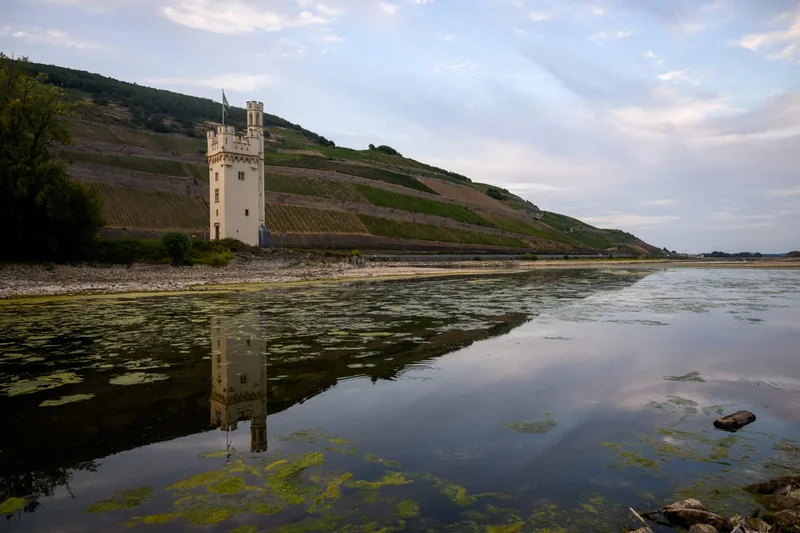
Analysts have said that record low water levels on the Rhine river could risk curbing German growth.
The issue could potentially drag Europe’s largest economy back into stagnation at a time where it has started to show early signs of recovery.
Germany has suffered from successive heatwaves coupled with low rainfall this summer, similar to large parts of Europe.
As a result, waterways like the Rhine, which is an important shipping route for grains, minerals, coal and refined oil products, are experiencing low water levels.
Shallow water means cargo vessels are often able to sail only about 20 per cent loaded, forcing shipments to be spread among multiple vessels and creating unwelcome extra expenses for German industry.
German gross domestic product grew more than expected in the second quarter, data showed last week, and economists had expected slight growth of no more than 0.2 per cent for the summer months.
But the low water levels alone could trim third-quarter GDP growth by 0.1 per cent to 0.2 per cent, said economist Stefan Kooths of the Kiel Institute for the World Economy, who warned they were unlikely to quickly rise back above the critical threshold.
"Transport capacity is likely to remain affected by low water levels for some time into the coming month," he said.
Drought worsening long-term water loss trend
The lack of rainfall this summer has worsened a long-term trend in Germany, which has lost 60 billion cubic metres of water over the past 25 years due to climate change, according to the environment ministry.
Without action, water scarcity could cost Germany €625 billion ($714 billion) by 2050, or around €25 billion annually, Environment Minister Carsten Schneider warned, citing studies.
This summer's conditions are raising concerns over the economy in the short term, said Carsten Brzeski, global head of macro at ING.
"The warm and dry summer weather has brought water levels in main transportation waterways to record low levels, potentially affecting industrial supply chains and activity in the construction sector," he said.
The water level at the Rhine river chokepoint of Kaub is forecast to fall to a record low of 18 cm (7.09 inches) on Friday, according to data published on Monday by Germany's Federal Waterways and Shipping Administration.
Marc Schattenberg, economist at Deutsche Bank Research, said whether the situation significantly curbs economic output will depend on how long high transport costs persist and if there are prolonged shipping disruptions in places like Kaub.
Already last month, Thyssenkrupp Steel suspended shipping of raw materials to the western city of Duisburg with its own vessels.
And German chemical maker BASF (BASFn.DE) said on Monday that, while it had maintained waterway transportation to date, isolated supply bottlenecks may occur if the current weather conditions persist.
"If the drought continues, it would place a further strain on the German economy, which is already in a very precarious state," said Dirk Binding, an expert at Germany's chamber of commerce and industry, DIHK.