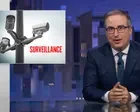
John Oliver discussed the tools that police are using to keep track of Americans on the latest episode of Last Week Tonight.
In recent years, the use of surveillance technology has exploded among local police forces due to decreasing prices and federal funding, with one local mayor comparing modern systems to “Big Brother on steroids”.
“I’m not sure that’s quite the sell he thinks it is,” said Oliver with a laugh. “Big Brother is pretty famously not the hero of [George Orwell’s] 1984 …
“But the truth is, a lot of the technologies that feed into those [local surveillance] centers have significant problems, and some civil liberties issues to the way they’ve been weaponized recently to target immigrants.
“There needs to be much more awareness of what’s actually out there.”
Local police forces use a combination of cameras, license plate readers, microphones and cell-site simulators in “predictive policing” that “combines all of them to make that Big Brother on steroids line true”, Oliver said.
In New Orleans, where there are more than 2,000 surveillance cameras, a police officer said that without them they would “absolutely not” have been able to determine who was the shooter and who was the victim in a recent case.
“That sounds like less of an argument for cameras than an argument against you guys,” said Oliver. “You basically just admitted there that ‘we couldn’t do dick-all until we got them video doodads’.”
Cameras are also used to identify people who are suspected of being potential criminals, in a “digital form of stop and frisk”. Police are increasingly able to use cameras used by private businesses or homeowners and routinely request access to the 85,000 cameras in the US.
One software company named Fusus recently advertised its ability to allow police to request all camera footage from businesses in an area at the click of a button. “Technology is amazing, but it does feel like turning on the panopticon should be a bit harder than that,” Oliver said.
Fusus is also developing tools to allow police to livestream footage from private homeowners’ Ring cameras, while cities such as Rialto, California, stipulate that businesses must allow authorities access to security footage.
“Now, you have to decide whether opening your nail salon is worth being a narc on passersby.”
Meanwhile, more than 200 US jurisdictions use a microphone system called ShotSpotter which alerts police when it picks up the sound of gunfire. Unfortunately, the system often mistakes fireworks, nail guns and other loud noises for firearms. “You don’t want hyped-up cops showing up, weapons drawn, because dad finally got around to putting up the Christmas lights,” noted Oliver.
Automated license plate readers (Alprs) also present similar issues. These cameras do not just scan license plates to check if a vehicle has been reported stolen, but bank photos of every car that passes and keep track of its movements for 30 days.
“Alprs will send up a lot of alerts, but many are false alarms,” Oliver said, adding that at least 35% of alerts are false alarms per a recent study. Police in Denver recently assumed that a car full of children was stolen and pulled over the vehicle with kids as young as six years old instructed to get on the ground.
“You already know that the police fucked up there, but I promise that you are not ready for just how dumb that fuckup was,” said Oliver. It turned out that the stolen vehicle that the police were looking for was a motorcycle from a different state with the same license plate number.
“Even when these systems work perfectly, they can still be wildly invasive,” Oliver added. “Cameras and license plate readers can track your movements wherever you go, which means they could find out, say, if you attended a protest or visited an abortion clinic.”
Cell site simulators – often called Stingray – convince phones that they are real cell towers and pass data to police.
“Cell site simulators are a mass surveillance tool and police can get a lot from them, from who you are calling to what you are texting,” said the host, adding that police recently used a Stingray to track down someone who stole 15 chicken wings and three sub sandwiches.
The “dumbest use of this tech” is predictive policing, Oliver said. “Think Minority Report, but instead of three pale orphans hanging out in goo, it’s a bunch of bland-looking computers.”
Predictive policing can allow authorities to compile lists of “potential offenders” based on arrest histories and other “arbitrary decisions by police analysts”, according to one report. Police departments in Los Angeles, Chicago and Philadelphia are now using the technology.
“Obviously, cops can be assholes no matter what, but it doesn’t help to have a computer program telling them, ‘you should absolutely go and be an asshole to this particular person because we think they’re a criminal just waiting to happen,” said Oliver.
He also pointed out that a lot of the technology discussed, such as ShotSpotter systems and license plate readers, are disproportionately used in communities of color.
“It sure seems to me that these surveillance tools have much bigger flaws than the people both selling and using them are comfortable admitting,” Oliver concluded. “Time and again, the pattern when they get rolled out is: they get deployed in secret, and then publicly presented in the most positive light, and only much later do we start to fully understand the damage they can do.
“Basically, the public conversation comes last.”