Director David Lowery grew up in a Protestant family that forbade him from listening to pop music. “To my parents, Madonna transgressed everything sacred,” he explains. As a child he even felt fear when he watched her, but that terror gradually turned into admiration. “I have always been fascinated by how she used the language and visual representations of faith for another purpose. I’ve come to appreciate it because I understand it: when pop stars use that Catholic imagery, it takes on a deeper, more compelling meaning for me.” From that fraught religious approach, Lowery wrote Mother Mary (which opened in U.S. theaters in April), in which Anne Hathaway plays the Virgin Mary of the title, a pop diva inspired by Beyoncé and Taylor Swift whose music was created collaboratively by Charli XCX, Jack Antonoff, and FKA Twigs (who even has a small role as a medium in the film).
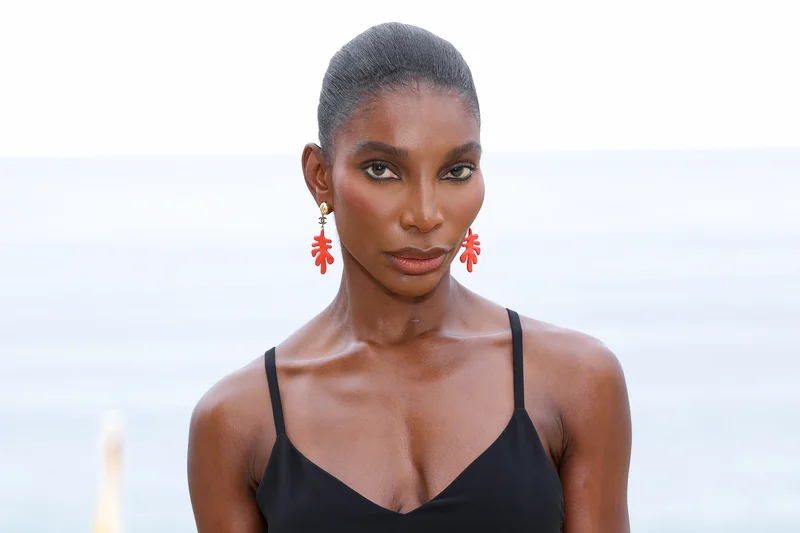
Hathaway plays a singer in crisis who seeks out her former friend Sam Anselm, who helped create her virginal image (always with a halo above her head), to make the gown for her stage comeback. Michaela Coel (London, 38) plays Anselm, who has spent a decade cloistered in an old castle, working in a barnlike, gloomy atelier, and who reluctantly receives the friend who betrayed her. Coel first read the script as a fellow writer of Lowery’s, but the director saw in her the character who hurls truths like blades to exorcise her pain. “I identified with her because, as a writer, I know what it’s like to live in the shadow of other people’s successes, and that’s something a fashion designer also understands,” Coel explains; she has spent her career drawing on her own life to create. She first did so in Chewing Gum (2015), where she exaggerated her childhood and adolescence in East London as a religious fanatic, and later, with great success and the first win for a Black woman in the Primetime Emmy Award for Outstanding Writing for a Limited Series, Movie, or Dramatic Special for the miniseries I May Destroy You (2020), in which she publicly revealed the sexual assault she suffered precisely while writing Chewing Gum. She is now finishing shooting her next series, First Day on Earth, in which she plays an author who returns to her native Ghana to reunite with her father, as happened to her — she is British, the child of Ghanaian parents, raised by her mother in London while her father returned to Africa.
Coel feels more comfortable being defined as a writer and artist than as only an actress, and she has rarely worked under others’ direction: she has appeared in Black Mirror, The Last Jedi, and Black Panther: Wakanda Forever; and this year, after the release of Mother Mary, she will appear in Steven Soderbergh’s The Christophers, playing a “ghost painter” for the artist portrayed by Ian McKellen. To become Sam Anselm, costume designer Bina Daigeler taught her to sew on a machine, imagined a backstory for her, and Coel savored an intense shoot in which she could only decompress by going to German techno clubs with her co-star Hunter Schafer.
Question. Why does Sam create a virginal style for her friend?
Answer. I don’t think it’s fair to say Sam creates Mother Mary, but she was part of her creation. She listened, understood which parts of her body she disliked and which she did not, and allowed her to feel comfortable, beautiful, and powerful onstage. I have always thought of my character as the protector.
Q. The relationship between the two is very complicated.
A. Their artistic relationship grew out of friendship — even the love they felt for one another. But the script is full of mysteries and questions. Everyone can have their own take on it. It’s a story of betrayal, revenge, and contempt. It’s also about fame. For a brief period of my life, I was a comedian, and I did pretty well. Then I had to move on to other things. In short, I discovered that if you don’t do certain things for your friends, fame ends up taking its toll on you in the long run.
Q. Fame is the result of hard work in your case…
A. I don’t know if I work that much. I haven’t done any promotional tours since the pandemic; I’ve worked on a couple of projects lately — just small things. I have some busy periods, but I lead a pretty normal life; I relax a lot.
Q. What does that normal life look like?
A. Traveling. I like music. I like going out to dance at clubs.
Q. What kind of music do you dance to?
A. I like Afro-techno and classic R&B. Hanging out with my friends, going on vacation with them. Taking my mom on vacation. Taking my nieces on trips — going to a restaurant and eating french fries with a five-year-old is the most fun. Watching TV. I invite my friends over and we watch trashy shows.
Q. Your mother, Kuukua Kwenua Osborne, was a seamstress. Was she an inspiration when creating this character?
A. Very much so! She’s my Mother Mary. All my creativity comes from her. She made my best friend’s wedding dress. And she still makes dresses, robes, and other clothes for me. She’s probably the reason I love fashion so much. I have a lot of respect for what the fashion houses do; I love seeing new creative directors come in and bring their fresh vision to a brand with a long tradition, and watching them create pieces you’ll wear every day for the next 10 years of your life. I also love that fashion allows me to collaborate with other people — that’s why I work with stylists; we all collaborate… Maybe because I’m a writer and spend a lot of time alone, these opportunities to work with creatives from different fields bring me immense satisfaction.