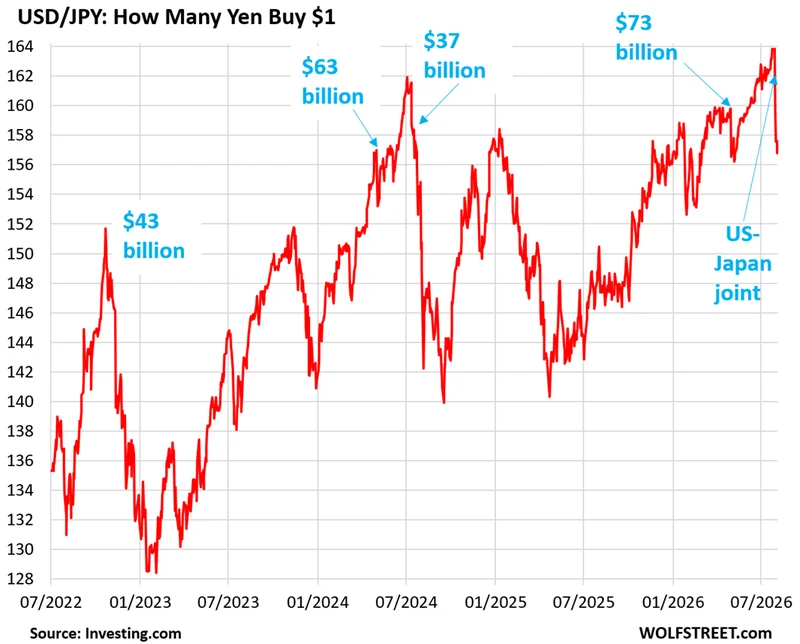
But the prior interventions failed to permanently turn around the downward spiral of the yen. What’s needed: much tighter monetary policies by the BOJ.
By Wolf Richter for WOLF STREET.
There were fears Japan would have to sell US Treasury securities to raise the USD cash to buy yen, as it battles to prop up the collapsing currency. This forced selling of Treasuries would have led to a further spike in Treasury yields. And it’s Bessent’s job – as the top bond salesman in the US – to keep those long-term yields from blowing out despite whatever else is going on. To forestall this forced selling of Treasuries, all kinds of stuff happened.
The numbers remain a secret, but the move has been confirmed by both Bessent and the Japanese Ministry of Finance: The US Treasury Department via its fiscal agent, the New York Fed, and Japan’s authorities jointly intervened in the currency market on Friday to prop up the yen, which had plunged to ¥164 to the USD by July 28.
Rumors about an impending joint move had already pushed up the yen on Thursday. Then in a piece of visual theatrics, Bessent put a one-item “To Do” list in view of the cameras at the cabinet meeting at Camp David on Friday. The only item on the list was “Buy Japanese Yen (JPY) $5 – 10 bill.”
According to a leaked comment published by the Financial Times, the New York Fed sold euros in its reserves – not dollars – and bought yen with the proceeds on Friday. The use of euros instead of USD has not been confirmed yet.
The amount was not leaked. But Bessent gave an indication with his “To Do” list. At the same time, the MOF and the Bank of Japan also intervened and bought yen.
(The MOF announces the amounts of interventions monthly, with the cut-off date being around the 28th, so the amount will be disclosed at the end of August).
The rumor effect before the intervention, the theatrics, the intervention itself, and the announcement and confirmation effect resulted in a jump of the yen against the USD, from about ¥164 to the USD on Wednesday to ¥156.9 currently. This joint intervention was the big kahuna.
And both sides said that they would be ready to do it again, if needed.
Sure, but the prior interventions by Japan failed to turn around the downward spiral of the yen; they just provided temporary reprieve before the yet started spiraling down again.
Much tighter monetary policies by the BOJ – including lots of QT and much higher rates much faster – need to happen to permanently end the plunge of the yen. The yen is getting crushed by the BOJ’s crazed monetary policies from 2012 to 2022. That’s the root cause. What’s amazing is that they got away with it for so long. All monetary sins ultimately lead to the currency.
Interventions are just temporary window dressing. And the big kahuna of interventions will be tested again.
And to forestall forced selling of Treasuries by Japan, the Bank of Japan will use the Fed’s Standing Repo Facility (SRF) for Foreign and International Monetary Authorities (FIMA) instead of selling Treasuries.
At the FEMA SRF, approved foreign central banks can put their Treasury securities as collateral for USD cash. This shift to the FEMA SRF, rather than selling Treasuries, was also part of the announcement, though the BOJ has had access to the FEMA SRF for years.
The Fed announced the establishment of the FIMA SRF on July 28, 2021, when it announced its regular SRF that US banks can use. This standing FIMA repo facility replaced the temporary FIMA repo facility the Fed had created in March 2020.
And this shift to the FIMA SRF by Japan to get USD liquidity for future interventions removed pressure from the Treasury market. And Treasury yields of 2 years and longer declined this morning, with the 10-year Treasury yield falling by about 5 basis points to 4.69%, and the 30-year Treasury yield falling by about 4 basis points to 5.23%.
The yen got crushed by a decade of crazed monetary policies. But the collapsing yen, and the resulting inflationary pressures feeding into the economy via now much more costly imports (in yen terms), has forced the BOJ to back off those policies.
But the BOJ’s policy rate is still only at 1.0% after five baby-hikes spread ridiculously far apart over more than two years, and remains negative in real terms (below the rate of inflation). So this hasn’t accomplished anything. It needs to hike a lot and fast to put a floor under the yen.
In late 2024, and to its credit, the BOJ started QT that it then accelerated, reducing its balance sheet so far by about 16%, which may have slowed the yen’s downward spiral, but it wasn’t enough; it needs to go much deeper. And it needs to hike its policy rates a lot more to put a permanent floor under the yen, instead of goofing around with these currency interventions.
Enjoy reading WOLF STREET and want to support it? You can donate. I appreciate it immensely. Click on the mug to find out how: