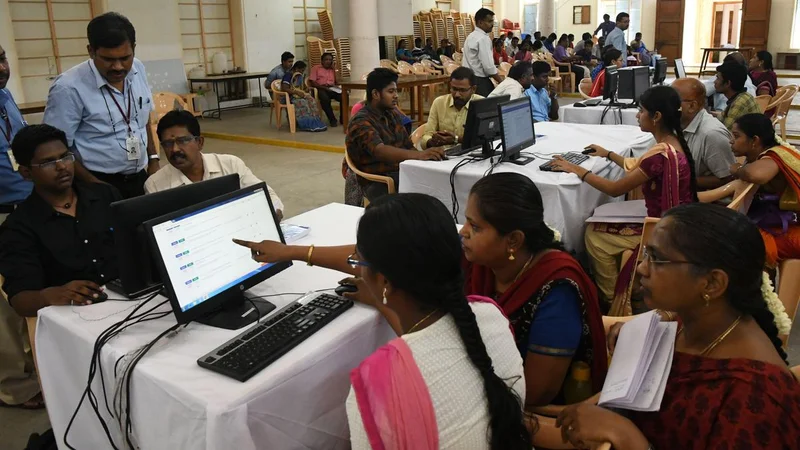
At the end of Round One of counselling for the Tamil Nadu Engineering Admissions (TNEA) 2026, computer science and engineering (CSE) and allied subjects continue to be the most preferred choice of students, followed by electronics and communications engineering (ECE).
Electrical and electronics engineering (EEE), although way down the pecking order, did manage to register a gentle upward swing in the number of seats filled after the first round, prompting analysts to take note. “There is no doubt a greater interest was shown in core engineering subjects like the ECE, EEE, and even mechanical,” said Jayaprakash Gandhi, a long-time career consultant. “Intake for civil and other core subjects are, however, a bit down,” he added.
Agreeing with Mr. Gandhi, R. Ashwin, independent career counsellor and analyst, said that among the top 100 students at the TNEA counselling this year, 73 preferred CSE and allied courses, 26 opted for ECE, and only one opted for mechanical engineering. Overall, more than half the seats filled were CSE and allied courses, while over 20% belonged to ECE and EEE was close to 5%.
Around 140 colleges have recorded zero intake after the first round of counselling, with over 30 of them being autonomous institutions. “This either points at lack of awareness among students about the institutions or the fact that the process of award of autonomous status by the authorities should be revisited,” Mr. Gandhi said.
Students favour Coimbatore
In region-wise performance, the Coimbatore region fared much better than the Chennai region this year as well. Many factors, according to Mr. Gandhi, work in the favour of Coimbatore, whether it is locational access of the institutions, their reputation, the pleasant weather, or the fact that Coimbatore is a textile, information technology, and accessories manufacturing hub. “Institutions in Coimbatore are connected to students in a wider area across the west and south of the State. For example, a student from Salem, Dharmapuri, or Tirunelveli would prefer to study in Coimbatore rather than coming to Chennai,” Mr. Gandhi said.
At the first round of counselling, absenteeism has crawled up to 35%, up by about three percentage points compared to last year. This means that either students have opted for medicine or other courses of study or the fact that they did not get their choice filling right, Mr. Ashwin postulates. Mr. Gandhi echoes the same concern, adding that in some cases, he had come across students opting for tier-two colleges instead of NIRF-ranked institutions. “This shows lack of awareness. It is quite acute among rural students,” he added.
Another aspect pointed out by Mr. Ashwin was that in the top 10 institutions in terms of filled-up seats in the first round, three private colleges have managed to fill about 85% of their seats. “Students are perhaps preferring private colleges because of better placements and infrastructure,” he observed.
So, what do all these portend for students at the second round? Candidates with cut-off marks of 160-170 would still be able to get into top institutions, which was not the case last year, Mr. Gandhi says. Mr. Ashwin has a word of advice: students who scored below 160 should fill as many choice combinations as possible so that they have a better chance to get a good seat.
Published - August 03, 2026 11:45 pm IST