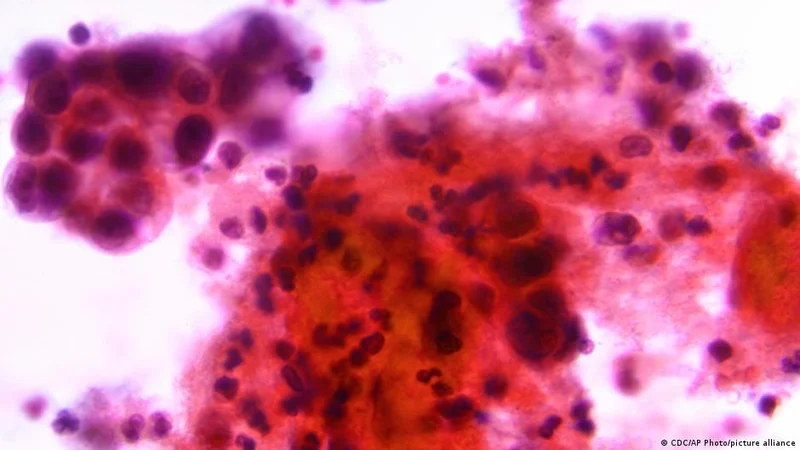
Susanna was just 28 years old when she was diagnosed with bowel cancer. Andre developed lung cancer when he was only 34. Both of them have turned to social media to talk about their fight against the disease. Neither of them are medical outliers — not anymore.
The German Cancer Research Center (DKFZ) has reported a sharp increase in gastrointestinal cancer cases for patients between the ages of 20 and 39. In the US, researchers have observed a similar development, with an even higher disease ratio than in Germany. Younger people are also increasingly being diagnosed with other types of cancers, including those that affect patients' bone marrow or uterus.
Cancer is usually regarded as an age-related disease. According to the German Cancer Aid non-profit, the average age for men and women with cancer is around 69. Cancer cells form when certain sections of the genetic sequence mutate and can no longer be repaired. The older we get, the less reliable our repair system becomes.
Gap between chronologal and biological gap increasing
A study by researchers at Washington University School of Medicine, US, has now found a link that could help explain why an increasing number of people under 50 are developing early-onset cancer. The reason, they suggest, is that younger generations are displaying a wider gap between their biological and their chronological ages. In short, they are aging faster.
While the chronological age counts how many years have passed since a person's birth, their biological age describes how much their body has aged, based on the cellular damage accumulated. Individual organs and tissues can age at varying speeds.
In other words, the same person's liver, heart and brain could each have different biological ages, all of which could differ still from the person's actual age.
The recent study has now for the first time established a link between the increasing gap between biological and chronological ages in younger generations on the one hand, and the risk of early-onset cancer on the other, Ron Jachimowicz explains. He's an attending physician and hematologist at the University Hospital Cologne, as well as head of the Max Planck Research Group for Biology of Aging.
"Don't forget, this is a correlative study," Jachomowicz cautions.
Correlation refers to two things appearing in concert, so it looks like they are related. It does not prove causation, which we speak of when one factor causes another.
While results can provide certain indications that seem quite plausible, researchers were already well aware of the fact "that there is an association between biological age and the risk of developing cancer," Jachomowicz says.
DNA, bloodmarkers and telomeres: How to determine one's biological age
It's not easy to determine a person's biological age. Calculating it requires a number of parameters — there is no single, precise test. Instead, epigenetic tests are used to determine chemical alterations of DNA sequences, evaluating certain blood values and measuring the length of so-called telomeres — that is, the repetitive DNA sequence located at the end of chromosomes that function as protective caps.
There are also physiological tests, to monitor various body and organ functions, as well as cognitive evaluations.
Researchers in the study at hand applied a combination of these various measurement techniques to analyze the data of more than 150,000 individuals drawn from the UK Biobank, a British biometric dataset.
They found that people born between 1965 and 1974 had a significantly higher gap between their chronological and biological ages than people born between 1950 and 1954. The younger the cohort examined, the wider that gap appeared to grow.
An investigation involving more than 10,000 US individuals revealed an even higher deviation for participants born between 1990 and 1999, compared to a cohort born between 1965 and 1969.
"In Australia, Canada, the United Kingdom (UK) and the US, people born in the 1990s face at least fourfold higher risk of early-onset colorectal cancer compared with those in the 1960s," the authors write in the study.
Can I improve my biological age?
We used to assume that a healthy lifestyle could make up 75% to 90% of one's biological age. Now we know that's not true, Jachimowicz explains.
"We can influence about 50% of it," he says, "while the other 50% are genetically predetermined."
To help slow the aging process, he recommends "typical lifestyle interventions," such as working out regularly, eating a balanced diet, getting enough sleep, and avoiding drugs and alcohol.
And the value of social contacts should not be underestimated, he adds.
It's not easy to say why, on a biological level, younger generations are aging faster than their parents and grandparents. But there are a few hypotheses.
"Younger people are being exposed to earlier and longer obesity," says Tanwei Yuan, an epidemiologist in the Department of Clinical Epidemiology and Aging Research of the DKFZ in Heidelberg.
Other contributing factors are a sedentary lifestyle, and poor sleep quality due to extended periods of time in front of a screen, Yuan adds. She says the current study delivers valuable insights that confirm hypotheses long held by cancer researchers.
She also stresses the value of a healthy lifestyle to help reduce the risk of early-onset cancer.
"If you feel unwell, go to a doctor and ask for the screening," Yuan recommends.
Yuan knows what she's talking about. The 32-year-old researcher says she had felt unwell for quite some time before being diagnosed with intestinal polyps last year. While these can start out benign, if left untreated, polyps can become cancerous. That's why it's important to listen closely to your body and take measures early, she says.
Can my doctor determine my biological age?
In a word: no, says Jachimowicz.
Determining an individual's biological age is the "subject of current scientific research, but in no way a practical routine or part of everyday clinical work."
However, he believes it should be, especially when it comes to initiating early cancer interventions. He believes this current study is particularly valuable because it highlights this path forward for future studies.
"It's still far off in the future," he says, "but it's very exciting."
This article was originally published in German.