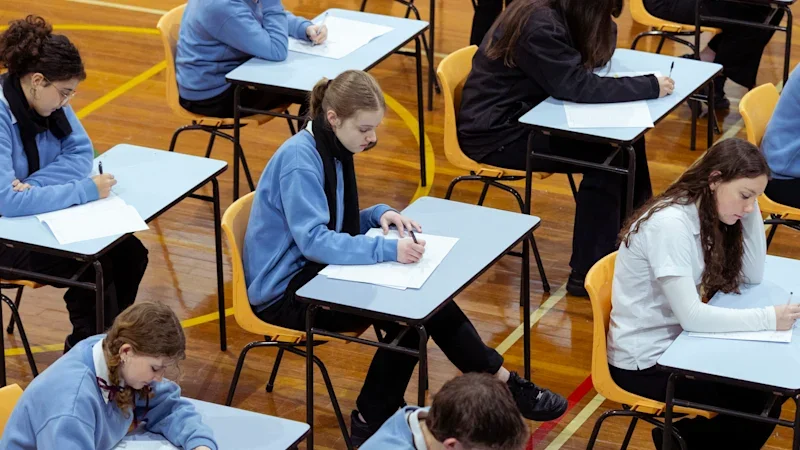
The NSW education system has irrevocably shifted towards a more choice-oriented approach, focusing on individual student needs and family preferences, yet limited Higher School Certificate data is short-changing parents who wish to be better informed about where to send their children.
The data is heavily skewed to success, and therefore to selective or expensive independent schools. Authorities only publish the names and schools of students who achieve in the top band of HSC subjects. Such information not only fails to recognise the large cohort of good, hard-working students who do not achieve a band six, but also overlooks schools that help their students improve beyond expectations.
With the cost of education soaring for all, the Herald’s analysis of HSC subject averages at each public school has become increasingly valuable for parents.
The Herald’s education team, Christopher Harris and Nigel Gladstone, put considerable effort into collating this data from public high schools’ annual reports.
They found that James Ruse students’ average mark across all subjects was 91.3 last year, placing them just above students at North Sydney Boys and North Sydney Girls. Selective schools dominated, taking out 19 of the top spots, but non-selective single-sex schools – including Willoughby Girls, Balgowlah Boys and Cheltenham Girls – outperformed several partially selective ones.
But the analysis of that data – which averages the average of all subjects to form a fairer picture of success – is not perfect because the information supplied by schools across sectors is inconsistent. Some comprehensive schools are missing, and Catholic and most independent schools do not report subject averages.
The Herald would like to give its readers a truly comprehensive guide to a school’s HSC performance but cannot because NSW has restricted HSC data for four decades.
At the heart of the restrictions is a Daily Telegraph story 30 years ago that defamed a class of students in which none achieved a tertiary entrance rank above 50. The intention of the story was to point out that, as a society, we had let these children down. The outrage that followed prompted governments to restrict the release of data, and limit any publication of permitted data to the top 10 per cent of schools.
The Herald has long wished for more open data to provide a clearer picture of how schools across all sectors perform. It does not have to identify the most poorly performing schools; band fives as well as sixes would be a start, median ATARs would be better, and improvement metrics would be highly valuable.
Victoria publishes median VCE (HSC equivalent) scores, high scores and post-school destinations for every school. As a result, our Melbourne-based sister paper, The Age, has developed an informative annual series that profiles schools which lead the state of Victoria on different metrics.
For decades, our students have been pushed along a path to year 12, just as they were once pushed into apprenticeships at 15. Yet no one single model works. The best education system is neither private nor public, but one which offers a real choice.
If governments are committed to school choice, then they should supply information that allows families to make an informed one. Curated information based on the success of elite high achievers alone does not help NSW families.