As co-founder Grace Li tells it, her company started a few weeks before graduation in 2025, with a handful of college friends trying to make their AI game engine work. The models could make functional games, but none of the games were fun — which raised the interesting question, how can you tell if a game will be fun?
There was no substitute for human judgment, they decided, and soon they were brainstorming ways to get honest human feedback at scale.
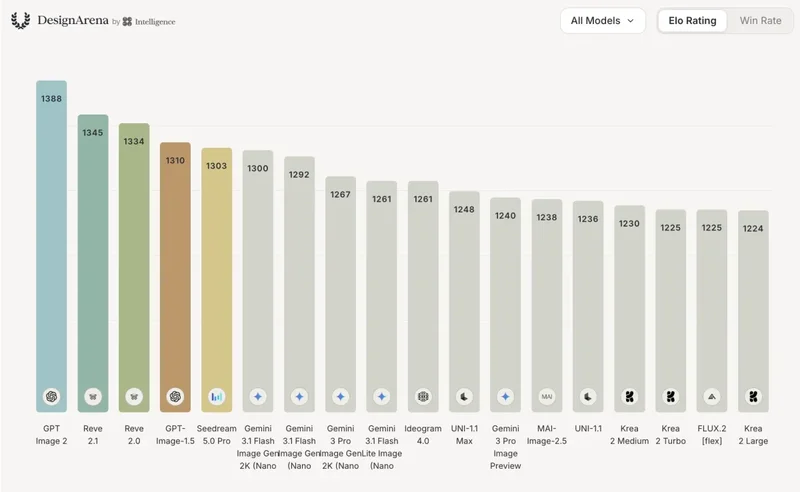
The result became DesignArena, an AI tool now used by 5.3 million people around the world. As it turned out, there were lots of AI companies looking for scalable user feedback — and many of them were willing to pay for it.
“It was the missing bottleneck for a lot of these models to make improvements in the design space,” Li says. “About a week later, we closed our first major deal with a frontier lab, and the rest is kind of history.”
On Monday, the company behind DesignArena — dubbed Intelligence — announced a $7.9 million seed round led by Index Ventures with participation from Conviction (Sarah Guo and Mike Vernal), A*, Valkyrie, and others.
For non-enterprise users, using DesignArena is a lot like using a sophisticated model router. There’s a Chat-GPT-style window for prompts, with separate dropdowns for websites, images, and a dozen other visual formats. Once you put in the request, format and style, you’ll be presented with a series of “A vs. B” choices until you’ve ranked the handful of outputs from best to worst.
It’s a useful service, but the real value of the platform comes from the enterprise side, where participating models can treat it as a source of endless instant feedback for their media-generating models. The users tend to be indifferent to which models they’re ranking — as Li puts it, they just want the best output they can get — so their rankings can give critical input to what users really want.
For frontier labs, that’s a service worth paying for, Li says, adding the site is currently generating $60 million in ARR, solidifying its position as a key source of human-led evaluation data for the AI industry.
Crucially, users have to log in to get their output, so Intelligence can also track how those tastes change across different continents and over time. (Li notes that web dashboards in Asia tend to have a more maximalist design style.) These measures are an important complement to automated benchmarks, which can operate at a greater scale but are often subject to being gamed or otherwise manipulated, as the Hugging Face breach demonstrated in dramatic fashion last week.
That’s not to say that crowdsourced human feedback will be an automatic winning market. Less than a year after launching, Yupp shuttered its doors earlier this year after raising $33M from a16z crypto’s Chris Dixon. It too nabbed some frontier models as customers and had, it said, over 1.3 million users, but still couldn’t build a sustainable long-term business.
Even so, other startups based on human evaluation seem to be thriving. LM Arena, which takes a similar approach to text-based responses, raised $150 million in a Series A in January, just four months after formally launching its paid product.